
Sapphire has exceptional hardness and high mechanical strength.
Yet sapphire windows can still crack during assembly or service.
In many systems, failure does not begin in the center of the polished optical surface.
It begins at the edge.
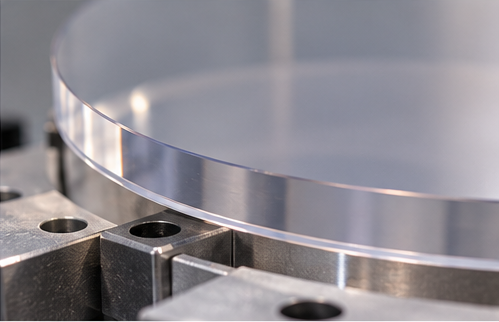
Why Edges Are Vulnerable
The edge is where several risk factors meet:
- grinding damage;
- machining chips;
- contact with the mount;
- local bending stress;
- clamp pressure.
A polished optical face cannot compensate for a deep edge chip.
Why Sharp Edges Are Usually Avoided
A very sharp edge creates strong local stress concentration and high handling sensitivity.
This is why sapphire windows commonly use chamfers, bevels or controlled edge radii.
These features are functional, not merely cosmetic.
Chamfer Size Must Match the Design
A larger chamfer is not automatically better.
It reduces usable clear aperture and can change the supported diameter of a pressure window.
Important dimensions include:
- chamfer width;
- angle;
- clear aperture;
- support diameter.
Edge Finish Matters
After cutting and grinding, the edge may contain microcracks.
Depending on the application, additional edge finishing can reduce severe machining damage.
However, not every edge needs optical polishing.
The objective is a controlled, chip-free mechanical interface.
Mounting Contact Can Create Failure
Point loading is especially dangerous for brittle sapphire.
Common problems include:
- uneven clamp torque;
- hard particles trapped beneath the window;
- metal contact on a small area;
- tilted seating surfaces.
These conditions can create concentrated stress near the edge.
Gaskets Are Part of the Mechanical Design
A gasket can provide sealing, compliance and load distribution.
But excessive compression can bend the sapphire.
The gasket should therefore be selected according to pressure, temperature, chemical environment and housing material.
Thermal Expansion Mismatch
A sapphire window is often mounted inside a metal housing.
As temperature changes, the metal and sapphire expand by different amounts.
If the mounting structure is too rigid, thermal stress may develop around the edge.
Pressure Loads Increase With Aperture
A larger clear aperture exposes the window to greater total force.
That force must be transferred through the supported edge.
Therefore, pressure-window design must consider:
- unsupported diameter;
- thickness;
- pressure differential;
- support geometry;
- edge condition.
Conclusion
Sapphire’s intrinsic strength is only useful when the component is designed and mounted correctly.
Reliable performance depends on:
bulk material + surface quality + edge quality + support geometry + mounting stress.
Article Images: