
When engineers purchase a precision sapphire window, one specification appears frequently:
surface flatness.
Typical requirements may be λ/4, λ/10 or another fraction of the measurement wavelength.
Flatness is important, but it does not describe everything that happens to the beam after it passes through the complete window.
For imaging and laser systems, transmitted wavefront error can be more meaningful.
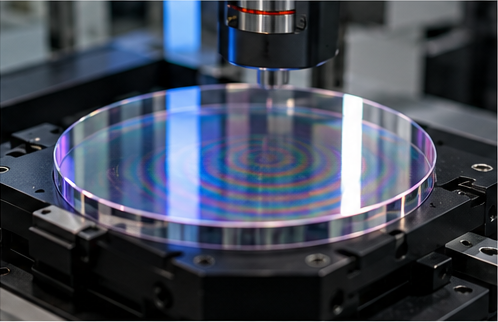
What Does Surface Flatness Measure?
Surface flatness describes how much one optical surface deviates from an ideal reference plane.
It evaluates one surface.
A sapphire window has two optical surfaces.
The transmitted beam interacts with both surfaces and with the crystal between them.
What Is Transmitted Wavefront Error?
Transmitted wavefront error measures how much the optical wavefront is distorted after passing through the complete window.
It can include the combined effects of:
- front-surface shape;
- rear-surface shape;
- thickness variation;
- wedge;
- refractive-index uniformity;
- crystal anisotropy;
- mounting stress.
Why Sapphire Makes This Important
Sapphire is a single crystal with a relatively high refractive index.
For ordinary protective windows, small transmitted-wavefront variations may not matter.
For high-resolution imaging, interferometry and collimated laser beams, they may become critical.
Parallel Surfaces Are Not Always Enough
Even when both surfaces are individually flat, a slight angular difference between them produces wedge.
Wedge may cause beam deviation, image displacement or ghost-image separation.
In some laser applications, intentional wedge is useful because it prevents back-reflections from retracing the same optical path.
Thickness Variation Affects Optical Path
Because light travels more slowly inside sapphire than in air, thickness differences change optical path length.
This means local thickness variation may produce phase distortion even when surface flatness appears acceptable.
Mounting Stress Can Distort an Excellent Window
A window may pass inspection before assembly and perform poorly after installation.
Uneven clamping, excessive gasket compression or thermal-expansion mismatch may deform the optic.
For demanding systems, mounted performance may therefore matter more than loose-component performance.
Large Apertures Are More Sensitive
As aperture increases:
- gravity sag becomes more important;
- mounting stress becomes more influential;
- polishing uniformity becomes harder to maintain.
This is why large precision sapphire windows should not simply be specified as scaled-up versions of small windows.
Imaging vs Protective Applications
For a basic sensor cover, priorities may be durability, transmission and moderate flatness.
For a precision imaging window, transmitted wavefront, wedge and stress-free mounting become much more important.
For a laser window, coating absorption and beam deviation may also need attention.
Conclusion
Surface flatness answers:
“How flat is this surface?”
Transmitted wavefront answers:
“What happens to the beam after it passes through the complete sapphire window?”
For precision optical systems, the second question is often more useful.