
Sapphire windows are widely used in high-pressure environments where conventional optical materials such as glass or quartz may fail. Thanks to their exceptional mechanical strength, high hardness, chemical resistance, and broad optical transmission range, sapphire windows have become the preferred choice for demanding applications in aerospace, deep-sea exploration, semiconductor processing, industrial monitoring, and scientific instrumentation.
However, selecting the appropriate sapphire window thickness is one of the most critical design considerations. A window that is too thin may fracture under pressure, while an excessively thick window can increase cost, weight, and optical distortion.
This article explores the key factors that influence sapphire window thickness selection and provides practical guidelines for engineers and system designers.
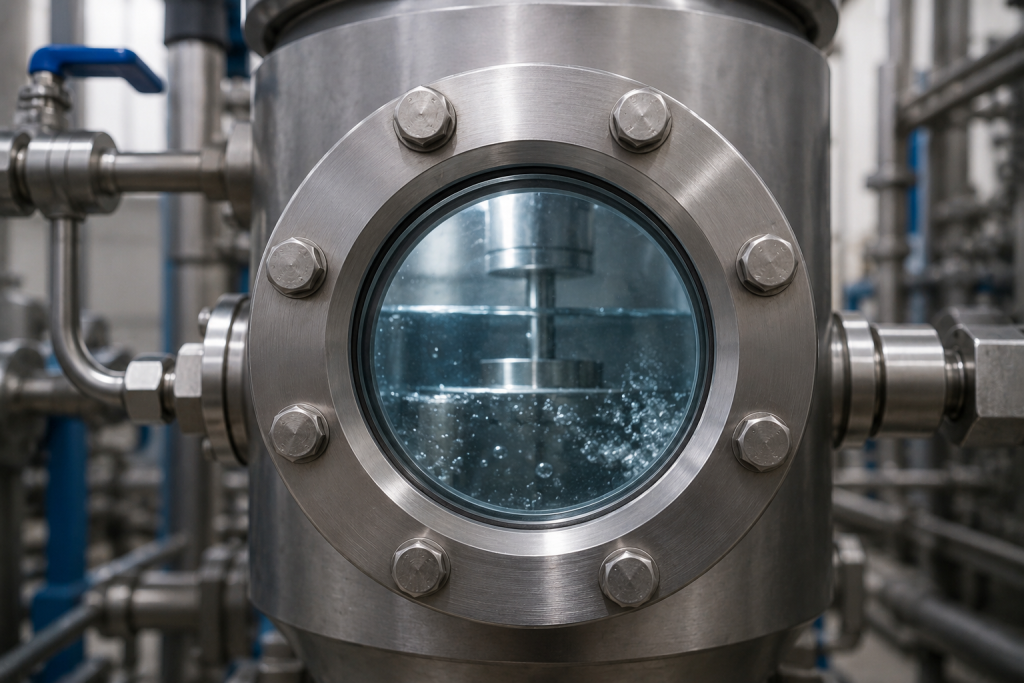
Why Thickness Matters
In high-pressure applications, the sapphire window acts as a barrier between two environments while allowing light, laser beams, or visual information to pass through.
The window must withstand:
- External pressure
- Internal pressure
- Pressure differentials
- Mechanical shock
- Thermal stress
As pressure increases, the mechanical load applied to the window also increases. Thickness directly affects the window’s ability to resist bending and fracture.
A properly designed sapphire window ensures:
- Structural safety
- Optical performance
- Long service life
- Reduced maintenance costs
Factors Affecting Thickness Selection
Operating Pressure
The most important parameter is the maximum pressure differential the window must withstand.
Typical examples include:
| Application | Pressure Range |
|---|---|
| Industrial Process Monitoring | 5–50 bar |
| High-Pressure Reactors | 50–300 bar |
| Deep-Sea Equipment | 100–1000+ bar |
| Scientific Pressure Chambers | 500–3000+ bar |
Higher pressures generally require thicker sapphire windows.
Window Diameter
Window diameter often has a greater influence on strength than pressure alone.
For example:
- A 10 mm diameter window may withstand high pressure with relatively small thickness.
- A 100 mm diameter window under the same pressure may require several times greater thickness.
As diameter increases, bending stress rises significantly.
Engineers often find that reducing aperture size is more effective than dramatically increasing thickness.
Mounting Configuration
The way a sapphire window is mounted strongly affects its load-bearing capacity.
Common mounting designs include:
- Clamped windows
- Brazed assemblies
- Compression-sealed designs
- Metal-frame bonded windows
Proper edge support reduces stress concentration and allows thinner window designs.
Safety Factor
Engineering designs rarely use theoretical failure limits.
Typical safety factors range from:
- 2× for controlled laboratory environments
- 3×–4× for industrial systems
- 5× or higher for critical aerospace and subsea applications
Higher safety factors often result in increased thickness requirements.
Temperature Conditions
Elevated temperatures can affect:
- Seal materials
- Mounting stresses
- Thermal expansion mismatch
Although sapphire retains excellent mechanical properties at high temperatures, thermal design must still be considered when determining final thickness.
Typical Thickness Guidelines
The following table provides general engineering references for circular sapphire windows.
| Diameter | Pressure Range | Typical Thickness |
| 10–20 mm | Up to 100 bar | 2–4 mm |
| 20–50 mm | Up to 300 bar | 5–10 mm |
| 50–75 mm | Up to 500 bar | 10–20 mm |
| 75–100 mm | Up to 1000 bar | 20–35 mm |
These values are only preliminary references and should not replace detailed mechanical analysis.
The Role of Finite Element Analysis (FEA)
Modern sapphire window design often relies on Finite Element Analysis (FEA).
FEA helps engineers evaluate:
- Stress distribution
- Deflection behavior
- Failure probability
- Edge stress concentration
- Thermal-mechanical interactions
Simulation enables optimization of both thickness and geometry before manufacturing begins.
For high-value applications, FEA is strongly recommended.
Optical Considerations
Increasing thickness improves mechanical strength but may affect optical performance.
Potential concerns include:
- Increased optical absorption
- Higher system weight
- Additional reflection losses
- Image distortion in certain optical systems
Designers must balance mechanical safety with optical requirements.
In laser systems, anti-reflective coatings are often applied to thicker sapphire windows to maintain transmission efficiency.
Sapphire vs Other Optical Materials
When compared with common optical materials, sapphire generally allows thinner designs under equivalent pressure conditions.
| Material | Relative Strength | Pressure Resistance |
| Optical Glass | Moderate | Moderate |
| Fused Quartz | Good | Good |
| Sapphire | Excellent | Excellent |
The superior flexural strength and hardness of sapphire make it particularly attractive for compact high-pressure optical assemblies.
Applications Requiring Thick Sapphire Windows
High-pressure sapphire windows are commonly used in:
Deep-Sea Observation Systems
Subsea cameras and sensors may operate thousands of meters below sea level, requiring sapphire windows capable of withstanding extreme hydrostatic pressure.
High-Pressure Chemical Reactors
Sapphire viewports allow visual inspection and optical monitoring of reactions occurring under elevated pressures and temperatures.
Aerospace Systems
Pressure-resistant sapphire windows are used in sensors, guidance systems, and environmental monitoring equipment.
Semiconductor Processing Equipment
Certain plasma and vacuum processing chambers utilize sapphire windows to provide optical access while maintaining process integrity.
Conclusion
Selecting the correct thickness for a high-pressure sapphire window requires balancing pressure resistance, optical performance, window diameter, mounting configuration, operating temperature, and safety requirements.
While thicker windows generally provide greater mechanical strength, overdesign can increase costs and introduce optical challenges. The most effective approach combines engineering calculations, appropriate safety factors, and finite element analysis to achieve a reliable and cost-efficient design.
As pressure requirements continue to increase in aerospace, deep-sea, industrial, and scientific applications, sapphire remains one of the most trusted materials for transparent high-pressure viewing and optical access solutions.