
Why Surface Quality Matters in Sapphire Optical Windows
Sapphire optical windows are widely used in aerospace, defense, semiconductor equipment, laser systems, medical devices, and harsh-environment optical applications. Their exceptional hardness, broad optical transmission range, and outstanding chemical stability make them one of the most reliable optical materials available today.
However, the performance of a sapphire optical window is determined not only by the material itself but also by its surface quality. Even a high-purity sapphire substrate can suffer from optical scattering, image distortion, reduced laser transmission, or premature failure if the surface finish does not meet application requirements.
Understanding surface quality specifications is therefore essential when selecting or designing sapphire optical windows.
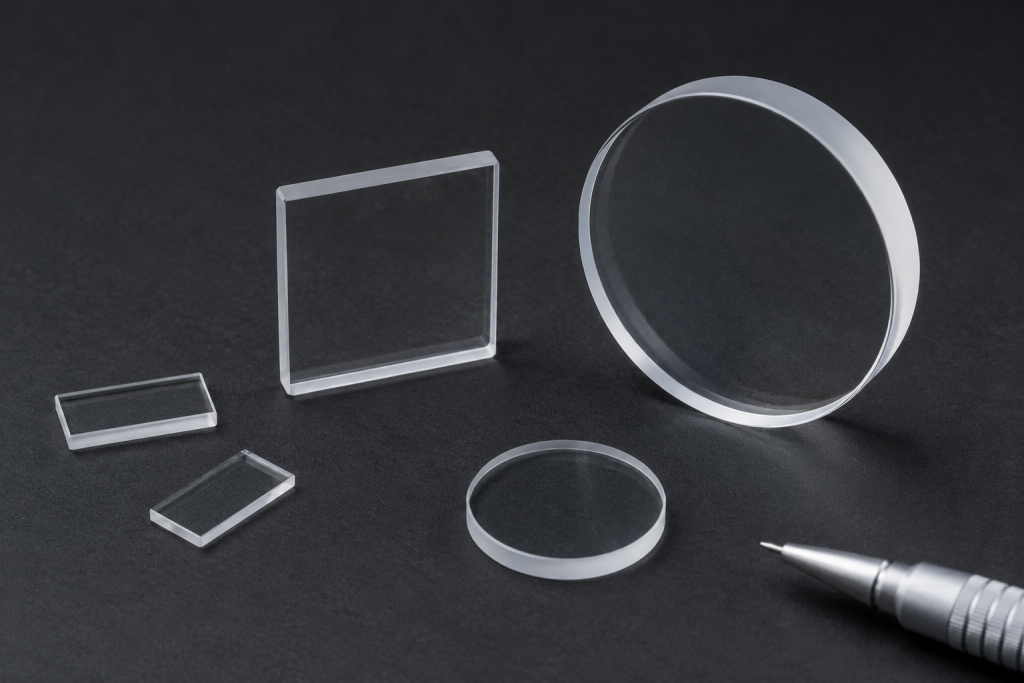
What Is Surface Quality?
Surface quality refers to the condition of an optical surface after grinding, polishing, and finishing processes. It evaluates the presence of imperfections that may affect optical performance.
The most common parameters include:
- Scratch-Dig Specification
- Surface Roughness
- Surface Flatness
- Surface Defects
- Edge Quality
- Parallelism and Wedge Angle
Each parameter addresses a different aspect of optical performance.
Scratch-Dig Specification
Scratch-dig is one of the most widely recognized standards for evaluating optical surfaces.
Originally defined under military optical standards, scratch-dig specifications quantify visible surface imperfections:
- Scratches are narrow linear marks caused during manufacturing or handling.
- Digs are small pits, chips, or depressions on the surface.
Typical specifications include:
| Grade | Typical Application |
|---|---|
| 80-50 | Industrial optics |
| 60-40 | Standard optical windows |
| 40-20 | Precision optical systems |
| 20-10 | High-performance imaging |
| 10-5 | Laser and aerospace optics |
The lower the numbers, the stricter the quality requirement.
For example, a sapphire window specified as 20-10 possesses significantly fewer and smaller defects than one specified as 60-40.
Surface Roughness
Surface roughness measures microscopic irregularities remaining after polishing.
Common measurement units include:
- Nanometers (nm)
- Angstroms (Å)
Typical sapphire optical polishing levels are:
| Surface Finish | Roughness (Ra) |
| Standard Optical Polish | < 5 nm |
| Precision Polish | < 2 nm |
| Ultra-Precision Polish | < 1 nm |
Lower roughness values reduce light scattering and improve transmission efficiency.
For high-power laser applications, ultra-smooth surfaces help minimize localized heating and optical losses.
Surface Flatness
Surface flatness evaluates how closely the optical surface conforms to an ideal plane.
It is commonly expressed in fractions of a wavelength:
| Flatness Specification | Description |
| λ/2 | General optical applications |
| λ/4 | Precision optics |
| λ/10 | High-accuracy imaging |
| λ/20 | Interferometric systems |
Flatness is typically measured using interferometry with a reference wavelength of 632.8 nm.
Poor flatness can introduce wavefront distortion, reducing image quality and measurement accuracy.
Surface Defects and Inclusions
Although sapphire is grown as a single crystal, manufacturing processes may introduce defects such as:
- Inclusions
- Subsurface damage
- Crystal growth defects
- Polishing artifacts
For demanding applications, these defects can lead to:
- Reduced optical transmission
- Increased scattering
- Laser-induced damage
- Mechanical weakness
Advanced inspection methods such as optical microscopy and laser interferometry are often used to detect and characterize these imperfections.
Edge Quality and Chamfering
The edges of sapphire windows are often overlooked but play an important role in durability.
Sharp edges can:
- Increase the risk of chipping
- Create stress concentration points
- Complicate assembly processes
Therefore, sapphire windows are frequently supplied with:
- Safety chamfers
- Beveled edges
- Rounded corners
Proper edge finishing significantly improves handling safety and long-term reliability.
Parallelism and Wedge Tolerance
For applications requiring accurate beam transmission, both surfaces of the sapphire window must maintain precise parallelism.
Typical specifications include:
| Parameter | Typical Value |
| Parallelism | < 30 arcsec |
| Precision Parallelism | < 10 arcsec |
| Laser Grade | < 5 arcsec |
A wedge angle between surfaces can deflect optical beams and introduce alignment errors.
High-precision optical systems therefore require tight control of parallelism during fabrication.
Selecting the Appropriate Surface Quality
Not every application requires the highest specification.
For example:
Industrial Sensors
- Scratch-Dig: 60-40
- Flatness: λ/2
- Roughness: <5 nm
Imaging Systems
- Scratch-Dig: 40-20
- Flatness: λ/4
- Roughness: <2 nm
Laser Optics
- Scratch-Dig: 20-10 or better
- Flatness: λ/10
- Roughness: <1 nm
Aerospace and Defense
- Scratch-Dig: 10-5
- Flatness: λ/10 to λ/20
- Ultra-precision polishing
Choosing unnecessarily tight specifications may substantially increase manufacturing costs without delivering meaningful performance benefits.
Manufacturing Challenges
Achieving high surface quality on sapphire is particularly challenging because sapphire ranks among the hardest engineering materials, with a Mohs hardness of 9.
Its extreme hardness results in:
- Longer polishing cycles
- Increased tool wear
- More difficult defect removal
- Higher processing costs
Modern techniques such as chemical-mechanical polishing (CMP), ultra-precision grinding, and advanced metrology have significantly improved achievable surface quality levels.
Future Trends in Sapphire Surface Finishing
As optical systems continue to evolve, demand for superior sapphire surface quality is increasing.
Emerging trends include:
- Sub-nanometer surface roughness
- Larger-diameter sapphire windows
- Advanced laser-polished surfaces
- AI-assisted optical inspection
- Ultra-high flatness for photonics applications
These developments are enabling sapphire optical windows to support increasingly demanding applications in semiconductor manufacturing, quantum technologies, aerospace systems, and high-energy laser platforms.
Conclusion
Surface quality specifications are critical indicators of sapphire optical window performance. Parameters such as scratch-dig, surface roughness, flatness, parallelism, and edge quality directly influence optical transmission, image quality, laser resistance, and long-term reliability.
By understanding these specifications and matching them to application requirements, engineers and designers can optimize both performance and cost, ensuring that sapphire optical windows deliver their full potential in demanding optical environments.