
Sapphire is often treated as if it were ordinary optical glass.
It is not.
Sapphire is a single crystal with an anisotropic hexagonal structure. Its optical behavior therefore depends partly on crystallographic orientation.
For many protective windows this difference may not be critical.
For polarization-sensitive and precision optical systems, however, specifying only “sapphire window” may be incomplete.
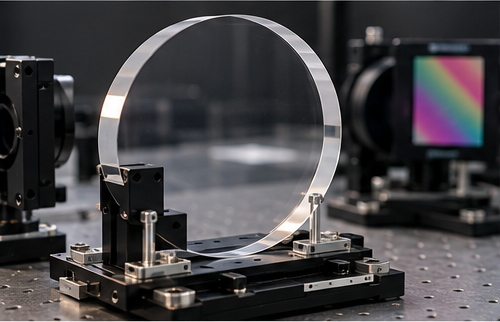
Sapphire Is Birefringent
Sapphire is a uniaxial birefringent crystal.
Light can experience two principal refractive indices:
- ordinary refractive index;
- extraordinary refractive index.
The relationship depends on propagation direction relative to the sapphire optical axis.
What Is a C-Plane Sapphire Window?
For a C-plane sapphire window, the surface normal is aligned approximately with the c-axis.
At ideal normal incidence, the beam travels approximately along the optic axis.
This can minimize certain birefringence effects compared with propagation at a large angle to the optical axis.
What Is A-Plane Sapphire?
In A-plane sapphire, the c-axis lies within the window plane.
This changes the relationship between the beam and the crystal’s optical axes.
Depending on beam direction and polarization, measurable phase retardation may occur.
Why Polarized Lasers Need More Attention
Many laser systems use controlled polarization.
Examples include interferometry, spectroscopy, polarization imaging and precision metrology.
If a sapphire window changes the relative phase of orthogonal polarization components, the polarization state downstream can also change.
The effect depends on:
- orientation;
- wavelength;
- thickness;
- angle of incidence.
Crystal Orientation Also Affects Mechanical Behavior
Sapphire is mechanically anisotropic as well.
Elastic and fracture properties vary with crystal direction.
For most ordinary windows, geometry and surface defects dominate mechanical performance.
For demanding high-temperature or high-load applications, orientation may also be relevant.
Surface Quality Is Still Essential
Orientation alone does not determine optical performance.
A precision sapphire window may also require control of:
- scratch-dig;
- flatness;
- parallelism;
- wedge;
- transmitted wavefront;
- surface roughness;
- AR coating.
When Does Orientation Matter Most?
Orientation deserves particular attention when:
- polarization must be preserved;
- the beam enters at a large angle;
- the window is relatively thick;
- interferometric phase is important.
It may be less important for basic protective covers used near normal incidence.
Conclusion
Sapphire is not simply “hard transparent glass.”
Its crystal orientation can influence optical behavior.
For precision optical systems:
material + orientation + thickness + incidence angle
should be considered together.