
As underwater robotics continue to expand in offshore inspection, marine research, seabed mapping, and defense applications, optical components are facing much harsher service environments. Cameras, sensors, and imaging modules used in ROV (Remotely Operated Vehicle) and AUV (Autonomous Underwater Vehicle) systems must operate under high hydrostatic pressure, saltwater corrosion, mechanical shock, and long deployment cycles.
Among the materials used for subsea optical windows and domes, sapphire is widely valued for its outstanding combination of high strength, excellent optical transmission, scratch resistance, and chemical durability. For buyers and engineers working on underwater optical systems, sapphire optical domes are often a preferred solution when conventional glass or acrylic cannot deliver enough reliability.
This article explains the key factors to consider when selecting subsea sapphire optical domes for ROV and AUV systems, including pressure resistance, dome geometry, optical distortion, sealing design, and saltwater durability.
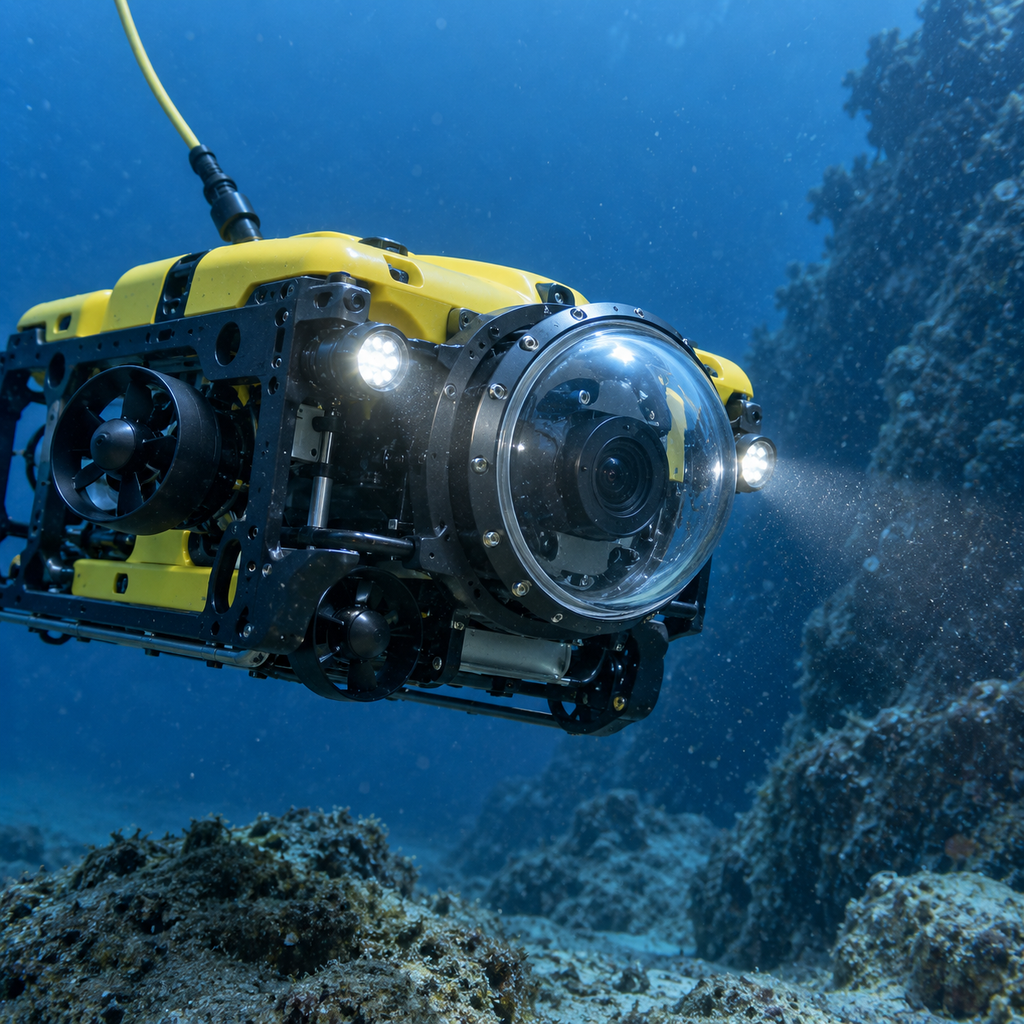
Why Sapphire Is Used in Subsea Optical Domes
Sapphire is a single-crystal form of aluminum oxide (Al2O3). It offers a set of properties that make it highly suitable for subsea viewing and sensing applications.
Key advantages include:
- High compressive strength, helping the dome withstand external water pressure
- Excellent hardness and scratch resistance, ideal for abrasive marine environments
- Broad optical transmission range, covering visible and parts of UV/IR wavelengths
- Good thermal and chemical stability, even in harsh conditions
- Superior wear resistance compared with many conventional optical materials
For ROV and AUV systems carrying cameras, lasers, optical sensors, or underwater imaging modules, sapphire domes can help improve both optical reliability and service life.
1. Pressure Resistance: The First Design Priority
In subsea applications, external pressure rises quickly with water depth. As depth increases, the optical dome must resist deformation, cracking, or catastrophic failure.
When evaluating a sapphire dome for pressure-bearing use, buyers should focus on:
- Operating depth
- Safety factor
- Dome diameter
- Wall thickness
- Mounting structure
- Edge support condition
A deeper operating environment generally requires a more carefully optimized balance between mechanical strength and optical performance. A thicker dome can improve strength, but it may also increase weight and affect optical behavior. In addition, dome performance depends not only on the sapphire itself but also on how the part is integrated into the metal housing.
For high-pressure subsea use, suppliers are often asked to review:
- Maximum working depth
- Burst pressure target
- Thickness tolerance
- Surface finish
- Edge condition
- Finite element analysis or structural recommendations
If the application is mission-critical, it is advisable to discuss both normal operating pressure and short-term extreme conditions with the manufacturer.
2. Dome Geometry: More Than Just Shape
The geometry of a subsea optical dome strongly affects both strength and imaging quality. Common dome types include:
- Hemispherical domes
- Partial spherical domes
- Flat or near-flat windows
- Custom dome geometries
A hemispherical or spherical-section dome is often preferred because it helps distribute external pressure more evenly. However, geometry selection also depends on the optical path, field of view, sensor position, and housing design.
Important geometric parameters include:
- Outer diameter
- Inner diameter
- Center thickness
- Edge thickness
- Radius of curvature
- Clear aperture
- Concentricity
For wide-angle underwater cameras, the dome geometry must be matched carefully to the camera lens system. Otherwise, even a mechanically strong dome may introduce imaging problems.
When requesting a custom sapphire dome, it is helpful to provide:
- System cross-section or drawing
- Field-of-view requirements
- Sensor/lens position
- Wavelength range
- Depth rating
- Housing material and sealing concept
3. Optical Distortion: Critical for Imaging Accuracy
In ROV and AUV systems, optical distortion can directly affect imaging, target recognition, inspection quality, and measurement accuracy. A poorly designed dome may cause:
- Image blur
- Refraction error
- Focus shift
- Reduced edge clarity
- Geometric distortion
Distortion is influenced by several factors:
- Dome radius and thickness
- Surface figure accuracy
- Parallelism or symmetry
- Surface roughness
- Refractive index effects in water
- Alignment between dome and optical axis
Because underwater imaging already involves a refractive interface, the optical dome must be considered as part of the full imaging system. Buyers should not focus only on material choice; they should also confirm the required surface quality, form accuracy, and optical tolerances.
Typical optical specifications that may be discussed include:
- Surface quality
- Surface flatness or figure
- Surface roughness
- Wedge or concentricity
- Clear aperture
- Coating requirements if needed
For high-end subsea cameras, laser imaging, or scientific instruments, optical design compatibility is just as important as pressure resistance.
4. Sealing Design: A Good Dome Can Fail with Poor Integration
Even when the sapphire dome itself is well manufactured, poor sealing design can still lead to leakage or failure. In subsea systems, the interface between the sapphire dome and the housing is often one of the most critical points.
Common considerations include:
- Metal housing tolerance
- O-ring groove design
- Compression control
- Bonding or gasket compatibility
- Thermal expansion mismatch
- Edge loading distribution
The sealing method should avoid excessive stress concentration on the sapphire edge. While sapphire has excellent hardness and compressive strength, it is still a brittle crystal material and must be mounted properly.
Depending on the application, customers may use:
- O-ring sealing
- Gasket sealing
- Precision-machined metal seats
- Bonded sealing structures
During supplier communication, it is useful to confirm:
- Edge finish requirements
- Chamfer details
- Seating area tolerance
- Contact surface quality
- Recommended mounting method
For custom projects, the best results often come from coordinating both the optical component design and the housing/sealing design at an early stage.
5. Saltwater Durability and Long-Term Reliability
Subsea equipment must maintain performance in prolonged exposure to seawater, humidity, suspended particles, and mechanical cleaning cycles. Sapphire performs well in marine environments because it offers:
- Strong resistance to saltwater corrosion
- Excellent surface hardness
- Good resistance to abrasion from particles
- Stable optical performance over long service periods
However, long-term durability still depends on the entire assembled system. Potential risks include:
- Surface contamination
- Biofouling
- Seal aging
- Coating damage
- Mechanical impact during operation or maintenance
If the dome includes coatings, buyers should confirm whether the coating system is suitable for marine use. In some cases, an uncoated sapphire surface may be preferred for durability, while in other cases a specific optical performance target may require coatings with careful protection measures.
For long-term deployment projects, customers may also request:
- Cleaning recommendations
- Protective packaging
- Inspection standard before shipment
- Material certification
- Dimensional inspection report
How to Source the Right Subsea Sapphire Dome
When sending an RFQ for a subsea sapphire optical dome, it is helpful to include the following information:
- Application: ROV, AUV, underwater camera, laser, sensor, etc.
- Operating depth or pressure
- Dome type and dimensions
- Optical wavelength range
- Required transmission or image quality
- Surface quality and roughness
- Mounting/sealing method
- Quantity
- Whether drawings are available
A clear RFQ helps the supplier evaluate manufacturability and recommend the right sapphire dome configuration.
Conclusion
Subsea sapphire optical domes play an important role in protecting and enabling underwater imaging and sensing systems. For ROV and AUV applications, selecting the right dome is not only about choosing a strong material. It requires a careful balance of pressure resistance, dome geometry, optical distortion control, sealing compatibility, and saltwater durability.
A well-designed sapphire dome can help improve system reliability, image performance, and service life in challenging marine environments. For custom subsea projects, early technical discussion with an experienced manufacturer is often the best way to reduce risk and achieve the right result.
If you are sourcing custom sapphire optical domes for ROV or AUV systems, it is best to prepare your depth rating, dimension requirements, optical specifications, and housing details in advance so the manufacturer can provide an accurate recommendation and quotation.