
Sapphire windows are widely used in demanding optical systems because they combine excellent mechanical strength, high hardness, broad optical transmission, and strong thermal and chemical stability. In applications such as high-power laser equipment, MWIR imaging systems, industrial sensing, defense optics, and harsh-environment instruments, sapphire is often selected when conventional optical glass cannot provide enough durability.
However, when the application moves from standard optical windows to large sapphire windows, the technical challenges become much more complex. Buyers and engineers must consider not only the basic material properties, but also the practical limits of window size, crystal orientation, flatness control, thermal stress management, and anti-reflection coating performance.
This article explains the key issues to evaluate when sourcing large sapphire windows for high-power laser and MWIR systems.
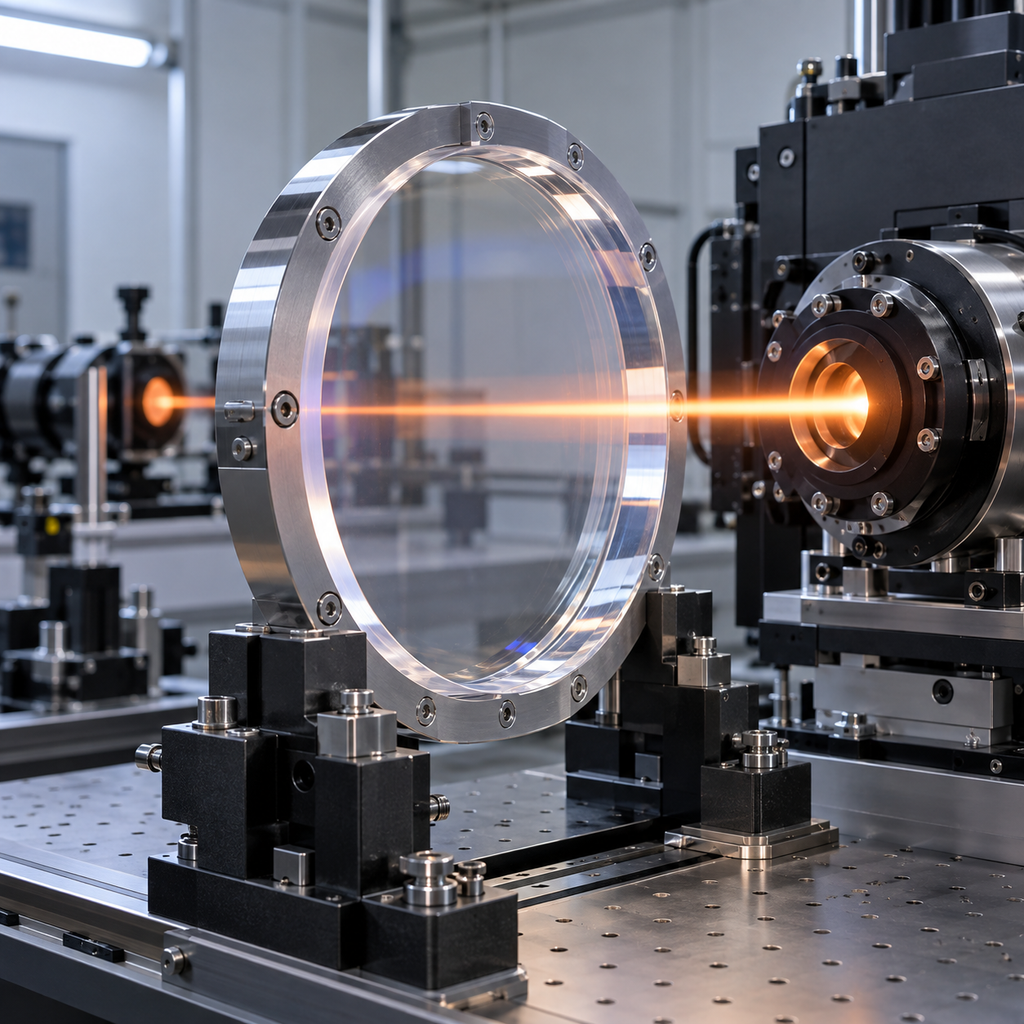
Why Large Sapphire Windows Are Used
Large sapphire windows are commonly used where the optical component must handle a combination of:
- High mechanical loads
- Large optical apertures
- Harsh operating environments
- Elevated temperatures
- Abrasive or chemically aggressive conditions
- Stable transmission in visible, near-IR, or mid-wave infrared bands
Typical applications include:
- High-power laser protection windows
- MWIR imaging and sensing windows
- Optical ports for harsh-environment instruments
- Aerospace and defense electro-optical systems
- Industrial monitoring equipment
- Vacuum or pressurized optical chambers
Compared with many common optical materials, sapphire offers several important advantages:
- Very high hardness and scratch resistance
- Good resistance to particle erosion
- Strong compressive strength
- Good transmission across a wide wavelength range
- Excellent durability in demanding service environments
For systems exposed to thermal load, high optical power, or challenging mechanical environments, sapphire is often a practical long-life solution.
1. Size Limits: What “Large” Really Means
As sapphire windows become larger, manufacturing difficulty rises significantly. A larger optical window is not simply a scaled-up version of a small one. In practice, large sapphire windows bring higher requirements for:
- Crystal growth quality
- Internal defect control
- Thickness uniformity
- Grinding and polishing stability
- Flatness over a wider aperture
- Stress control during machining
- Coating uniformity
When discussing “large sapphire windows,” buyers usually focus on dimensions such as:
- Diameter for round windows
- Length × width for rectangular windows
- Thickness
- Clear aperture
- Aspect ratio
The practical size limit depends on the combination of:
- Required optical quality
- Thickness
- Final geometry
- Surface specification
- Application wavelength
- Mechanical loading
- Quantity demand
In general, larger dimensions may lead to:
- Higher production cost
- Longer lead time
- Greater flatness control difficulty
- Higher risk of warpage or internal stress effects
- More challenging coating processes
Therefore, the RFQ should describe not only the outside dimensions, but also the actual optical requirements. A supplier needs to know whether the part is a protective window, a precision optical window, or a high-energy laser window, because those categories imply very different manufacturing standards.
2. C-Axis Orientation: Why Crystal Direction Matters
Sapphire is a single-crystal material, so crystal orientation can significantly affect optical and mechanical behavior. For many optical window projects, customers specify C-axis sapphire because it is commonly used and easier to integrate into many optical designs.
When discussing orientation, buyers should confirm:
- Whether C-axis material is required
- Whether another orientation is acceptable
- Whether birefringence effects must be minimized
- Whether the optical system is polarization-sensitive
- Whether the window will operate in a demanding thermal environment
For high-power laser and MWIR applications, orientation matters because it may influence:
- Optical anisotropy
- Polarization behavior
- Thermal performance
- Machining response
- Final optical consistency
In many standard applications, C-axis sapphire is a practical and widely used choice. But for more advanced optical systems, the designer may need to evaluate orientation together with the wavelength range, polarization requirements, and system architecture.
If the buyer does not specify orientation clearly, a manufacturer may not know whether the application prioritizes optical isotropy, cost efficiency, or specialized optical behavior.
3. Flatness: A Critical Requirement for Large Optical Windows
Flatness becomes one of the biggest challenges when the aperture size increases. A small sapphire window may be relatively easy to polish to a stable flat surface, but a large window requires more advanced process control to maintain consistent form accuracy across the entire part.
Poor flatness can affect:
- Beam quality
- Imaging sharpness
- Wavefront quality
- Optical alignment
- Sealing contact in mounted assemblies
For high-power laser systems, flatness is especially important because any form error may influence beam propagation and optical performance. For MWIR systems, flatness also affects image quality and system accuracy.
When specifying flatness, it is useful to discuss:
- Overall flatness
- Local surface figure quality
- Clear aperture
- Edge exclusion
- Parallelism
- Thickness uniformity
In addition to flatness, some projects may also require:
- Tight wedge control
- Low surface roughness
- High-quality polish
- Low subsurface damage
- Strict scratch-dig or cosmetic standards
For large windows, these parameters are closely related. In many cases, tighter flatness requirements also increase manufacturing complexity and cost.
4. Thermal Stress: A Key Risk in High-Power Applications
Thermal stress is one of the most important considerations for large sapphire windows used in high-power laser and MWIR systems. Even though sapphire has strong thermal and mechanical properties, a large optical part can still experience stress caused by:
- Local heating
- Temperature gradients
- High optical power density
- Mechanical clamping
- CTE mismatch with metal housings
- Uneven cooling conditions
In laser systems, the window may be exposed to continuous or pulsed energy that produces localized heating. In infrared systems, the component may also see temperature variation due to environmental exposure or system operation.
Potential problems caused by thermal stress include:
- Optical distortion
- Surface figure change
- Stress-induced birefringence
- Mounting stress concentration
- Reduced coating life
- Fracture risk in extreme conditions
To reduce these risks, system designers often consider:
- Proper thickness selection
- Edge design optimization
- Controlled mounting pressure
- Suitable housing materials
- Thermal expansion compatibility
- Stable coating processes
For demanding projects, the supplier may be asked to review not only the sapphire drawing, but also the mounting concept and expected operating conditions.
5. AR Coating: Improving Transmission Without Sacrificing Reliability
For many high-power laser and MWIR applications, uncoated sapphire may not provide the desired transmission performance. In those cases, anti-reflection (AR) coating is often used to reduce surface reflection and improve optical efficiency.
However, coating a large sapphire window is not just a matter of applying a standard optical layer. Buyers should confirm:
- Operating wavelength band
- Single-band or broadband AR requirement
- Incident angle range
- Laser energy level
- Environmental durability
- Coating side(s): one side or both sides
AR coating selection depends heavily on the application. A coating designed for visible optics may not be suitable for MWIR use, and a coating appropriate for standard optics may not withstand the thermal or power load of a laser system.
Important coating considerations include:
- Transmission target
- Reflection reduction
- Laser damage tolerance
- Adhesion stability
- Environmental durability
- Coating uniformity over large apertures
For harsh environments, coating durability can be just as important as the optical improvement itself. A coating with poor adhesion or insufficient thermal stability may fail before the sapphire substrate does.
When evaluating coated sapphire windows, buyers should also ask whether the supplier can provide:
- Coating specification
- Wavelength range
- Transmission data
- Environmental reliability information
- Handling and cleaning recommendations
Design and Procurement Factors to Confirm
When sourcing a large sapphire window, especially for high-power laser or MWIR service, it is helpful to provide complete technical information as early as possible.
Key factors to confirm include:
- Window shape and dimensions
- Thickness
- Clear aperture
- Crystal orientation
- Surface quality
- Flatness and parallelism
- Surface roughness
- Application wavelength
- Laser power or thermal load
- AR coating requirement
- Mounting method
- Operating environment
- Quantity
A clear RFQ helps the manufacturer determine whether the requested combination of size, optical quality, and coating is practical, and what process route is most appropriate.
How Large Sapphire Windows Are Typically Evaluated
For precision optical applications, sapphire windows are commonly evaluated through a combination of:
- Dimensional inspection
- Thickness measurement
- Flatness or figure testing
- Surface roughness inspection
- Cosmetic quality inspection
- Parallelism or wedge inspection
- Transmission or coating verification
- Visual inspection for edge quality and defects
If the project is high-value or technically demanding, customers may also request additional documentation such as:
- Material certification
- Inspection report
- Coating data
- Packing standard
- Application-specific recommendations
Conclusion
Large sapphire windows are an excellent choice for high-power laser and MWIR systems, but the success of the project depends on much more than material selection alone. Buyers and engineers need to consider the real manufacturing and application challenges associated with size limits, C-axis orientation, flatness control, thermal stress, and AR coating.
As window size increases, controlling optical and mechanical performance becomes more demanding. A well-prepared RFQ and early technical communication with the supplier can reduce risk, improve manufacturability, and help ensure that the final sapphire window meets the needs of the optical system.
If you are sourcing large custom sapphire windows for laser, infrared, or harsh-environment applications, it is best to provide your dimensions, optical tolerances, wavelength range, coating requirements, and operating conditions in detail so the manufacturer can recommend the most suitable solution.