
X-ray imaging systems depend on carefully engineered protective barriers to separate sensitive components from demanding operating environments. These barriers may need to withstand abrasion, chemicals, pressure differences, thermal cycling, cleaning procedures, and accidental contact while maintaining the performance of the imaging system.
Synthetic sapphire is an attractive material for some of these applications because it combines high hardness, chemical resistance, mechanical strength, and excellent optical clarity. However, sapphire is not universally suitable as an X-ray entrance window. Its usefulness depends on the energy of the X-rays, the required window thickness, and whether the component lies directly in the X-ray beam or serves as an optical protection window elsewhere in the detector assembly.
This guide explains how to evaluate sapphire windows for X-ray imaging applications, including transmission behavior, thickness selection, surface quality, mounting considerations, and detector protection.
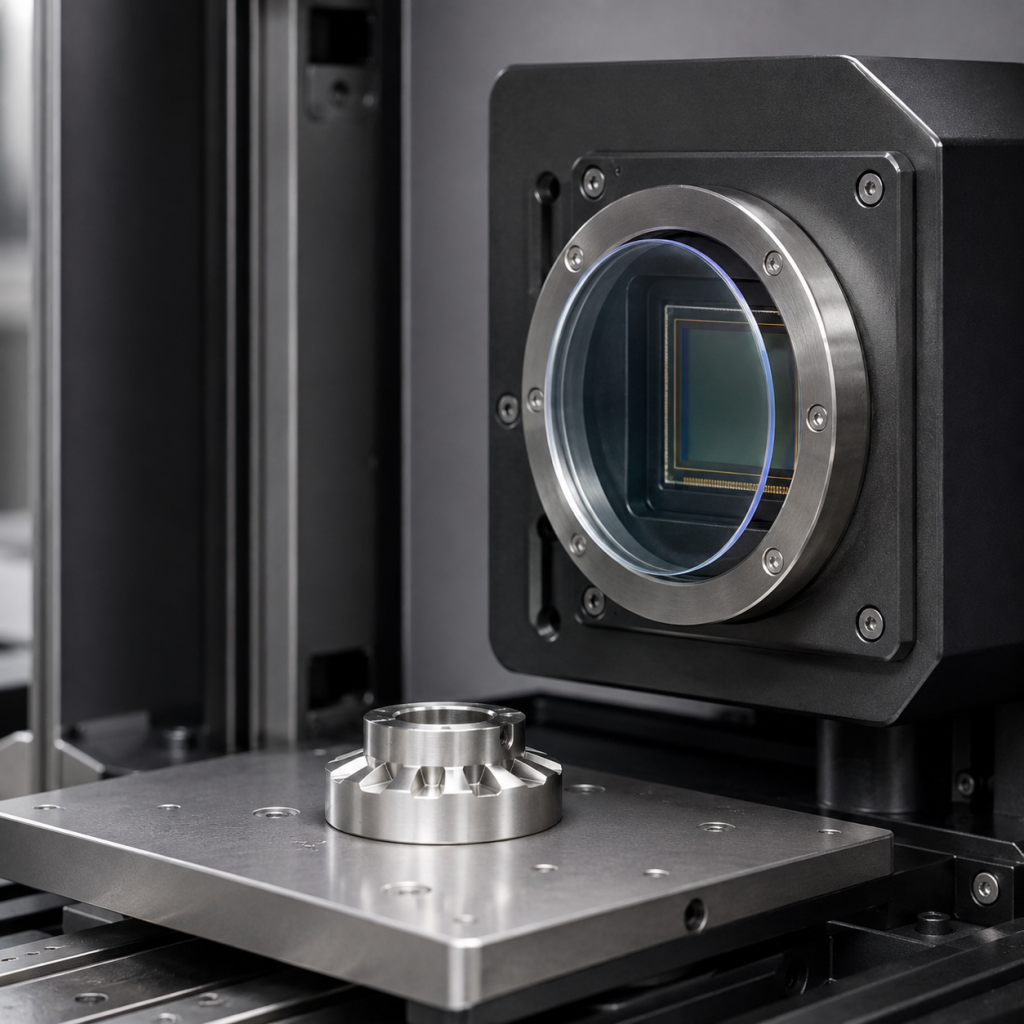
What Is a Sapphire Window?
A sapphire window is an optical component manufactured from synthetic single-crystal aluminum oxide, also known as Al₂O₃.
Unlike conventional glass, sapphire has a crystalline structure that provides a combination of mechanical durability and optical performance. It is commonly used in industrial sensors, semiconductor equipment, medical devices, analytical instruments, and harsh-environment optical systems.
Important characteristics include:
- High scratch resistance.
- Excellent resistance to many chemicals and cleaning agents.
- Strong performance at elevated temperatures.
- Good optical transmission across a broad ultraviolet, visible, and near-infrared range, depending on material grade and thickness.
- High mechanical rigidity.
- Compatibility with precision polishing and custom fabrication.
- Availability in circular, rectangular, square, and custom geometries.
In X-ray imaging equipment, these properties can be valuable when a component must protect a detector, scintillator, camera, or observation port from environmental exposure.
However, the first engineering question should always be whether the window must transmit X-rays directly.
Understanding Sapphire Transmission in X-Ray Imaging Systems
The phrase “X-ray imaging window” can describe several different components within an imaging system.
Some windows are positioned directly in the X-ray beam. Others protect visible-light optical paths associated with scintillators, cameras, or inspection chambers.
These two applications have very different material requirements.
Sapphire as a Direct X-Ray Beam Window
When sapphire is placed directly in the X-ray path, it attenuates part of the incident radiation.
The amount of attenuation depends on:
- X-ray photon energy.
- Sapphire thickness.
- Material density.
- Beam angle.
- Spectral distribution of the X-ray source.
- Detector sensitivity.
- Required image contrast and exposure time.
Lower-energy X-rays are generally attenuated more strongly than higher-energy X-rays. As a result, sapphire is typically less suitable for applications involving soft X-rays or low-energy X-ray detection, especially when the window must be thick enough to provide significant mechanical protection.
Depending on the application, alternative materials such as beryllium, thin polymer films, silicon nitride membranes, or diamond may provide more favorable X-ray transmission.
Sapphire can be considered for certain higher-energy applications when the mechanical or environmental advantages justify the transmission loss and the system design confirms acceptable imaging performance.
Sapphire as an Optical Window in an X-Ray Detector Assembly
Many X-ray detectors do not detect incoming radiation directly through a sapphire component.
Instead, an X-ray-sensitive scintillator converts X-ray energy into visible light. That visible light is then transmitted to a camera, photodetector, or other optical sensor.
In this configuration, sapphire may be used as:
- A protective cover for an optical imaging channel.
- A window between a scintillator enclosure and a camera.
- A protective barrier in an inspection chamber.
- An observation window for an X-ray system.
- A durable optical interface in a harsh industrial environment.
When sapphire is located in the visible-light portion of the system rather than the primary X-ray beam, its optical clarity, scratch resistance, and chemical durability become more relevant than its direct X-ray transmission.
Understanding this distinction prevents inappropriate material selection and helps define realistic performance requirements.
How to Evaluate X-Ray Transmission Through Sapphire
For direct-beam applications, X-ray transmission should be calculated using the actual energy distribution of the source and the proposed sapphire thickness.
A simplified relationship is:
Where:
- is the transmitted fraction at photon energy .
- is the linear attenuation coefficient of sapphire at that energy.
- is the material thickness.
The linear attenuation coefficient can also be expressed as:
Where:
- is the mass attenuation coefficient.
- is the density of the sapphire material.
Synthetic sapphire has a density of approximately 3.98 g/cm³.
For practical engineering, calculations should account for the complete X-ray spectrum rather than relying on a single nominal tube voltage. A system operating at a given kVp produces a range of photon energies, and filtration can significantly change the effective spectrum.
Useful evaluation questions include:
- What is the minimum photon energy that must reach the detector?
- What percentage of transmission is required at that energy?
- How much additional exposure time can the system tolerate?
- Will the sapphire introduce unacceptable beam hardening?
- Does the system require accurate quantitative measurements?
- Is the sapphire window directly in the imaging path or outside it?
- Can the required mechanical protection be achieved with a thinner component or a different material?
For precision applications, the proposed sapphire geometry should be validated through attenuation calculations, simulation, or physical testing.
Thickness Selection: Balancing Protection and Transmission
Window thickness is one of the most important design variables because it affects mechanical durability and radiation transmission simultaneously.
A thicker sapphire window generally provides:
- Greater resistance to mechanical impact.
- Improved rigidity.
- Better resistance to pressure-related deflection.
- Increased robustness during handling.
- Greater tolerance for repeated cleaning and industrial exposure.
However, increased thickness can also result in:
- Higher X-ray attenuation.
- Greater beam hardening.
- Increased visible-light absorption in certain optical configurations.
- Higher manufacturing costs.
- Greater component weight.
- More demanding mounting requirements.
The appropriate thickness depends on the actual application.
| Application | Primary Design Priority | Thickness Consideration |
|---|---|---|
| Direct X-ray beam window | X-ray transmission and structural integrity | Use the minimum thickness that satisfies mechanical requirements |
| Scintillator-side optical protection | Visible-light transmission and surface quality | Select thickness based on rigidity, mounting, and optical requirements |
| Industrial inspection enclosure | Impact resistance and environmental protection | Thickness may increase to improve durability |
| Vacuum or pressure-separated chamber | Pressure resistance and sealing | Thickness must be calculated from differential pressure, unsupported diameter, and safety factor |
| High-temperature observation port | Thermal stability and mechanical reliability | Evaluate thermal gradients, expansion mismatch, and mounting conditions |
| Medical imaging equipment cover | Cleanability, optical quality, and durability | Balance abrasion resistance, geometry, and instrument design |
For circular windows, the unsupported diameter is especially important. A larger clear aperture can significantly increase the mechanical demand on the component even when the pressure difference remains unchanged.
A window should never be specified by thickness alone. Diameter, support geometry, edge condition, operating pressure, and temperature must also be considered.
Surface Quality Requirements for Imaging Performance
Surface quality influences optical performance, contamination control, and long-term reliability.
For sapphire windows used in visible-light imaging paths, surface defects can scatter light and reduce image contrast. Scratches, pits, polishing defects, and contamination may become especially problematic in high-resolution detector assemblies.
Common specification categories include:
Scratch-Dig Quality
Scratch-dig specifications describe allowable visible surface imperfections.
Typical examples include:
- 60-40 for general industrial optical applications.
- 40-20 for more demanding imaging systems.
- 20-10 for high-performance optical assemblies.
The appropriate requirement depends on the location of the window, the optical magnification, and the imaging system’s sensitivity to scattered light.
A detector protection window located far from the focal plane may tolerate a less restrictive specification than a precision optical interface positioned near an image plane.
Surface Roughness
Surface roughness affects light scattering and can influence cleanliness and coating performance.
Polished sapphire windows for imaging applications may require very low surface roughness, particularly when used with high-resolution cameras or sensitive optical sensors.
However, an unnecessarily tight roughness requirement can increase manufacturing cost without improving system performance.
The specification should reflect the functional optical requirements of the application.
Flatness
Surface flatness becomes important when the sapphire window must preserve an optical wavefront or maintain consistent imaging geometry.
Insufficient flatness can contribute to:
- Image distortion.
- Focus variation.
- Wavefront errors.
- Uneven optical coupling.
- Reduced measurement accuracy.
Flatness requirements should be defined over the usable clear aperture rather than assumed across the entire physical component.
Parallelism
For windows used in imaging systems, insufficient parallelism can introduce beam deviation and positional errors.
This is particularly important when the component is installed in:
- Precision optical inspection systems.
- Scintillator-coupled imaging assemblies.
- Laser alignment channels.
- High-resolution detector modules.
- Measurement equipment with tightly controlled optical geometry.
Where appropriate, the specification should also define wedge angle or maximum allowable beam deviation.
Protecting Detectors from Industrial and Environmental Hazards
X-ray detectors are often expensive and sensitive to environmental exposure.
In industrial systems, damage may result from:
- Abrasive particles.
- Metal dust.
- Chemical splashes.
- Cleaning fluids.
- Thermal exposure.
- Accidental tool contact.
- Mechanical vibration.
- Condensation.
- Process contamination.
Sapphire can provide an effective protective barrier where standard glass would scratch more easily or degrade under repeated cleaning.
Its high hardness makes it particularly attractive for inspection systems exposed to abrasive materials or frequent maintenance.
Potential applications include:
- Industrial X-ray inspection equipment.
- Battery inspection systems.
- Electronics and semiconductor inspection tools.
- Automated production-line imaging systems.
- Scientific measurement equipment.
- In-situ process monitoring chambers.
- Medical imaging instrument protection.
- Optical viewing channels in radiation-related equipment.
The exact role of the sapphire component should always be clearly defined. A protective optical cover is not necessarily interchangeable with a low-attenuation X-ray entrance window.
Sapphire Windows in Scintillator-Based Detector Systems
Scintillator-based imaging systems convert incident X-ray energy into visible light.
A simplified detector arrangement may include:
- An incoming X-ray beam.
- A scintillator layer.
- An optical transfer section.
- A camera or photodetector.
- A protective housing or enclosure.
Sapphire may be integrated into the optical section when durability and optical clarity are required.
Potential benefits include:
- Protection of sensitive optical components.
- Resistance to repeated cleaning.
- Improved durability in contaminated environments.
- Support for sealed detector enclosures.
- Stable optical performance under elevated temperatures.
- Reduced risk of surface scratching during maintenance.
However, sapphire has a relatively high refractive index compared with standard optical glass. Without appropriate surface treatment, reflections at the air-to-sapphire interface can reduce visible-light transmission.
For demanding optical systems, anti-reflective coatings may be considered when they are compatible with the scintillator emission wavelength and operating environment.
Coating selection should account for:
- Emission wavelength of the scintillator.
- Angle of incidence.
- Operating temperature.
- Humidity.
- Cleaning chemicals.
- Required coating durability.
- Whether one or both surfaces require coating.
Mounting and Mechanical Integration
The performance of a sapphire window depends not only on the material but also on the way it is mounted.
Poor mounting can lead to localized stress, edge damage, cracking, optical distortion, or sealing failure.
Important design considerations include:
Edge Preparation
Sharp edges are more vulnerable to chipping during installation and handling.
Common options include:
- Chamfered edges.
- Rounded edges.
- Ground edges.
- Polished edges.
- Custom edge profiles.
The appropriate edge finish depends on assembly method, sealing requirements, and handling conditions.
Thermal Expansion Compatibility
Sapphire and metal housings can expand at different rates when exposed to temperature changes.
If a window is rigidly constrained, thermal cycling may create stress at the interface.
Mounting designs should account for:
- Housing material.
- Operating temperature range.
- Heating and cooling rates.
- Seal geometry.
- Adhesive or gasket properties.
- Mechanical preload.
A compliant interface may be necessary when thermal expansion mismatch is significant.
Sealing Method
Depending on the equipment design, sapphire windows may be installed using:
- Elastomer gaskets.
- Compression seals.
- Adhesive bonding.
- Mechanical retaining rings.
- Metalized and brazed interfaces.
- Custom vacuum-compatible assemblies.
Each method involves different tradeoffs in temperature capability, chemical resistance, leak tightness, repairability, and manufacturing cost.
For vacuum applications, the complete assembly—not only the sapphire component—must be evaluated for leak performance and outgassing.
Radiation Exposure and Long-Term Optical Performance
Sapphire is often valued for its stability in demanding environments, but long-term radiation exposure should still be evaluated when the component is used near high-intensity radiation sources.
Depending on the radiation environment and material characteristics, prolonged exposure can affect optical properties through the formation of color centers or other radiation-induced changes.
The impact depends on:
- Radiation type.
- Total accumulated dose.
- Exposure rate.
- Material purity.
- Crystal quality.
- Operating temperature.
- Required optical wavelength range.
For systems relying on visible-light transmission, even modest changes in optical transmission may become relevant if the detector operates with a low signal margin.
Where radiation exposure is significant, accelerated testing or application-specific material qualification may be appropriate.
When Sapphire Is Not the Best Choice
Although sapphire offers substantial mechanical and environmental advantages, it is not the optimal material for every X-ray imaging system.
Alternative materials should be considered when the application requires:
- Very high transmission of low-energy X-rays.
- Extremely thin entrance windows.
- Minimal beam hardening.
- Very low background interference.
- Large unsupported apertures with minimal attenuation.
- Highly specialized soft X-ray detection.
Depending on system requirements, engineers may evaluate:
- Beryllium windows.
- Silicon nitride membranes.
- Thin polymer windows.
- Diamond windows.
- Specialized composite structures.
- Alternative optical glasses for non-abrasive environments.
Material selection should be based on the actual optical, radiation, mechanical, environmental, and regulatory requirements of the equipment.
Sapphire is most compelling when its durability and environmental resistance provide a clear advantage and its transmission characteristics are compatible with the intended optical or X-ray path.
Information to Provide When Requesting a Custom Sapphire Window
A detailed technical inquiry allows a manufacturer to recommend the appropriate material, geometry, and finishing process.
For an X-ray imaging or detector-protection application, provide:
- Window shape: circular, square, rectangular, or custom.
- Outer dimensions and dimensional tolerances.
- Required thickness and thickness tolerance.
- Clear aperture.
- Whether the window is located directly in the X-ray beam.
- X-ray energy range or operating tube voltage.
- Required X-ray transmission, if applicable.
- Visible-light wavelength range, if applicable.
- Surface quality requirements.
- Surface flatness.
- Parallelism or wedge specification.
- Edge finishing requirements.
- Operating temperature.
- Pressure differential or vacuum conditions.
- Mounting and sealing method.
- Chemical exposure and cleaning procedures.
- Coating requirements.
- Expected production quantity.
If the sapphire component will be used directly in an X-ray beam, include the required transmission at the lowest relevant photon energy rather than relying only on the nominal operating voltage of the X-ray source.
Conclusion
Sapphire windows can provide exceptional durability, scratch resistance, chemical stability, and optical quality in selected X-ray imaging applications.
Their suitability depends on understanding the component’s actual position within the system. Sapphire may work well as a protective optical window in a scintillator-based detector assembly, as a durable observation window, or as a harsh-environment barrier. Its use directly in the X-ray beam requires careful evaluation of photon energy, attenuation, window thickness, and imaging performance.
By defining transmission requirements, mechanical loads, surface quality, mounting conditions, and detector-protection needs early in the design process, engineers can determine whether a custom sapphire window is the right solution for their imaging equipment.