
Sapphire is a single-crystal material composed of alpha aluminum oxide (α-Al₂O₃). While it is widely known as a precious gemstone, engineered sapphire has become one of the most important materials in modern optics. Thanks to its exceptional optical transparency, mechanical strength, chemical stability, and thermal resistance, sapphire is extensively used in optical windows, protective covers, laser systems, infrared equipment, aerospace applications, and high-end consumer electronics.
One of sapphire’s most remarkable characteristics is its ability to transmit light across a very broad spectrum—from approximately 200 nm in the ultraviolet region to 5,500 nm in the mid-infrared range. Combined with a Mohs hardness of 9, second only to diamond among common materials, sapphire has become a preferred substrate for demanding optical environments.
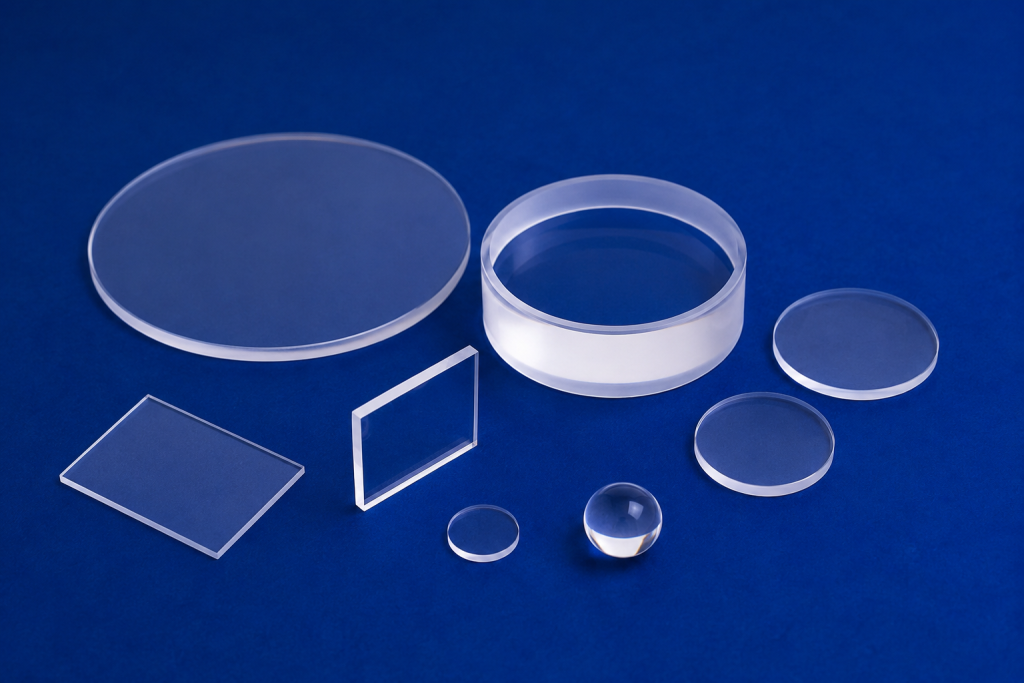
The Optical Fundamentals of Sapphire
A Naturally Transparent Optical Material
Sapphire is a wide-bandgap crystal with a bandgap energy of approximately 8.8 eV, allowing it to transmit light over an exceptionally wide wavelength range.
Key optical properties include:
| Property | Value |
|---|---|
| Chemical Composition | α-Al₂O₃ (Single-Crystal Aluminum Oxide) |
| Refractive Index | ~1.76 at 550 nm |
| Transmission Range | 200–5500 nm |
| Mohs Hardness | 9 |
| Melting Point | ~2040°C |
The relatively high refractive index of sapphire provides excellent optical performance but also causes stronger surface reflections compared to conventional optical glass.
Where Does the Lost Light Go?
Even though sapphire is highly transparent, not all incident light passes through the material.
The primary causes of transmission loss include:
Surface Reflection
An uncoated sapphire surface reflects approximately 7.5% of incoming light. Since most optical windows have two surfaces, total reflection losses can exceed 14%.
Material Absorption
At shorter ultraviolet wavelengths, transmission may be reduced by impurities and crystal defects. At longer infrared wavelengths, absorption increases due to lattice vibrations (phonon absorption), eventually limiting transmission beyond approximately 5.5 μm.
Transmission Performance of Uncoated Sapphire
The transmission characteristics of sapphire vary depending on wavelength.
| Spectral Region | Wavelength Range | Typical Transmission | Main Limitation |
|---|---|---|---|
| Deep UV | 200–300 nm | 50–80% | Band-edge absorption and scattering |
| Visible Light | 400–700 nm | 85–90% | Surface reflection |
| Near Infrared | 700–3000 nm | 80–85% | Reflection-dominated losses |
| Mid Infrared | 3000–5500 nm | 70% to <50% | Multi-phonon absorption |
| Far Infrared | >5500 nm | Near 0% | Strong lattice absorption |
Limitations of Bare Sapphire
In the UV Region
Transmission below 300 nm is highly dependent on crystal quality and purity. High-performance UV applications often require premium-grade optical sapphire.
In the Infrared Region
Beyond approximately 3 μm, absorption increases significantly. Thicker sapphire windows experience greater attenuation, making thickness optimization critical for infrared optical systems.
Anti-Reflective Coatings: Unlocking Sapphire’s Full Potential
While sapphire itself offers excellent transparency, anti-reflective (AR) coatings dramatically improve optical efficiency by minimizing surface reflections.
How AR Coatings Work
AR coatings use carefully engineered thin-film layers to create destructive interference for reflected light. This reduces reflection and increases transmission through the optical component.
Performance Comparison
| Parameter | Uncoated Sapphire | AR-Coated Sapphire |
|---|---|---|
| Surface Reflection | ~7.5% per side | 0.5–1.5% per side |
| Total Transmission | ≤86% | 95–99% |
| Optical Efficiency | Moderate | Excellent |
Sapphire Coatings for Different Wavelengths
Different applications require coatings optimized for specific spectral regions.
| Spectral Region | Coating Type | Typical Transmission | Typical Applications |
|---|---|---|---|
| UV | Fluoride-based coatings (e.g., MgF₂) | 80–95% | UV lasers, lithography systems |
| Visible | Broadband AR coatings (400–700 nm) | 94–98% | Cameras, imaging systems, display covers |
| Near IR | Single-wavelength AR coatings (e.g., 1064 nm) | >99% | Fiber optics, laser cutting systems |
| Mid IR | 3–5 μm AR coatings | 85–92% | Thermal imaging, infrared sensors |
Considerations When Choosing Coatings
Although coatings improve optical performance, they also introduce design trade-offs:
- Narrowband coatings perform best only within specific wavelength ranges.
- Hard coatings offer superior durability but may slightly reduce peak transmission.
- Softer coatings can achieve higher transmission but are more susceptible to damage.
- Multi-layer coating processes increase manufacturing complexity and cost.
Major Applications of Sapphire Optical Components
Aerospace and Defense
Sapphire windows are widely used in harsh environments due to their exceptional durability.
Applications include:
- Aircraft and spacecraft optical windows
- High-temperature observation ports
- Infrared missile seeker windows
- Radiation-resistant optical systems
Deep-Sea Exploration
Sapphire’s high compressive strength and corrosion resistance make it ideal for:
- Underwater camera housings
- Deep-sea observation windows
- Thermal vent monitoring systems
Consumer Electronics
Sapphire has become a premium material in high-end electronics.
Examples include:
- Smartphone camera lens covers
- Wearable device screens
- Luxury watch crystals
- Fingerprint sensor protection windows
Its extreme scratch resistance helps maintain optical clarity over long service lifetimes.
Industrial and Scientific Instruments
Sapphire is frequently used in advanced optical systems such as:
- Ultrafast laser equipment
- Spectroscopy instruments
- Optical sensors
- High-pressure viewing windows
- Semiconductor processing systems
How to Choose the Right Sapphire Optical Component
Consider the Operating Wavelength
For ultraviolet applications:
- Select high-purity optical sapphire.
- Use UV-optimized AR coatings.
For visible-light systems:
- Broadband AR coatings provide excellent overall performance.
For infrared applications:
- Carefully control substrate thickness.
- Avoid sapphire when transmission beyond 5.5 μm is required.
Consider the Operating Environment
For harsh environments involving high temperatures, abrasion, or corrosive chemicals:
- Choose durable hard-coating solutions such as diamond-like carbon (DLC) coatings.
For frequently handled optical surfaces:
- Consider hydrophobic and oleophobic coatings to improve cleanliness and reduce fingerprints.
Balance Cost and Performance
For general-purpose protective windows:
- Uncoated sapphire often provides sufficient performance.
For precision optical systems:
- Custom-designed coatings can significantly improve system efficiency and overall optical performance.
The Future of Sapphire Optics
The transformation of sapphire from a precious gemstone into a critical optical engineering material highlights the remarkable progress of materials science. With its unique combination of optical transparency, mechanical durability, thermal stability, and chemical resistance, sapphire continues to play a vital role in industries ranging from aerospace and defense to photonics and consumer electronics.
As coating technologies and advanced optical designs continue to evolve, sapphire is expected to find even broader applications in emerging fields such as quantum communication, advanced imaging systems, photonic integration, and metasurface optics.
For applications that demand both optical performance and environmental durability, sapphire remains one of the most reliable optical materials available today.