
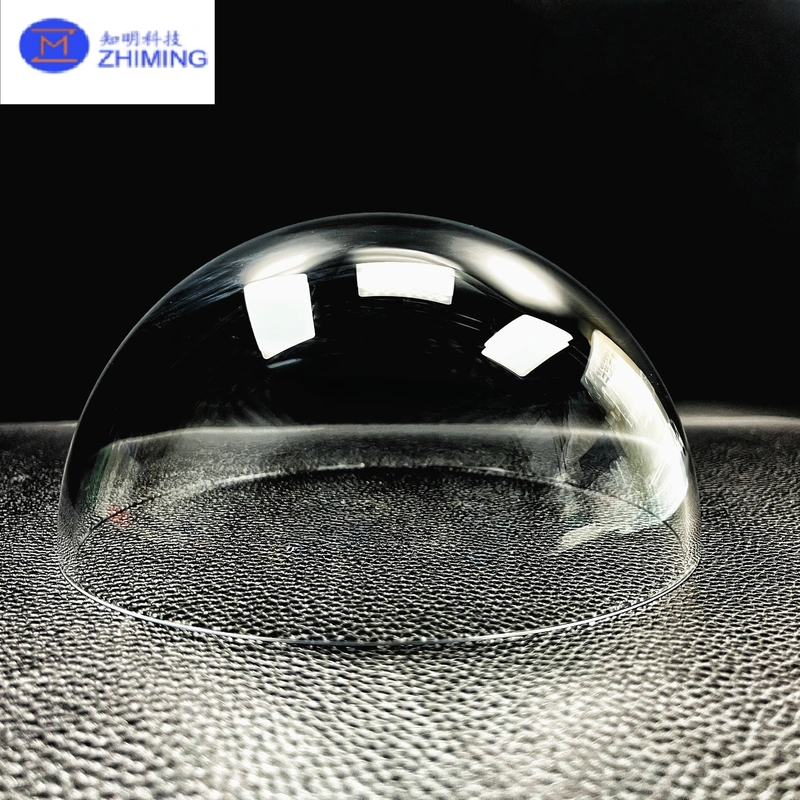
Sapphire optical domes are critical components in advanced optical and infrared systems, particularly in aerospace, defense, and high-performance industrial applications. Due to their exceptional mechanical strength, wide optical transmission range, and resistance to harsh environments, sapphire domes have become a preferred choice over conventional materials. This article provides a comprehensive overview of the manufacturing process of sapphire optical domes and highlights their key advantages from both material science and engineering perspectives.
1. Introduction
Sapphire (single-crystal aluminum oxide, Al₂O₃) is widely recognized for its outstanding physical and optical properties. Unlike conventional optical glass, sapphire exhibits superior hardness, thermal stability, and chemical resistance.
Sapphire optical domes are typically used as protective windows for:
- Infrared sensors
- Missile guidance systems
- Aerospace imaging devices
- High-pressure optical instruments
Their hemispherical or custom curved geometry enables minimal optical distortion while providing robust environmental protection.
2. Raw Material Preparation
The manufacturing process begins with high-purity synthetic sapphire crystals. These are typically produced using advanced crystal growth methods such as:
- Kyropoulos (KY) method
- Edge-Defined Film-Fed Growth (EFG) method
The KY method is more commonly used for optical domes due to its ability to produce large, high-quality single crystals with low internal stress and minimal defects.
After growth, sapphire boules are carefully inspected to ensure:
- Low dislocation density
- High optical clarity
- Uniform crystal orientation
3. Shaping and CNC Machining
Once the sapphire boule is prepared, it is cut into rough blanks using diamond wire saws. These blanks are then shaped into dome structures through precision CNC machining.
Key steps include:
- Outer and inner radius shaping
- Thickness control
- Surface geometry optimization
Due to sapphire’s extreme hardness (Mohs 9), specialized diamond tools are required. Machining must be carefully controlled to avoid micro-cracks and subsurface damage.
4. Grinding and Polishing
After shaping, the dome undergoes multi-stage grinding and polishing processes:
4.1 Fine Grinding
Removes machining marks and improves dimensional accuracy.
4.2 Precision Polishing
Achieves optical-grade surface finish with:
- Surface roughness typically < 5 nm
- High optical transmission
- Minimal scattering
Advanced polishing techniques such as chemical-mechanical polishing (CMP) are often applied to achieve ultra-smooth surfaces.
5. Coating and Surface Treatment
Depending on the application, sapphire domes may receive additional surface treatments:
- Anti-reflective (AR) coatings for enhanced transmission
- Infrared coatings for specific wavelength optimization
- Protective coatings for erosion resistance
These coatings are applied using vacuum deposition techniques to ensure uniformity and durability.
6. Quality Inspection and Testing
Before deployment, sapphire optical domes undergo rigorous testing, including:
- Optical transmission measurement
- Surface figure and roughness analysis
- Mechanical strength testing
- Thermal shock resistance evaluation
High-end applications require compliance with strict aerospace or military standards.
7. Key Advantages of Sapphire Optical Domes
7.1 Exceptional Hardness and Durability
Sapphire is second only to diamond in hardness, making it highly resistant to scratches, erosion, and particle impact.
7.2 Wide Optical Transmission Range
Sapphire transmits light from ultraviolet (~150 nm) to mid-infrared (~5.5 μm), making it suitable for multi-spectral applications.
7.3 High Thermal Stability
It can withstand extreme temperatures and rapid thermal cycling without deformation or failure.
7.4 Chemical and Environmental Resistance
Sapphire is resistant to acids, alkalis, and corrosive environments, ensuring long service life.
7.5 Structural Strength
Its high compressive strength allows it to function reliably in high-pressure and high-velocity environments.
8. Comparison with Alternative Materials
| Property | Sapphire | Quartz | Optical Glass (BK7) |
|---|---|---|---|
| Hardness | Very High | Medium | Low |
| Thermal Resistance | Excellent | Good | Moderate |
| IR Transmission | Excellent | Limited | Poor |
| Mechanical Strength | Very High | Moderate | Low |
This comparison highlights why sapphire is often selected for demanding optical dome applications.
9. Conclusion
The manufacturing of sapphire optical domes is a complex and highly controlled process involving crystal growth, precision machining, advanced polishing, and rigorous quality inspection. These processes ensure that the final product meets the stringent requirements of high-performance optical systems.
With their unmatched combination of mechanical strength, optical clarity, and environmental resistance, sapphire optical domes continue to play a vital role in modern aerospace, defense, and industrial technologies.