
Sapphire viewports are increasingly used in vacuum chambers, plasma equipment, semiconductor process tools, high-temperature furnaces and analytical systems where an ordinary glass window may not provide sufficient mechanical, thermal or chemical durability.
A sapphire viewport can combine:
- optical access;
- vacuum containment;
- resistance to aggressive plasma and chemicals;
- high-temperature capability;
- abrasion resistance;
- relatively high mechanical strength.
However, designing a reliable sapphire viewport requires more than selecting a sapphire disc with the correct diameter.
The complete engineering system must consider:
sapphire orientation → clear aperture → thickness → pressure differential → thermal gradient → edge geometry → mounting method → sealing material → flange CTE → optical quality → coating → vacuum leak requirement
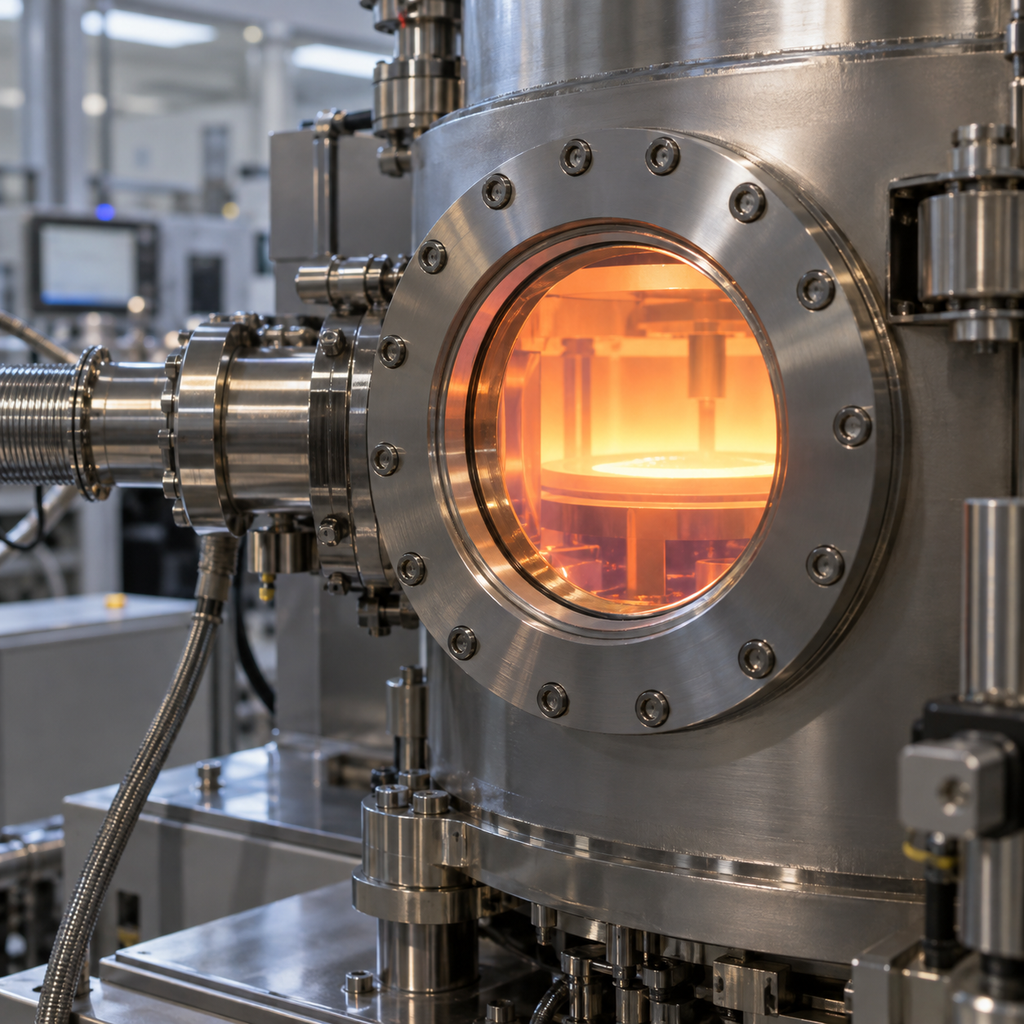
This becomes particularly important in semiconductor equipment because the viewport may be exposed simultaneously to:
- vacuum;
- plasma;
- corrosive process gases;
- repeated bake-out;
- thermal cycling;
- optical monitoring;
- strict particle requirements.
A viewport that performs well at room temperature may fail after repeated thermal cycles if the sealing and mounting system is not designed correctly.
This guide explains how to specify sapphire viewports for high-temperature vacuum chambers and semiconductor equipment.
1. Why Use Sapphire for a Vacuum Viewport?
Single-crystal sapphire is aluminum oxide, Al₂O₃, grown as a single crystal.
It combines several properties that are unusual for a transparent optical material:
- high hardness;
- high mechanical strength;
- high thermal conductivity;
- good thermal stability;
- strong chemical resistance;
- broad optical transmission;
- plasma resistance.
These properties make sapphire particularly suitable for harsh-process observation windows.
KYOCERA specifically identifies sapphire as a material used for semiconductor manufacturing equipment viewports, where resistance to plasma, corrosive chemicals and elevated temperature is required.
Sapphire is also used commercially in high- and ultra-high-vacuum viewport assemblies because it can be metallized and brazed to other materials to produce hermetic structures.
2. Sapphire Viewport vs Ordinary Optical Window
An ordinary optical window only needs to transmit light and survive its surrounding environment.
A vacuum viewport has another function:
It forms part of the pressure boundary.
This means it must withstand the pressure differential between the vacuum chamber and the atmosphere.
If the inside of a chamber is under high vacuum, atmospheric pressure continuously loads the outside surface.
The sapphire therefore behaves as both:
an optical component
and:
a structural pressure component
This distinction affects:
- thickness;
- edge support;
- clear aperture;
- mounting;
- allowable stress;
- safety factor.
For critical vacuum systems, viewport thickness should never be selected only from optical requirements.
3. Why Sapphire Is Attractive for Semiconductor Equipment
Semiconductor chambers can expose windows to much harsher conditions than ordinary laboratory vacuum systems.
Typical environments include:
- plasma etching;
- CVD;
- PECVD;
- sputtering;
- ion processing;
- thermal processing;
- chamber cleaning;
- optical endpoint detection.
The viewport may experience reactive gases such as:
- fluorine-containing chemistry;
- chlorine chemistry;
- oxygen plasma;
- cleaning gases.
KYOCERA reports that single-crystal sapphire has strong plasma and corrosion resistance and is used for windows and components in sputtering, CVD and etching equipment. Its published testing includes exposure to CF₄ + O₂ plasma environments and ClF₃ corrosion testing.
For this reason, sapphire can offer longer service life than softer window materials where:
plasma erosion + chemical attack + particle generation
are major concerns.
4. Sapphire Material Properties Relevant to Viewport Design
Representative sapphire properties published by KYOCERA include approximately:
| Property | Representative Sapphire Value |
|---|---|
| Vickers hardness | 22.5 GPa |
| Flexural strength | 690 MPa |
| Young’s modulus | 470 GPa |
| Thermal conductivity at 20°C | ~42 W/m·K |
| CTE parallel to C-axis, 40–400°C | ~7.7 × 10⁻⁶/K |
| CTE perpendicular to C-axis | ~7.0 × 10⁻⁶/K |
| Melting point | ~2053°C |
These are representative material values, not guaranteed design values for every sapphire grade or finished viewport.
Three properties are especially relevant to viewport engineering:
mechanical strength
thermal conductivity
anisotropic thermal expansion
5. Sapphire Material Temperature Is Not the Viewport Temperature Rating
This is one of the most important distinctions in a sapphire viewport project.
Sapphire itself remains mechanically and chemically stable at temperatures far above the normal operating temperature of commercial vacuum viewport assemblies.
But an assembled viewport includes:
- sapphire;
- metallization;
- braze alloy;
- transition ring;
- stainless steel or other flange;
- gasket;
- weld.
One of these components may determine the actual temperature limit.
For example, CeramTec lists a standard sapphire viewport temperature range of approximately:
-69°C to 450°C
while its standard fused-silica viewport range is lower at approximately:
-65°C to 200°C.
Other commercial sapphire viewport assemblies may be rated around:
200°C, 350°C or 450°C
depending on seal design and flange construction.
Therefore, an RFQ should not simply state:
Sapphire can withstand 1000°C, so the viewport must withstand 1000°C.
The correct requirement is:
Required assembled viewport operating temperature: ___°C
and:
Required bake-out temperature: ___°C
6. Thermal Shock: Why It Matters
Thermal shock occurs when different regions of a component experience rapid temperature differences.
For a sapphire viewport, one possible situation is:
hot chamber interior + relatively cool metal flange
The center of the sapphire may heat more quickly than the perimeter.
This produces a thermal gradient.
The resulting stress depends on:
- temperature difference;
- heating rate;
- cooling rate;
- sapphire thickness;
- clear aperture;
- edge restraint;
- crystal orientation;
- flange material;
- sealing structure.
Although sapphire has good thermal conductivity compared with many optical glasses, thermal shock should still be treated carefully.
7. High Thermal Conductivity Helps — But Does Not Eliminate Thermal Stress
Sapphire’s room-temperature thermal conductivity is much higher than many conventional glasses.
Representative KYOCERA data give approximately:
42 W/(m·K) at 20°C.
Higher thermal conductivity helps distribute heat more rapidly through the window.
However, sapphire also has a higher thermal expansion coefficient than fused silica.
This means the complete thermal-shock behavior cannot be judged from thermal conductivity alone.
The real problem is often the combination:
thermal gradient + CTE mismatch + rigid mounting
Therefore, viewport design should focus on how the sapphire is allowed to expand relative to the metal structure.
8. Sapphire Is Anisotropic
Unlike fused silica, sapphire is a single crystal.
Its properties depend on crystal orientation.
For example, published CTE data differ between directions parallel and perpendicular to the C-axis.
This means orientation can affect:
- thermal expansion;
- birefringence;
- optical behavior;
- mechanical design.
For many optical windows, C-plane sapphire is commonly selected.
However, orientation should be specified rather than assumed when:
- polarization matters;
- high optical precision is required;
- thermal stress is critical;
- the component geometry is unusual.
An RFQ may therefore specify:
Material: Single-crystal sapphire
Orientation: C-plane (0001)
9. Why the Metal-Sapphire Interface Is Critical
Sapphire and stainless steel do not expand at the same rate.
When an assembly is heated, the metal flange may expand more than the sapphire.
If the sapphire is rigidly constrained, this CTE mismatch can create severe stress at the edge.
Potential failure modes include:
- edge cracking;
- braze cracking;
- sapphire fracture;
- seal leakage;
- permanent optical distortion.
For this reason, high-quality brazed sapphire viewport assemblies often include a compliant transition structure between the sapphire and the main flange.
Commercial designs may use:
- thin metal rings;
- Kovar or NiFe alloys;
- flexible transition members;
- multilayer braze structures.
A published high-temperature sapphire viewport design used two C-shaped metallic rings specifically to reduce thermally induced stress between the sapphire and flange; that assembly was demonstrated from room temperature up to approximately 450°C under both vacuum and high-pressure conditions.
10. Brazed Sapphire Viewports
For high vacuum and UHV applications, brazing is one of the most important sealing methods.
A typical structure may be:
sapphire → metallization → braze alloy → transition metal → flange
The sapphire surface is first prepared so that the metal system can form a hermetic joint.
KYOCERA confirms that sapphire can be metallized and brazed to other materials for airtight vacuum-device applications.
CeramTec similarly uses conventional metallization and brazing techniques for sapphire vacuum viewports.
Advantages of brazed construction include:
- UHV compatibility;
- low outgassing;
- no elastomer in the primary optical seal;
- repeated bake-out capability;
- compact construction.
But the braze and transition structure must accommodate differential thermal expansion.
11. O-Ring Sealed Sapphire Viewports
Not every vacuum application requires brazing.
For lower-temperature vacuum systems, a sapphire disc may be mechanically mounted with an O-ring.
This approach can offer:
- simple assembly;
- easy replacement;
- lower manufacturing cost;
- flexible sealing.
However, O-rings introduce limitations.
These can include:
- outgassing;
- temperature limit;
- chemical compatibility;
- permeation;
- compression set.
For semiconductor tools with high-temperature bake-out or UHV requirements, an elastomer seal may therefore become the limiting component.
In these applications, brazed or metal-sealed viewport assemblies may be preferable.
12. Metal Gasket and CF Viewports
ConFlat, or CF, flange systems are widely used in UHV equipment.
The external flange connection uses a metal gasket—typically copper—compressed between knife edges.
The optical window itself may already be brazed into the viewport body.
This creates two separate sealing interfaces:
sapphire-to-metal hermetic seal
and:
viewport flange-to-vacuum chamber seal
Commercial CF sapphire viewports are available specifically for repeated bake-out and UHV operation.
13. KF vs CF Sapphire Viewports
The choice of flange depends on the vacuum requirement.
KF / NW
Often used for:
- rough vacuum;
- medium vacuum;
- general industrial equipment;
- systems requiring quick installation.
Advantages include:
- rapid assembly;
- reusable clamps;
- convenient maintenance.
However, elastomer O-rings usually limit bake-out temperature and ultimate vacuum performance.
CF
Often used for:
- high vacuum;
- UHV;
- semiconductor process systems;
- research chambers;
- high-temperature bake-out.
Advantages include:
- metal gasket;
- low outgassing;
- high bake-out capability;
- very low leak rate.
For demanding semiconductor systems, CF or custom welded interfaces are often more appropriate than a standard KF connection.
14. Leak Rate
Vacuum viewport performance should include a leak specification.
A common UHV metric is the helium leak rate.
Commercial sapphire viewports demonstrate specifications on the order of:
<1 × 10⁻¹⁰ mbar·L/s
for selected designs.
The required leak rate should be determined by the customer’s overall vacuum system.
For example:
Helium leak rate ≤1 × 10⁻⁹ mbar·L/s
or:
≤1 × 10⁻¹⁰ mbar·L/s
may be specified.
The inspection method should also be agreed.
15. Viewport Thickness: Why Diameter Matters
A larger clear aperture requires greater structural support.
Under atmospheric pressure, the total force on the window increases approximately with the area.
Therefore:
larger diameter → much greater total pressure load
A 100 mm clear aperture is not simply twice as difficult as a 50 mm aperture.
The loaded area increases with the square of diameter.
Viewport thickness therefore depends on:
- clear aperture;
- supported diameter;
- pressure differential;
- support geometry;
- sapphire strength;
- safety factor;
- temperature;
- thermal stress.
Thickness should not be selected by copying the value from a smaller viewport.
16. Clear Aperture vs Outside Diameter
Another common RFQ mistake is specifying only:
Ø50 mm sapphire window.
The engineering team needs to know whether Ø50 mm means:
- sapphire outside diameter;
- clear optical aperture;
- metal flange opening.
These are not the same.
A viewport might have:
Sapphire OD: 60 mm
Supported diameter: 52 mm
Clear aperture: 48 mm
The unsupported diameter is particularly important for mechanical calculations.
Therefore a drawing should clearly identify:
OD → support area → clear aperture
17. Thickness Should Be Calculated for the Actual Mounting Condition
The strength of a circular window depends strongly on how it is supported.
Possible conditions include:
- simply supported edge;
- clamped edge;
- brazed perimeter;
- gasket support;
- partial support.
The same sapphire thickness can experience very different stress under different boundary conditions.
Therefore, a generic table saying:
50 mm sapphire window = 3 mm thickness
should not automatically be used for a safety-critical viewport.
For pressure-critical applications, engineering calculation or finite-element analysis should consider the actual assembly.
18. Safety Factor
Sapphire is strong but brittle.
Unlike ductile metals, it does not gradually deform before fracture.
Its effective strength can also depend on:
- surface defects;
- edge chipping;
- polishing quality;
- crystal orientation;
- component size.
Therefore, viewport calculations require a suitable safety factor.
The designer should not use an ideal laboratory flexural-strength number directly as the allowable operating stress.
Edge quality becomes particularly important because a small chip can act as a crack initiator.
19. Edge Quality and Chamfer
A sapphire viewport should not normally have a perfectly sharp edge.
A controlled bevel or chamfer can reduce damage during:
- machining;
- handling;
- coating;
- assembly;
- brazing.
Common drawing requirements may include:
0.2 × 45°
or:
0.5 × 45°
depending on the part dimensions.
Commercial custom sapphire viewport suppliers commonly specify controlled chamfers and fine-ground or polished edges.
For brazed parts, edge geometry should be coordinated with the metallization and seal design.
20. Edge Chipping Must Be Controlled
Chips at the outer circumference can reduce mechanical strength.
The RFQ may define:
Maximum edge chip: ___ mm
or:
No chips within sealing region greater than ___ µm
Instead of stating only:
No edge defects.
For semiconductor equipment, chipped edges can also become a particle source.
This matters even if the chip does not immediately threaten structural integrity.
21. Optical Transmission Range
Sapphire offers broad transmission from UV through visible and into the near/mid-infrared.
Commercial vacuum viewport systems commonly cite useful sapphire transmission roughly from:
0.25 µm to 4 µm
while some sapphire grades and component specifications extend farther depending on material quality, thickness and measurement criteria.
This makes sapphire useful for:
- visible process observation;
- UV sensing;
- NIR imaging;
- laser monitoring;
- pyrometry;
- spectroscopy.
But system transmission also depends on:
- sapphire thickness;
- orientation;
- surface quality;
- coating;
- angle of incidence.
22. Sapphire Has High Surface Reflection
Sapphire has a relatively high refractive index compared with air.
This creates Fresnel reflection at each uncoated surface.
For simple visual observation, this may be acceptable.
For optical measurement or laser transmission, an AR coating can significantly improve throughput.
Coatings can be designed for:
- 355 nm;
- 532 nm;
- 1064 nm;
- 1550 nm;
- dual-band;
- broadband VIS;
- broadband NIR.
However, high-temperature viewport coatings require additional consideration.
The coating must survive:
- operating temperature;
- bake-out;
- plasma exposure;
- chemical cleaning.
A coating optimized only for room-temperature optical performance may not be suitable inside a semiconductor chamber.
23. When Should the Viewport Be Uncoated?
An uncoated sapphire window can be preferable when:
- optical throughput is not critical;
- plasma exposure is severe;
- coating contamination is unacceptable;
- high-temperature stability is more important;
- the component will undergo aggressive cleaning.
The trade-off is higher reflection.
For many chamber-viewing applications, mechanical and chemical durability may be more important than maximizing transmission.
24. Surface Quality
Optical surface quality is commonly specified using scratch-dig notation.
Typical examples include:
60/40
40/20
20/10
The correct requirement depends on application.
Visual Observation
60/40 may often be adequate.
Machine Vision
40/20 may be appropriate.
Laser or Precision Imaging
20/10 or better may be required.
Commercial sapphire viewport components commonly offer specifications around 40/20 for precision grades.
Do not automatically request 10/5 if the viewport is only used for visual chamber monitoring.
Over-specification increases polishing cost without necessarily improving the process.
25. Flatness
Flatness becomes important for:
- imaging;
- laser transmission;
- interferometry;
- optical metrology.
A typical specification may be:
λ/2 @ 632.8 nm
or:
λ/4 @ 632.8 nm
depending on aperture.
Commercial sapphire viewport components are available with approximately λ/2-per-inch-level flatness for precision configurations.
However, flatness before assembly does not guarantee flatness after brazing.
The joining process can introduce stress and deformation.
For precision optical systems, assembled-wavefront performance may therefore need to be considered.
26. Parallelism and Wedge
For simple observation:
parallelism may not be critical.
For laser transmission:
wedge can cause beam deviation.
A drawing may therefore specify:
Parallelism ≤30 arc sec
or another value appropriate to the system.
Alternatively, some laser applications deliberately require a small wedge to suppress etalon effects and back-reflections.
Therefore:
perfect parallelism is not always the correct optical design.
The requirement should depend on the optical system.
27. Birefringence and Crystal Orientation
Sapphire is birefringent.
For ordinary process observation, this may have little practical impact.
For polarization-sensitive applications, however, it can affect:
- beam polarization;
- optical path;
- imaging;
- laser measurement.
The engineering drawing should therefore specify crystal orientation when necessary.
A common choice is C-plane sapphire with the C-axis normal to the optical faces.
But other orientations can be manufactured for specialized applications.
28. Sapphire vs Fused Silica Viewports
Both materials are widely used in vacuum systems.
A simplified comparison is:
| Property | Sapphire | Fused Silica |
|---|---|---|
| Hardness | Extremely high | Lower |
| Mechanical strength | High | Lower |
| Thermal conductivity | Much higher | Lower |
| Thermal expansion | Higher | Very low |
| Plasma resistance | Excellent in many environments | Application dependent |
| Scratch resistance | Excellent | Good |
| UV transmission | Good | Excellent in UV grades |
| IR range | Broader into IR | More limited depending on grade |
| Birefringence | Yes | Essentially no intrinsic birefringence |
| Machining cost | Higher | Generally lower |
| High-temperature brazed viewport | Strong option | Seal-dependent |
CeramTec’s commercial standard viewport data illustrate the practical difference: its sapphire assemblies are specified to higher standard temperatures and higher pressure than its fused-silica versions.
This does not mean sapphire is always better.
Fused silica may be preferable when:
- very low CTE is critical;
- UV transmission dominates;
- birefringence must be minimized;
- lower cost is important.
29. Sapphire vs Borosilicate Glass
Borosilicate glass is widely used in general-purpose viewing windows.
It offers:
- low cost;
- good thermal resistance;
- easy fabrication.
But sapphire provides much higher:
- hardness;
- wear resistance;
- mechanical strength;
- plasma resistance.
Therefore sapphire becomes attractive when a standard borosilicate window experiences:
- scratching;
- erosion;
- chemical attack;
- repeated thermal cycling;
- high pressure differential.
For semiconductor plasma systems, this service-life improvement can justify the higher material cost.
30. Semiconductor Plasma Viewports
A viewport in an etch or deposition tool is not simply a passive window.
Its surface may gradually interact with the chamber environment.
Possible effects include:
- erosion;
- coating deposition;
- clouding;
- roughening;
- particle release.
KYOCERA notes that sapphire’s plasma resistance helps suppress particle generation and contamination and identifies sputtering, CVD and etching equipment as applications.
For this reason, viewport lifetime should sometimes be evaluated using:
optical transmission over process cycles
rather than only initial transmission.
31. Chamber-Side Coating Deposition
Even a perfectly resistant sapphire surface may become obscured if process material deposits onto it.
This is common in:
- PVD;
- CVD;
- PECVD.
Possible system-level solutions include:
- purge gas;
- protective shutters;
- replaceable shields;
- recessed mounting;
- controlled viewport angle.
The optical-material supplier cannot solve all deposition issues through sapphire selection alone.
Viewport geometry should therefore be reviewed as part of the chamber design.
32. High-Temperature Furnace Viewports
Sapphire can also be used for:
- vacuum furnaces;
- heat-treatment equipment;
- crystal-growth observation;
- high-temperature spectroscopy;
- pyrometry.
Important requirements include:
- repeated thermal cycles;
- temperature gradients;
- thermal radiation;
- atmosphere;
- pressure differential.
For temperature measurement through the viewport, the engineer must also consider the wavelength sensitivity of the pyrometer.
The viewport transmission curve can influence measured temperature.
Therefore, for pyrometry:
viewport spectral transmission must be included in the optical calibration.
33. Laser Viewports
When a laser beam passes through a sapphire viewport, additional specifications become important.
These may include:
- wavelength;
- laser power;
- CW or pulsed operation;
- pulse duration;
- beam diameter;
- fluence;
- angle of incidence;
- polarization.
Then specify:
- AR coating;
- transmitted wavefront;
- wedge;
- surface quality;
- laser damage threshold.
A viewport suitable for visual observation should not automatically be assumed suitable for a high-power laser.
34. Large-Aperture Sapphire Viewports
As aperture increases, several problems become harder:
- material cost;
- flatness;
- thickness;
- polishing;
- mechanical stress;
- braze stress;
- thermal gradients.
The window thickness may need to increase substantially.
This makes the component heavier and more expensive.
Large apertures may also require tighter control of:
- global flatness;
- local surface figure;
- mounting uniformity.
Therefore, designers should avoid specifying a larger clear aperture than the optical system actually needs.
Reducing clear aperture can significantly reduce mechanical load and component cost.
35. Round vs Rectangular Sapphire Viewports
Round sapphire windows are generally easier to design for uniform pressure loading.
Rectangular windows may be necessary for:
- cameras;
- scanning optics;
- line-of-sight systems.
However, corners introduce additional stress concentration.
For rectangular viewports, corner radius becomes important.
Avoid extremely sharp internal geometry where possible.
The RFQ should specify:
- outside dimensions;
- clear aperture;
- corner radius;
- thickness;
- mounting area.
For unusual geometries, mechanical simulation is recommended.
36. Cleaning Sapphire Viewports
Semiconductor viewport cleaning must balance contamination removal against damage to coatings or brazed seals.
Potential cleaning methods may include:
- high-purity solvent;
- DI water;
- ultrasonic cleaning;
- semiconductor cleaning chemistry;
- plasma cleaning.
The correct method depends on:
- AR coating;
- metal seal;
- chamber contaminants.
Do not automatically apply aggressive chemical cleaning to a coated sapphire viewport.
The coating may fail even though the sapphire itself is chemically resistant.
37. Bake-Out and Thermal Cycling
For UHV systems, bake-out is often required to remove adsorbed water and other gases from chamber surfaces.
A viewport therefore needs to withstand:
repeated heating + dwell + cooling
rather than only one exposure to maximum temperature.
Commercial sapphire UHV viewports are specifically designed for repeated high-temperature bake-out.
An RFQ should specify:
Operating Temperature: ___°C
Bake-Out Temperature: ___°C
Heating Rate: ___°C/min
Cooling Rate: ___°C/min
Expected Number of Cycles: ___
Heating rate can be as important as maximum temperature because rapid temperature changes increase thermal gradients.
38. What Should Be Tested After Brazing?
A finished sapphire-metal assembly may require:
Helium Leak Test
Confirms hermetic performance.
Visual Inspection
Checks the sapphire, metallization and braze region.
Dimensional Inspection
Checks flange and optical alignment.
Optical Inspection
Checks:
- transmission;
- flatness;
- surface quality.
Thermal Cycling
For critical assemblies, verifies seal stability after repeated heating and cooling.
Commercial UHV sapphire viewports are routinely supplied with helium-leak testing as part of their production control.
39. Example RFQ — Semiconductor Plasma Viewport
Product: Sapphire Vacuum Viewport
Application: Plasma Etch Equipment
Window Material: Single-Crystal Sapphire
Orientation: C-plane
Window OD: 60 mm
Clear Aperture: 45 mm
Thickness: To be evaluated
Vacuum: ≤1 × 10⁻⁸ mbar
Operating Temperature: 250°C
Bake-Out Temperature: 300°C
Flange: CF
Flange Material: 304L / 316L stainless steel
Seal: Hermetic brazed
Helium Leak Rate: ≤1 × 10⁻¹⁰ mbar·L/s
Surface Quality: 40/20
Flatness: λ/4 @632.8 nm
Coating: Uncoated
Process Gas: CF₄ / O₂
Quantity: 5 pcs qualification + production forecast
This provides enough information for meaningful technical evaluation.
40. Example RFQ — High-Temperature Furnace Viewport
Application: Vacuum Furnace Observation
Material: C-plane sapphire
Clear Aperture: 30 mm
Window OD: 45 mm
Operating Temperature at Window: 400°C
Chamber Temperature: 900°C
Pressure: High vacuum
Bake-Out: 450°C
Flange: Custom metal flange
Optical Range: 500–1000 nm
Purpose: Visual observation + pyrometry
Surface Quality: 40/20
Coating: To be evaluated
Quantity: 10 pcs
Notice that:
chamber temperature ≠ sapphire window temperature.
This distinction is essential.
A furnace chamber may operate at 1000°C while the viewport itself remains at a much lower temperature because of distance, shielding or cooling.
41. Example RFQ — Laser UHV Viewport
Application: UHV Laser Chamber
Sapphire: Optical-grade C-plane
Wavelength: 1064 nm
Laser: CW / pulsed
Power: ___ W
Beam Diameter: ___ mm
Angle of Incidence: 0°
Clear Aperture: 25 mm
Flatness: λ/10 @632.8 nm
Surface Quality: 10/5
Parallelism: ≤10 arc sec
AR Coating: R < ___% @1064 nm
Vacuum: 1 × 10⁻⁹ mbar
Bake-Out: 250°C
Leak Rate: ≤1 × 10⁻¹⁰ mbar·L/s
For laser systems, optical specifications may be significantly more demanding than for normal chamber observation.
42. Sapphire Viewport RFQ Checklist
Before requesting a quotation, provide:
Window
- Sapphire grade
- Crystal orientation
- Outside diameter / size
- Thickness
- Clear aperture
Mechanical Conditions
- Vacuum level
- External pressure
- Internal positive pressure if any
- Safety requirement
- Vibration or shock
Temperature
- Operating temperature
- Chamber temperature
- Viewport temperature
- Bake-out temperature
- Heating/cooling rate
Seal
- O-ring
- Metal gasket
- Brazed
- Custom hermetic seal
Flange
- KF
- CF
- ISO
- Custom
- Flange material
Optical Requirements
- Wavelength
- Surface quality
- Flatness
- Parallelism
- Wedge
- AR coating
- Clear aperture
Process Environment
- Plasma chemistry
- Process gases
- Cleaning chemicals
- Particle requirements
Inspection
- Helium leak test
- Dimensional report
- Optical inspection
- Material certificate
Quantity
- Prototype
- Qualification
- Production quantity
Providing these parameters reduces back-and-forth during quotation and helps prevent an incorrectly specified viewport.
43. Common Sapphire Viewport Design Mistakes
Mistake 1 — Using Sapphire’s Maximum Material Temperature as the Assembly Rating
The seal usually becomes the limiting factor.
Mistake 2 — Specifying Window Diameter but Not Clear Aperture
Mechanical calculations require the unsupported opening.
Mistake 3 — Selecting Thickness Without Pressure Calculation
Diameter, support and pressure must be evaluated together.
Mistake 4 — Rigidly Clamping Sapphire Between Metal Parts
Thermal expansion mismatch can create edge stress.
Mistake 5 — Ignoring Heating Rate
Thermal gradients can damage the assembly even below the nominal maximum temperature.
Mistake 6 — Overspecifying Optical Quality
A process observation viewport usually does not need laser-grade 10/5 or λ/10 performance.
Mistake 7 — Adding AR Coating Without Considering Plasma Exposure
The coating may become the weakest surface in the chamber.
Mistake 8 — Ignoring Crystal Orientation
This can matter for polarization-sensitive and high-precision optical systems.
44. How to Select a Sapphire Viewport Supplier
A capable supplier should understand both:
optical sapphire
and:
vacuum mechanical design
Key questions include:
Sapphire Processing
Can the supplier control:
- crystal orientation;
- thickness;
- diameter;
- surface quality;
- flatness;
- parallelism;
- edge quality?
Metallization and Brazing
Can sapphire be joined hermetically to metal?
CTE Management
Is the transition structure designed to reduce thermal stress?
Vacuum Testing
Can helium leak data be provided?
High-Temperature Qualification
Can the assembly survive the required bake-out cycle?
Semiconductor Cleanliness
Can components be cleaned and packed appropriately?
Custom Design
Can the supplier manufacture custom clear apertures, thicknesses, coatings and flange structures?
For semiconductor equipment, these capabilities are more important than simply offering sapphire discs.
Conclusion
A high-temperature sapphire viewport is not merely a sapphire window installed in a vacuum chamber.
It is an engineered optical, mechanical and hermetic assembly.
Reliable design requires the complete system to be considered:
sapphire material
→ crystal orientation
→ clear aperture
→ thickness
→ pressure differential
→ edge quality
→ thermal gradient
→ CTE mismatch
→ metallization
→ brazing
→ flange
→ optical quality
→ coating
→ leak testing
Sapphire offers several major advantages for semiconductor and harsh vacuum environments, including high hardness, thermal conductivity, chemical resistance and plasma resistance. KYOCERA specifically identifies sapphire viewports for semiconductor manufacturing equipment because of their heat, chemical and plasma resistance.
However, the sapphire crystal’s high-temperature capability should never be confused with the rating of the finished viewport. Commercial hermetic sapphire viewport assemblies typically have much lower specified operating and bake-out limits determined by their brazing, transition structures and flange systems.
For vacuum chambers, semiconductor equipment, plasma systems, furnaces and optical monitoring systems, the viewport specification should therefore be based on the actual operating conditions rather than sapphire material properties alone.
ZMSH Sapphire Windows can provide custom sapphire windows and viewport components for:
- semiconductor equipment;
- vacuum chambers;
- UHV systems;
- plasma etching systems;
- CVD and PECVD equipment;
- high-temperature furnaces;
- laser chambers;
- spectroscopy;
- pyrometry;
- optical monitoring systems.
Customers can provide the drawing, clear aperture, sapphire diameter, thickness, vacuum level, pressure differential, operating temperature, bake-out temperature, flange type, wavelength, optical quality, coating and quantity for technical evaluation and quotation.
FAQ
How hot can a sapphire vacuum viewport operate?
There is no single universal temperature. Sapphire material itself tolerates very high temperatures, but the complete viewport is limited by its metallization, braze, transition ring, flange and gasket. Commercial sapphire UHV viewport assemblies commonly have ratings from roughly 200°C to 450°C depending on construction.
Is sapphire suitable for semiconductor plasma equipment?
Yes. Single-crystal sapphire is used in semiconductor viewports because of its heat, chemical and plasma resistance. It is used in applications including sputtering, CVD and etching equipment.
How do I choose sapphire viewport thickness?
Thickness should be calculated from clear aperture, pressure differential, support condition, sapphire properties, temperature and required safety factor. Outside diameter alone is not sufficient.
Can sapphire be brazed directly to a metal flange?
Sapphire can be metallized and brazed into hermetic metal assemblies, but a correctly engineered transition structure is important because sapphire and metal have different thermal expansion behavior.
Is sapphire better than fused silica for vacuum viewports?
It depends on the application. Sapphire generally offers higher hardness, mechanical strength, plasma resistance and high-temperature capability. Fused silica offers much lower thermal expansion and can be preferable for certain UV or precision optical applications.
Does a semiconductor sapphire viewport need AR coating?
Not necessarily. AR coatings improve optical transmission, but an uncoated sapphire surface may offer better durability in aggressive plasma, high-temperature or chemical environments. Coating selection should be based on both wavelength and chamber conditions.
What flange is best for UHV sapphire viewports?
CF flanges are commonly preferred for UHV and high-temperature bake-out because they use metal gaskets and have low outgassing. KF systems are more convenient but normally use elastomer seals and therefore have lower temperature and vacuum performance.
What information should I provide for a custom sapphire viewport quotation?
Provide clear aperture, sapphire OD, thickness or pressure requirement, vacuum level, flange type, operating and bake-out temperatures, process gases, optical wavelength, surface quality, coating, leak-rate requirement and quantity.