
Sapphire is widely used as a protective optical window in demanding UV systems because it combines optical transmission with exceptional hardness, mechanical strength, chemical resistance and high-temperature capability.
However, designing a sapphire window for the 200–400 nm range is more complicated than simply specifying “UV-grade sapphire.”
At shorter ultraviolet wavelengths, especially close to the 200–240 nm region, relatively small differences in crystal quality, impurity concentration, lattice defects, thickness and surface condition can create noticeable changes in transmission.
For this reason, a sapphire window that performs well at 365 nm may not necessarily provide equally good performance at 220 nm.
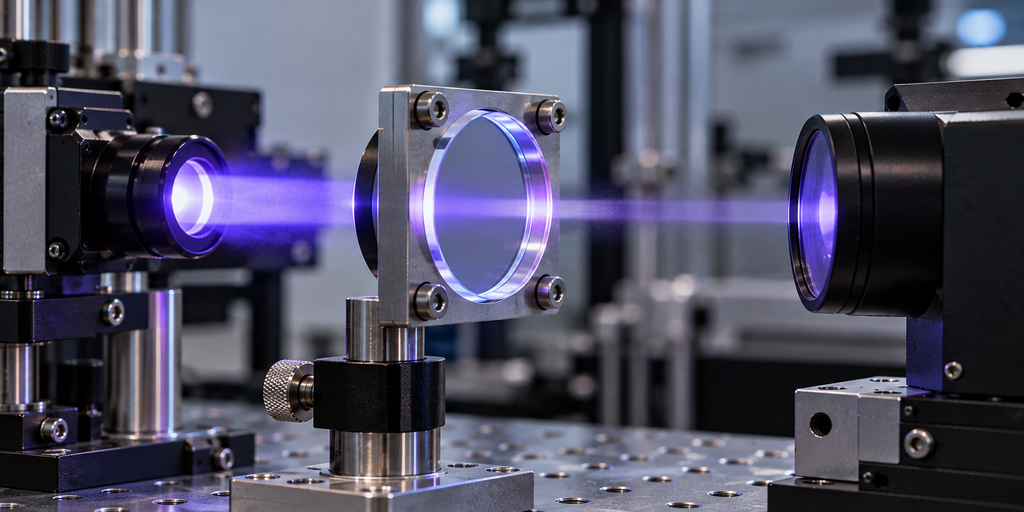
When specifying sapphire for UV equipment, engineers should consider:
- Target wavelength
- Required transmission
- Sapphire material grade
- Crystal quality
- Window thickness
- Crystal orientation
- Surface roughness
- Scratch-dig
- Flatness
- Parallelism
- AR coating
- Environmental exposure
The correct specification depends on the complete optical system.
1. Why Use Sapphire for 200–400 nm Windows?
Several optical materials can transmit ultraviolet light.
Common choices include:
- Sapphire
- UV-grade fused silica
- Calcium fluoride
- Magnesium fluoride
Sapphire is often selected when the window must also survive harsh mechanical or environmental conditions.
Its advantages include:
- High surface hardness
- Strong resistance to scratching
- High mechanical strength
- Good chemical stability
- High-temperature capability
- Good thermal conductivity
- Broad optical transmission
- Good resistance to particle erosion
This makes sapphire particularly useful for UV systems exposed to:
- Industrial environments
- High pressure
- Abrasive particles
- Repeated cleaning
- High temperature
- Outdoor exposure
- Chemical processes
Typical applications include:
- UV sensors
- UV spectrometers
- Flame detectors
- UV imaging systems
- UV curing equipment
- Plasma monitoring
- Combustion monitoring
- Environmental sensors
- Industrial analytical instruments
2. The 200–400 nm Range Is Not One Uniform Optical Region
It is useful to divide the UV range into smaller sections.
315–400 nm
This is the UVA region.
Sapphire normally performs relatively well here, and material quality requirements are generally less demanding than at shorter wavelengths.
Typical applications include:
- 365 nm UV curing
- Fluorescence excitation
- UV LEDs
- Imaging systems
- Inspection equipment
280–315 nm
This corresponds broadly to the UVB region.
Material absorption becomes more important, and window thickness and material purity deserve more attention.
200–280 nm
This includes much of the UVC and deep-UV region.
Here, sapphire quality becomes increasingly important.
Small amounts of impurities, oxygen vacancies or other crystal defects can cause additional absorption.
This is why two sapphire windows with identical dimensions may show noticeably different transmission around 200–240 nm.
3. Transmission Loss Is Not Caused Only by the Material
When engineers see lower-than-expected UV transmission, they sometimes assume that the sapphire material itself is absorbing too much light.
In reality, total transmission loss can come from several sources:
- Bulk absorption
- Surface reflection
- Crystal impurities
- Lattice defects
- Surface roughness
- Contamination
- Coating loss
- Excessive thickness
These factors should be separated during optical troubleshooting.
For example, a high-quality sapphire substrate may still show disappointing system transmission if both surfaces are uncoated and the optical design is sensitive to reflection loss.
Conversely, a good AR coating cannot compensate for strong bulk absorption caused by poor crystal quality.
4. Crystal Purity Becomes More Important Near 200 nm
Deep-UV transmission is especially sensitive to the quality of the sapphire crystal.
Trace impurities can create absorption bands that are much less obvious in visible or infrared applications.
Potential contributors include:
- Titanium
- Iron
- Chromium
- Carbon-related contamination
- Oxygen vacancy defects
- Growth-related defects
A sapphire material that appears perfectly transparent to the human eye can still have measurable absorption in the deep-UV region.
For demanding systems, visual inspection alone is therefore not sufficient.
Transmission should be specified at the actual working wavelength.
Instead of requesting:
“High-transmission sapphire”
a better RFQ would state:
“Transmission required at 220 nm”
or:
“Transmission spectrum required from 200 to 400 nm.”
5. Crystal Growth Conditions Affect UV Performance
Sapphire can be manufactured using several crystal-growth methods.
Different growth conditions can affect:
- Purity
- Internal stress
- Dislocation density
- Vacancy concentration
- Optical absorption
For ordinary mechanical windows, these differences may not matter very much.
For deep-UV applications, they can become important.
This is why a supplier should not select sapphire for a 200 nm optical system using only mechanical criteria such as diameter and thickness.
The optical requirement should be included when the raw material is selected.
6. Window Thickness Directly Affects UV Transmission
If the sapphire has any bulk absorption at the target wavelength, increasing thickness increases the optical path length through the material.
A 5 mm thick sapphire window may therefore show more absorption than a 1 mm window made from the same crystal.
This becomes especially important near the short-wavelength transmission edge.
Thickness selection should balance:
- Mechanical strength
- Pressure requirement
- Window diameter
- Optical transmission
- Flatness
- Mounting design
Sapphire’s high mechanical strength can be useful because it may allow a thinner optical window than some conventional glasses.
However, thickness should never be reduced without checking pressure, mounting and safety requirements.
7. Surface Reflection Is Another Important Loss
Sapphire has a relatively high refractive index.
As a result, an uncoated sapphire window can lose a noticeable amount of light through Fresnel reflection at the two air-to-sapphire interfaces.
For some UV detection systems, this loss is acceptable.
For systems requiring maximum signal, AR coating may be required.
This is particularly relevant for:
- Low-light UV detection
- Spectroscopy
- Fluorescence systems
- UV imaging
- Precision photometry
- Long optical paths
It is therefore important to distinguish bulk transmission from total window transmission.
These are not the same specification.
8. Surface Roughness Matters More at Short Wavelengths
Surface roughness causes optical scatter.
At shorter wavelengths, the same physical surface irregularity becomes more significant relative to the wavelength of light.
This means a surface finish that is acceptable in the infrared may not be acceptable for a deep-UV optical system.
For UV sapphire windows, surface roughness should be considered when the system requires:
- Low scatter
- High image contrast
- Precision spectroscopy
- Laser transmission
- Low stray light
For ordinary protective UV sensor windows, extremely low roughness may not always be necessary.
The specification should match the application rather than simply requesting the tightest possible value.
9. Scratch-Dig Should Match the Application
Scratch-dig describes visible surface defects such as scratches and pits.
Typical optical specifications may include:
- 80-50
- 60-40
- 40-20
- 20-10
A simple industrial UV detector may not require 20-10 surface quality.
However, a precision imaging or laser system may require tighter control.
Over-specifying scratch-dig can increase manufacturing cost without creating a meaningful improvement in system performance.
Before choosing a value, consider whether the system is sensitive to:
- Scatter
- Image artifacts
- Laser damage
- Stray light
- Cosmetic appearance
10. Flatness and Parallelism Can Affect UV Optical Systems
A sapphire window installed in front of a detector is not always optically neutral.
If the surfaces are not sufficiently flat or parallel, the window may introduce:
- Beam deviation
- Wavefront distortion
- Focus shift
- Ghost reflections
- Image distortion
For a basic photodiode detector, these effects may be insignificant.
For UV imaging, laser systems, spectroscopy and interferometry, flatness and parallelism can become important design parameters.
The required values should therefore be based on the complete optical path.
11. Sapphire Is Birefringent
Single-crystal sapphire is an anisotropic optical material.
This means its refractive index depends partly on crystal direction and polarization.
For many ordinary UV sensor windows, birefringence is not a major concern.
For precision systems, it may influence:
- Polarization
- Phase
- Image quality
- Spectroscopic measurements
In such applications, crystal orientation should be specified.
C-plane sapphire is commonly selected for optical windows when controlled orientation is required.
For non-polarization-sensitive industrial applications, other orientations may also be acceptable depending on the design.
12. UV AR Coatings Are More Difficult Than Visible Coatings
Anti-reflection coatings for deep-UV sapphire windows can be more challenging than coatings for visible or near-IR applications.
The coating must provide:
- Low reflection at short wavelengths
- Good adhesion
- Low absorption
- Environmental durability
- Thermal stability
Material choices become more limited as the wavelength becomes shorter.
A coating designed for 350–400 nm may not provide good performance at 220 nm.
This is one reason a customer should never request simply:
“UV AR coating.”
Instead, specify the actual wavelength or wavelength range.
Examples include:
AR coating optimized for 355 nm
AR coating for 250–280 nm
Broadband AR coating for 300–400 nm
These are very different coating designs.
13. Broadband 200–400 nm Coating Is Particularly Challenging
A single broadband coating covering the entire 200–400 nm range can be difficult to optimize.
The wavelength ratio between 200 nm and 400 nm is large.
Coating materials that perform well at longer UV wavelengths may introduce absorption or durability issues at the short-wavelength end.
For many systems, it is more practical to optimize the coating around a narrower operating band.
For example:
- 220–260 nm
- 280–320 nm
- 340–400 nm
This can provide better optical performance than trying to maximize transmission across the full 200–400 nm range.
14. Coating Durability Must Be Considered
One of sapphire’s main advantages is its extremely hard surface.
However, an AR coating is normally softer and less chemically robust than the underlying sapphire.
This matters when the window is exposed to:
- Abrasive cleaning
- Dust
- Outdoor weather
- Chemicals
- Repeated wiping
- Particle impact
In some harsh environments, an uncoated sapphire window may provide better long-term reliability even if reflection loss is higher.
Another option is to coat only the protected internal surface while leaving the exposed surface uncoated.
This preserves the abrasion resistance of sapphire on the environmental side while improving transmission through the protected side.
15. Surface Contamination Can Strongly Affect Deep-UV Transmission
Deep-UV systems are particularly sensitive to contamination.
Even a thin layer of:
- Oil
- Fingerprints
- Organic residue
- Cleaning residue
- Dust
- Hydrocarbon film
can absorb or scatter UV light.
A window may therefore meet the optical specification when new but show reduced transmission after installation.
Clean handling is especially important for wavelengths close to 200 nm.
Recommended practices may include:
- Clean-room handling where required
- Powder-free gloves
- Optical-grade cleaning materials
- Clean packaging
- Protection from organic contamination
16. Heat Treatment and Mounting Processes Need Attention
A sapphire window may undergo additional processing after polishing.
Examples include:
- Brazing
- Metal sealing
- Coating
- High-temperature assembly
- Bonding
For deep-UV applications, processing history can matter.
A manufacturing step that has little effect on visible transmission may influence defects or absorption near the UV edge.
This is another reason UV transmission should ideally be verified after all critical manufacturing steps when the application is highly demanding.
17. Sapphire vs UV-Grade Fused Silica
Sapphire is not automatically the best material for every UV system.
UV-grade fused silica often offers excellent deep-UV optical performance.
Sapphire becomes particularly attractive when the window also requires:
- High mechanical strength
- Scratch resistance
- Abrasion resistance
- High-temperature operation
- Harsh-environment durability
Choose sapphire when:
- Mechanical durability is critical
- Abrasion is present
- Window thickness must be minimized
- High temperature is involved
- Harsh chemical exposure exists
Consider UV-grade fused silica when:
- Deep-UV optical performance is the dominant requirement
- Mechanical loading is moderate
- Abrasion resistance is less important
- Extremely low UV absorption is required
The decision should be made at system level rather than based on transmission range alone.
18. Typical Applications for 200–400 nm Sapphire Windows
UV sapphire windows may be used in:
- Flame detectors
- UV photodiode housings
- UV spectroscopy
- Plasma diagnostics
- UV imaging systems
- Combustion monitoring
- UV LED systems
- Industrial curing equipment
- Environmental monitoring
- High-pressure UV sensors
- Chemical analysis instruments
Different applications require very different optical specifications.
A flame detector may prioritize durability and transmission.
A spectrometer may prioritize low scatter and spectral uniformity.
A laser system may prioritize wavefront quality and coating performance.
19. What Should Be Included in an RFQ?
For a custom UV sapphire window, buyers should ideally provide:
- Operating wavelength
- Wavelength range
- Minimum transmission requirement
- Diameter
- Thickness
- Clear aperture
- Crystal orientation
- Surface quality
- Surface roughness
- Flatness
- Parallelism
- Edge design
- AR coating requirement
- Operating temperature
- Pressure condition
- Environmental conditions
For demanding deep-UV applications, also consider requesting:
- UV transmission curve
- Material lot traceability
- Crystal quality information
- Coating spectral curve
- Inspection report
The more clearly the optical requirement is defined, the easier it is to select the correct sapphire material and manufacturing process.
20. Common Specification Mistakes
Mistake 1: Specifying Only “UV Sapphire”
This does not define whether the system operates at 220 nm, 280 nm or 365 nm.
Mistake 2: Assuming All Optical Sapphire Performs the Same Near 200 nm
Deep-UV transmission can vary with crystal quality and impurity level.
Mistake 3: Selecting Thickness Only for Mechanical Strength
Thickness also affects optical absorption.
Mistake 4: Requesting a Generic UV AR Coating
The coating should be designed for the actual wavelength.
Mistake 5: Ignoring Surface Roughness
Short-wavelength UV systems can be more sensitive to scatter.
Mistake 6: Ignoring Contamination
A clean sapphire window can perform very differently from one covered by a thin organic film.
Mistake 7: Over-Specifying Every Optical Parameter
Extremely tight flatness, scratch-dig and roughness may increase cost without improving a simple UV detector.
Conclusion
Sapphire is a valuable window material for 200–400 nm UV systems because it combines optical transmission with exceptional mechanical and environmental durability.
However, deep-UV performance depends on much more than the word “sapphire.”
The most important factors are:
Target wavelength + crystal quality + impurity level + thickness + surface finish + AR coating
For wavelengths near 200–240 nm, crystal quality and material purity become especially important.
At longer UV wavelengths such as 355 nm or 365 nm, sapphire selection is generally less sensitive, although reflection, coatings and surface quality still matter.
For custom UV sapphire windows, the best RFQ is therefore not:
“Need UV sapphire window.”
It is:
“Need sapphire window for a defined wavelength, transmission requirement, thickness, optical quality and operating environment.”
This gives the manufacturer enough information to select the correct sapphire grade, polishing specification and coating design.
TAGS: UV sapphire window, deep UV sapphire, 200 nm sapphire wind