
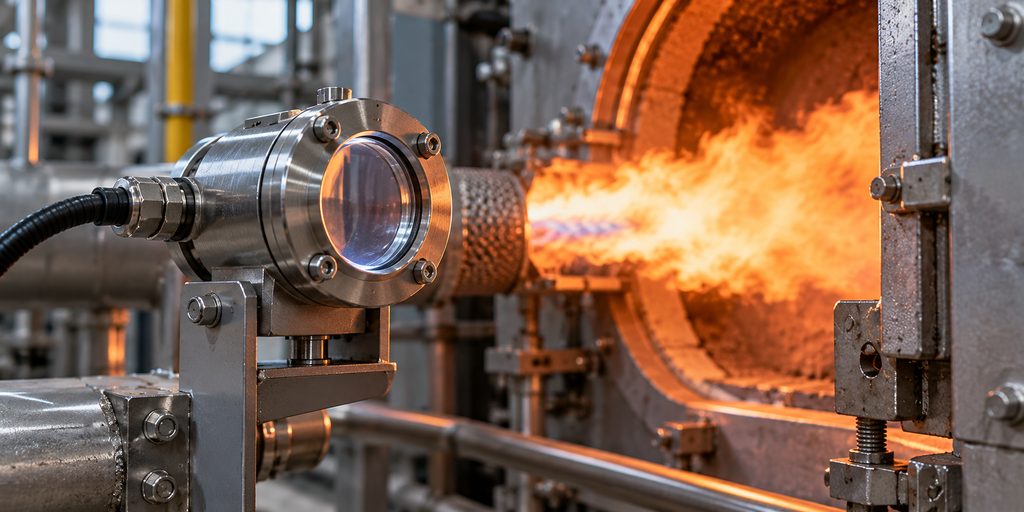
Flame detectors and combustion sensors rely on a clear optical path between the flame and the sensing element.
In industrial environments, however, the protective optical window may be exposed to high temperature, thermal cycling, soot, oil mist, dust, combustion particles, cleaning chemicals and mechanical abrasion.
For these applications, sapphire is an attractive protective-window material because it combines wide spectral transmission, high hardness, chemical resistance and good thermal stability.
However, selecting sapphire is not simply a matter of choosing a strong transparent material.
For a flame-detection system, the window must also transmit the exact wavelengths used by the sensor.
The main design questions are therefore:
- Which UV or IR wavelengths must pass through the window?
- How much transmission loss is acceptable?
- Will soot or process contamination block the signal?
- Should the sapphire be coated or uncoated?
- How should the window be cleaned?
- What thickness and mounting design are required?
1. Why Flame Detectors Use Different Spectral Bands
Industrial flame detectors do not all detect the same wavelengths.
Common detection architectures include:
- UV
- IR
- UV/IR
- Dual IR
- Multi-spectrum IR
- UV + visible + IR
Different fuels produce different optical signatures.
For example, some UV/IR flame detectors use a UV band around 185–260 nm together with an infrared channel around 4.3 µm.
Hydrogen flame detection may use a different infrared wavelength.
This creates an important requirement for the protective window:
The sapphire window must be specified according to the detector’s actual operating wavelength rather than simply described as a “UV/IR window.”
2. Why Sapphire Is Suitable for Flame Detector Windows
Optical-grade sapphire offers transmission from the deep ultraviolet region through the visible spectrum and into the mid-infrared.
Depending on material grade and thickness, high-quality sapphire can transmit from approximately 0.17 µm to beyond 5 µm.
This makes sapphire useful for detectors that require more than one wavelength band to pass through the same protective window.
Other useful properties include:
- High surface hardness
- Excellent abrasion resistance
- Good mechanical strength
- Chemical resistance
- High-temperature capability
- Good thermal conductivity
- Good environmental durability
These characteristics make sapphire particularly attractive for flame detectors installed close to furnaces, burners, petrochemical equipment and other harsh industrial environments.
3. UV Transmission: Sapphire Grade Matters
Some flame detectors operate in the solar-blind UV region.
This may include wavelengths below approximately 260 nm.
Although high-quality optical sapphire can transmit in this range, actual UV performance depends on several factors:
- Crystal quality
- Material purity
- Growth method
- Thickness
- Surface finish
- Coating
- Contamination
Not every sapphire window sold for industrial use is optimized for deep-UV transmission.
A supplier may offer a standard sapphire window intended mainly for visible or near-infrared applications.
For this reason, an RFQ for a UV flame detector should clearly specify the required wavelength range.
For example:
UV transmission requirement: 185–260 nm
This is more useful than simply writing:
UV sapphire window
4. IR Transmission for Combustion Sensors
Many combustion sensors and flame detectors also use infrared wavelengths.
Common monitoring regions may include approximately:
- 2.9 µm
- 3.0–3.5 µm
- 4.2–4.5 µm
These wavelength bands are useful for identifying combustion gases and flame signatures.
Optical sapphire can operate in these regions, but transmission should still be confirmed at the exact wavelength.
Important variables include:
- Window thickness
- Sapphire material grade
- Surface reflection
- Coating
- Temperature
A sapphire window that performs well in visible light should not automatically be assumed to meet a mid-IR detector specification.
5. Window Thickness Affects Both Strength and Transmission
A protective window must be mechanically strong enough for the detector housing and operating environment.
Thickness may therefore depend on:
- Window diameter
- Clear aperture
- Pressure differential
- Mechanical impact
- Housing geometry
- Environmental exposure
However, thicker is not always better.
Increasing thickness may:
- Increase optical absorption
- Increase weight
- Increase thermal mass
- Slow thermal response
Sapphire’s high mechanical strength can allow relatively thin protective windows compared with some conventional glass materials.
The correct thickness should therefore balance optical performance and mechanical reliability.
6. Surface Reflection Can Reduce Detector Signal
Even a perfectly clean sapphire window does not transmit 100% of incident light.
Part of the light is reflected at the front and rear surfaces.
For detectors receiving strong signals, this loss may be acceptable.
For applications requiring maximum detection distance or higher sensitivity, an anti-reflection coating may improve transmission.
However, the coating must be designed for the actual wavelength.
A coating optimized for 850 nm, for example, would not automatically improve transmission at 4.3 µm.
For UV/IR detectors, multiple wavelength bands may need to be considered during coating design.
7. Coated or Uncoated Sapphire?
AR coatings can improve optical transmission, but they introduce another surface layer that must survive the operating environment.
Flame detector windows may be exposed to:
- Soot
- Dust
- Oil mist
- Rain
- Salt spray
- Cleaning fluids
- Repeated wiping
- Temperature cycling
In some harsh environments, an uncoated sapphire window may provide better long-term durability even if its theoretical transmission is slightly lower.
The decision should balance:
Maximum optical transmission
versus
Long-term surface durability
For systems that require frequent cleaning, this can become an important consideration.
8. High Temperature Is Not the Only Thermal Problem
Sapphire can tolerate high temperatures.
However, the complete detector window assembly may contain:
- Metal housing
- O-rings
- Adhesive
- Brazed joints
- Retaining rings
- Optical coatings
These components may have lower operating-temperature limits than the sapphire itself.
The complete assembly should therefore be evaluated rather than focusing only on the sapphire substrate.
Important thermal factors include:
- Continuous operating temperature
- Short-term radiant heat
- Thermal cycling
- Local hot spots
- Housing temperature
- Differential thermal expansion
9. Thermal Gradients Can Create Mechanical Stress
A sapphire window installed close to a burner may experience very different temperatures on its two surfaces.
The front surface may receive strong radiant heat from the flame.
The rear surface may be cooled by:
- Ambient air
- Sensor housing
- Purge air
- Heat sinking
This creates a temperature gradient through the sapphire window.
The effect can become more important when:
- The window is thick
- The flame is close
- Temperature changes rapidly
- The housing strongly cools the edge
- Purge air contacts one surface
The mounting structure should therefore allow for reasonable thermal expansion rather than clamping the sapphire too rigidly.
10. Soot Can Reduce Detection Performance
One of the most common real-world problems is not sapphire breakage.
It is surface contamination.
Soot, oil mist, dust and combustion deposits can gradually cover the window.
The sapphire itself may remain mechanically undamaged while optical transmission decreases.
Possible consequences include:
- Reduced detector sensitivity
- Shorter detection distance
- Lower signal-to-noise ratio
- False maintenance alarms
- Delayed flame recognition
This means window cleanliness is part of the detector’s optical performance.
11. Dirty Windows Can Reduce Detection Distance
A flame detector is designed assuming that UV or IR radiation can reach the optical sensor.
If part of the window becomes covered with soot or deposits, the field of view may become partially blocked.
Even a thin film can reduce transmission.
For this reason, detector manufacturers commonly recommend periodic inspection and cleaning of protective optical windows.
In severe environments, maintenance frequency should be based on actual contamination rather than a fixed annual schedule.
12. How Often Should a Sapphire Window Be Cleaned?
There is no universal cleaning interval.
Cleaning frequency depends on:
- Soot concentration
- Fuel type
- Burner condition
- Dust
- Oil mist
- Outdoor exposure
- Process environment
- Purge-air effectiveness
A relatively clean outdoor flame detector may require little maintenance.
A detector installed near a combustion chamber may require much more frequent inspection.
The best approach is to establish a maintenance interval based on actual detector performance and contamination rate.
13. Cleaning Method Matters
Sapphire is extremely hard, but correct cleaning is still important.
The window may include an AR coating that is less durable than the sapphire substrate.
Recommended cleaning practices generally include:
- Use clean lint-free wipes
- Remove loose particles before wiping
- Use compatible optical cleaning fluids
- Avoid contaminated cloths
- Avoid aggressive abrasive compounds
- Dry the surface completely
Fingerprints, cleaning residue and oil films can also affect optical transmission.
For coated sapphire windows, the coating supplier’s cleaning recommendations should be followed.
14. Purge Air Can Help Prevent Soot Buildup
In highly contaminated environments, preventing deposits may be more effective than repeatedly cleaning the window.
A clean-air purge can create a protective airflow across the sapphire surface.
This may reduce:
- Soot
- Dust
- Smoke particles
- Oil mist
- Condensation
However, purge-air design should also consider thermal effects.
Very cold purge air directed onto a hot sapphire window can create a strong local temperature gradient.
The purge system should therefore be designed together with the window assembly.
15. Surface Quality Requirements
Not every flame detector requires extremely high optical surface specifications.
However, poor surface quality can increase:
- Scatter
- Stray light
- Signal loss
Typical specifications may include:
- Scratch-dig
- Surface roughness
- Flatness
- Parallelism
- Clear aperture
Simple UV or IR flame detection may tolerate more relaxed optical specifications than precision laser or imaging systems.
Over-specifying optical quality can unnecessarily increase cost.
16. Crystal Orientation
Sapphire is an anisotropic crystalline material.
For many industrial flame detectors, crystal orientation may not significantly affect system performance.
However, orientation may become important when the sensor involves:
- Polarization
- Precision imaging
- Spectroscopy
- Laser measurement
In these cases, the required sapphire orientation should be specified in the RFQ.
17. When Should the Sapphire Window Be Replaced?
A protective sapphire window should not be replaced simply because it has been installed for a certain number of years.
Replacement should be considered when there is:
- Cracking
- Significant edge chipping
- Permanent surface damage
- Severe scratching
- AR coating failure
- Chemical attack
- Deposits that cannot be removed
- Persistent detector sensitivity loss after cleaning
In many cases, contamination can be removed and the sapphire window can continue to be used.
Inspection and cleaning should therefore normally be performed before replacing an otherwise undamaged window.
18. What Should Be Included in an RFQ?
For a custom sapphire window used in a flame detector or combustion sensor, the RFQ should ideally include:
- Window diameter
- Thickness
- Shape
- Clear aperture
- UV wavelength
- IR wavelength
- Required transmission
- Sapphire orientation
- Surface quality
- Flatness
- Parallelism
- Edge design
- AR coating requirement
- Operating temperature
- Housing material
- Environmental conditions
- Cleaning method
For a UV/IR detector, specify both spectral bands.
For example:
UV: 185–260 nm
IR: 4.35 µm
This is much clearer than simply requesting:
UV/IR sapphire window
Conclusion
Sapphire is an excellent protective-window material for flame detectors and combustion sensors because it combines:
Broad UV-to-IR transmission
High surface hardness
Chemical resistance
Mechanical strength
High-temperature capability
However, successful detector performance depends on more than the sapphire material itself.
The most important factors are:
Detector wavelength + window thickness + surface coating + operating temperature + soot contamination + cleaning method
In many industrial environments, the sapphire window does not fail mechanically.
Instead, soot, oil or particulate buildup gradually reduces optical transmission.
Regular inspection, appropriate cleaning and correct wavelength specification are therefore essential for maintaining reliable flame detection.