
1. Introduction
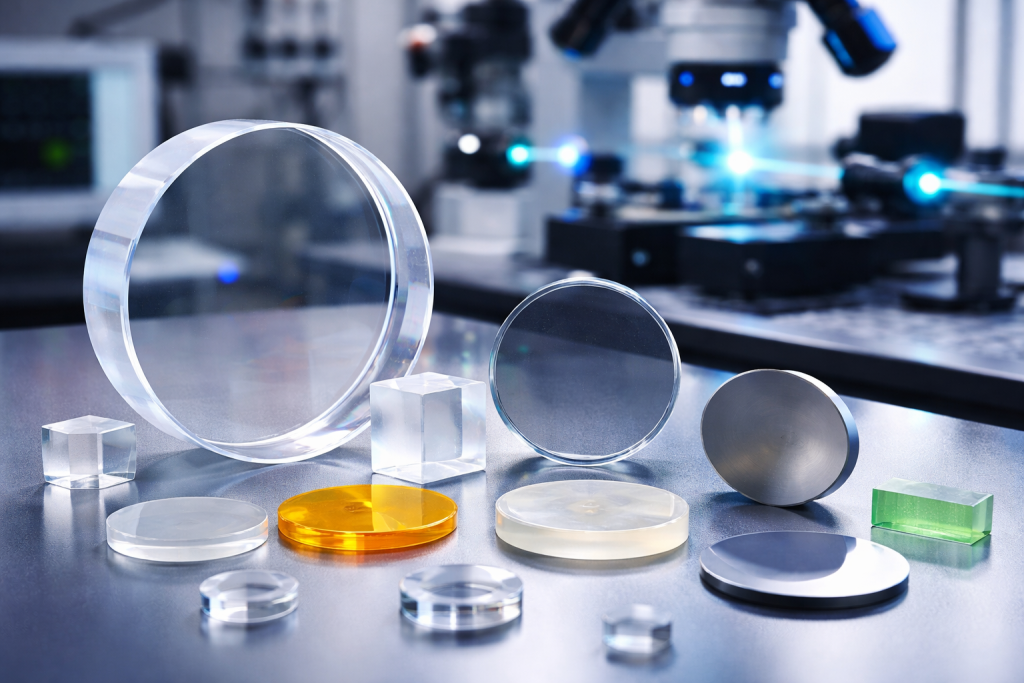
Optical window materials are critical components in modern optical and photonic systems, including laser engineering, infrared imaging, aerospace instrumentation, semiconductor equipment, and industrial inspection systems.
Their primary role is not only to transmit light with minimal loss, but also to physically isolate sensitive internal environments from extreme external conditions such as high temperature, pressure, radiation, or chemical exposure.
Because each material exhibits distinct optical transmission ranges and physical properties, correct material selection directly determines system performance, reliability, and lifetime.
2. Fused Silica (Quartz)
Fused Silica (Quartz) is one of the most widely used optical window materials due to its excellent UV transparency and mature manufacturing process.
Optical Characteristics
- Transmission range: ~180 nm – 2500 nm (UV to near-infrared)
Advantages
- Excellent ultraviolet transmission, ideal for UV optical systems
- Low thermal expansion, strong resistance to thermal shock
- High chemical stability against acids and most corrosive environments
- Mature processing technology and relatively low cost
Limitations
- Limited performance in mid-to-far infrared range
- Moderate hardness, susceptible to surface scratching
- Thermal distortion may occur under high-power laser exposure
Typical Applications
UV lithography systems, laboratory optics, and standard laser window protection
3. Sapphire (Al₂O₃)
Sapphire (Aluminum Oxide) is a premium optical material widely used in extreme environments.
Optical Characteristics
- Transmission range: ~150 nm – 5500 nm (deep UV to mid-IR)
Advantages
- Extremely high hardness (second only to diamond)
- Outstanding high-temperature resistance
- Excellent impact and wear resistance
- Strong chemical inertness
Limitations
- Optical anisotropy (birefringence effects)
- Difficult and costly machining process
- Limited availability of large-sized crystals
Typical Applications
Aerospace viewing windows, deep-sea equipment, high-pressure sensors, and laser protection systems
4. Optical Glass (BK7)
BK7 Optical Glass is one of the most common commercial optical glass materials used in visible-light systems.
Optical Characteristics
- High transparency in the visible spectrum with stable performance
Advantages
- Low cost and easy to manufacture
- High optical homogeneity
- Suitable for mass production
Limitations
- Poor thermal stability under harsh environments
- Limited resistance to impact and mechanical stress
- Not suitable for high-temperature applications
Typical Applications
Camera lenses, microscopes, and general optical instruments
5. Infrared Optical Materials
5.1 Zinc Selenide (ZnSe)
Zinc Selenide (ZnSe) is widely used in infrared optical systems.
- Transmission range: ~0.6–20 μm
- Excellent infrared transmission performance
Advantages
- High IR transparency
- Suitable for CO₂ laser systems
Limitations
- Soft material, easily scratched
- Requires protective coatings
- Relatively high cost
5.2 Germanium (Ge)
Germanium (Ge) is a key material for thermal imaging systems.
Advantages
- Excellent performance in 8–12 μm range
- High refractive index, beneficial for imaging design
Limitations
- High density (heavy components)
- Temperature-sensitive optical properties
- Expensive compared to alternatives
5.3 Silicon (Si)
Silicon (Si) is widely used in industrial infrared applications.
Advantages
- Good performance in 1.2–8 μm range
- Strong mechanical stability
- Cost-effective compared to Ge and ZnSe
Limitations
- Opaque in visible spectrum
- Performance variation at elevated temperatures
6. Silicon Carbide (SiC)
Silicon Carbide (SiC) is an advanced structural and optical material designed for extreme environments.
Optical Characteristics
- Broad potential optical applicability under harsh conditions
Advantages
- Extremely high thermal conductivity
- Outstanding stiffness and mechanical strength
- Exceptional thermal shock resistance
- Suitable for high-power optical systems
Limitations
- Extremely difficult to machine
- High production cost
- Complex fabrication of optical-grade surfaces
Typical Applications
Aerospace optical systems, high-power laser windows, and precision industrial equipment
7. Material Selection Logic
Selecting an appropriate optical window material requires balancing multiple engineering factors:
- Operating wavelength range (UV / visible / infrared)
- Environmental conditions (temperature, pressure, corrosion)
- Mechanical requirements (impact resistance, hardness, durability)
- Cost and manufacturability
Practical Selection Guidelines
- UV systems → Fused Silica
- Extreme mechanical/thermal environments → Sapphire or SiC
- Infrared systems → ZnSe, Ge, or Si
- General visible optics → BK7
8. Future Development Trends
The evolution of optical window materials is driven by next-generation technologies such as aerospace exploration, semiconductor scaling, and high-power laser systems.
Key trends include:
- Expansion of ultra-wide spectral transmission capabilities
- Higher crystal purity with fewer internal defects
- Improved cost-efficiency in precision machining
- Growth in advanced ceramics like sapphire and SiC for extreme applications
9. Conclusion
There is no universal “best” optical window material—only the most suitable choice for a specific application.
As system requirements become increasingly demanding, materials such as Sapphire (Aluminum Oxide) and Silicon Carbide (SiC) are gaining rapid importance due to their unmatched performance in extreme environments.
The future of optical window technology will be defined by broader spectral coverage, higher material purity, and more advanced low-cost manufacturing technologies.