
Sapphire windows are selected for demanding optical and mechanical applications because of their high hardness, excellent wear resistance, chemical stability, and ability to maintain optical performance in harsh environments.
However, sapphire is also a hard and relatively brittle crystalline material. For this reason, the geometry around the edge of a sapphire window can have a significant influence on handling safety, installation reliability, edge chipping, mechanical strength, clear aperture, and manufacturing cost.
When ordering a custom сапфировое окно, buyers often focus on parameters such as:
- diameter or length and width
- thickness
- surface flatness
- parallelism
- surface quality
- crystal orientation
- coating
- чистый диаметр
But the drawing may contain only a vague note such as:
“Break sharp edges.”
For simple applications, this may be acceptable. For precision housings, pressure windows, sensor covers, laser windows, or sapphire components that must survive repeated assembly, a more clearly defined edge specification is usually preferable.
This guide explains the differences between chamfers, bevels, radiused edges and edge thickness, and shows how these parameters can be specified when sourcing custom sapphire windows.
1. Why Does Sapphire Window Edge Geometry Matter?
The polished optical surfaces of a sapphire window receive most of the attention, but the outer edge often experiences the highest mechanical stress during:
- machining
- cleaning
- packaging
- transportation
- manual handling
- installation
- clamping
- thermal cycling
- impact
- housing assembly
An untreated 90-degree edge can be vulnerable to small chips and micro-damage.
Even if a small chip does not immediately affect the optical clear aperture, it can create several problems.
These may include:
- reduced cosmetic quality
- particles entering an optical assembly
- difficulty fitting the window into a housing
- localized stress concentration
- reduced mechanical reliability
- propagation of cracks under load
- coating damage near the edge
Appropriate edge finishing helps reduce these risks.
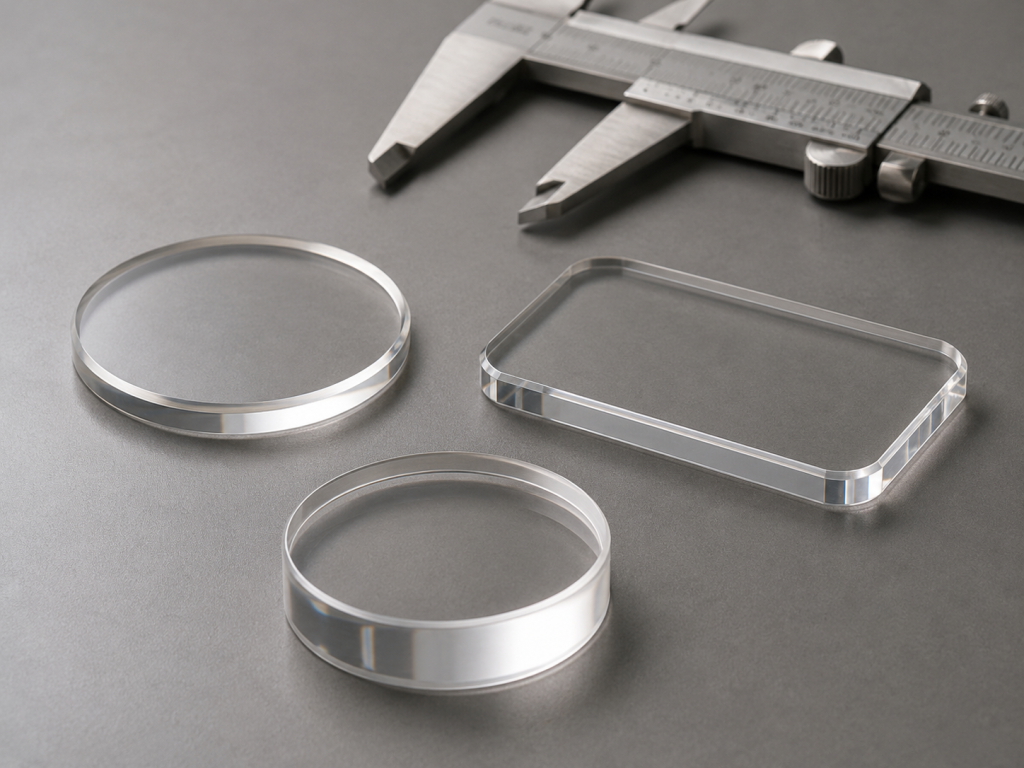
2. What Is a Chamfer on a Sapphire Window?
A chamfer is a flat surface produced by removing the sharp intersection between two adjacent surfaces.
For a conventional circular sapphire window, a chamfer may be applied around the circumference where the polished face meets the cylindrical outer diameter.
A common drawing format might look like:
C0.2 × 45°
This indicates a small flat chamfer at approximately 45 degrees.
Another drawing may specify:
0.2 mm max edge break
depending on how tightly the feature needs to be controlled.
The main purposes of a chamfer are usually to:
- remove sharp edges
- reduce edge chipping
- improve handling
- simplify assembly
- prevent interference with housing corners
- reduce stress concentration at the edge
Chamfers are widely used because they are relatively straightforward to manufacture and inspect.
3. What Is a Bevel?
In practical optical manufacturing, the terms bevel и chamfer are sometimes used interchangeably.
Both normally refer to a flat angled edge produced between two surfaces.
However, depending on the supplier, drawing convention, or industry, “bevel” may be used more broadly for an intentionally angled peripheral edge, while “chamfer” may refer to a smaller edge break.
Because terminology is not always consistent between manufacturers, buyers should avoid relying on the word alone.
Instead of writing:
Edge: beveled
a better specification is:
Edge bevel: 0.30 ±0.10 mm × 45°
This defines the actual geometry.
For optical components, a bevel may also protect the polished surface from edge damage during coating, cleaning and assembly.
4. Chamfer vs Bevel: Is There Really a Difference?
There is no universally reliable distinction that every optical supplier follows.
In many sapphire machining quotations:
Chamfer ≈ Bevel
The important information is therefore not the terminology but the dimensions.
A purchasing drawing should preferably define:
- bevel/chamfer width
- angle
- tolerance
- whether it applies to one side or both sides
- whether the feature runs around the complete perimeter
Например:
Both optical faces: 0.20–0.30 mm × 45° chamfer, full perimeter
is much clearer than:
Edges beveled.
5. What Is a Radiused Edge?
Instead of creating a flat angled surface, a sapphire edge can sometimes be finished with a rounded profile.
This is called a radius или radiused edge.
Например:
R0.3
means that the edge transition is designed with an approximately 0.3 mm radius.
A radius eliminates the sharp corner more gradually than a chamfer.
Radiused edges can be useful where:
- the part is frequently handled
- smooth contact with another component is important
- localized stress should be reduced
- the component needs a smooth external profile
- the sapphire part is exposed rather than fully enclosed
However, radius machining may be more complex than a simple chamfer, particularly when tight profile tolerances or polished curved surfaces are required.
For many conventional optical windows, a small bevel remains the more economical solution.
6. Chamfer vs Radius: Which Is Better?
Neither design is automatically better.
The correct choice depends on the assembly and mechanical requirement.
| Тип кромки | Main Advantage | Typical Consideration |
|---|---|---|
| Sharp edge | Maximum face area | Higher chipping risk |
| Small chamfer | Economical edge protection | Reduces usable face slightly |
| Large chamfer | Strong edge protection and easier assembly | May reduce clear aperture |
| Radius | Smooth transition and contact | More complex machining |
| Custom contour | Optimized for housing geometry | Higher manufacturing complexity |
For a standard sapphire protection window, a small chamfer is often sufficient.
For exposed covers, wearable components or mechanically loaded sapphire parts, a radius may offer advantages.
7. Why Sharp Sapphire Edges Can Be Risky
Sapphire has excellent hardness, but hardness should not be confused with resistance to all forms of damage.
A perfectly sharp sapphire edge creates a very small contact area.
During handling or assembly, force can therefore become concentrated at the edge.
Possible results include:
- edge chips
- corner chips
- microcracks
- fractures originating at the perimeter
This becomes particularly important for rectangular and square sapphire windows because their corners may experience even higher localized stress.
For this reason, rectangular sapphire windows often use:
- corner radius
- edge chamfer
- both corner radius and face-edge chamfer
depending on the housing design.
8. Corner Radius on Rectangular Sapphire Windows
For rectangular sapphire windows, there are actually two different radius concepts that should not be confused.
Face Edge Radius
This rounds the intersection between the optical face and the side wall.
Plan-View Corner Radius
This rounds the four outer corners of a rectangular part when viewed from above.
Например:
100 × 60 × 2 mm, 4 × R2 corners
means the rectangular sapphire window has four 2 mm corner radii.
Corner radii may be useful because they:
- improve installation into machined housings
- reduce sharp corner damage
- reduce stress concentration
- simplify gasket design
- reduce the possibility of corner chipping
If a rectangular housing already has an internal machining radius, adding compatible sapphire corner radii can also prevent interference.
9. What Is Sapphire Window Edge Thickness?
Edge thickness generally refers to the remaining material thickness near the outer perimeter after edge features such as bevels or chamfers have been produced.
For a simple plane-parallel window with only very small symmetrical bevels, the concept may not require a separate drawing dimension.
However, edge thickness becomes important when the window has:
- large chamfers
- tapered geometry
- wedge
- curved surfaces
- stepped edges
- recessed surfaces
- custom mechanical interfaces
For mechanically loaded windows, ensuring sufficient material remains at the edge can be particularly important.
A very large bevel on a thin sapphire window may leave a narrow edge section that is more difficult to manufacture and handle reliably.
10. Bevel Size vs Window Thickness
The bevel should be designed in proportion to the total thickness of the sapphire window.
For example, a 0.2 mm bevel may be relatively small on a 5 mm thick window but significant on a 0.5 mm thick sapphire plate.
This is particularly important for:
- thin sapphire covers
- miniature sensor windows
- watch-related sapphire components
- semiconductor optical components
- small laser windows
When the part is very thin, an oversized chamfer may:
- significantly reduce the usable surface
- make edge thickness difficult to control
- increase breakage during processing
- increase manufacturing cost
Therefore, edge geometry should always be considered together with the total window thickness.
11. How Edge Geometry Affects Clear Aperture
The clear aperture defines the usable optical region of a sapphire window.
A bevel occupies part of the outer area and therefore reduces the available full-thickness optical surface near the perimeter.
For example, consider a circular sapphire window with:
Diameter: 50 mm
and a relatively wide edge bevel.
The entire 50 mm diameter should not automatically be considered usable optical aperture.
A practical drawing might therefore specify:
Clear Aperture: Central ≥90% of diameter
This allows edge finishing, coating transitions and mounting contact to remain outside the critical optical region.
For precision imaging or laser applications, the relationship between:
- outer dimensions
- edge bevel
- coating aperture
- mechanical mounting area
- optical clear aperture
should be considered together.
12. Edge Geometry and Sapphire Window Mounting
The edge design should also match the housing.
К распространенным способам крепления относятся:
- retaining rings
- elastomer O-rings
- compression seals
- adhesive bonding
- metal frames
- threaded retainers
- mechanical clamps
A sharp corner contacting a metal housing can produce localized stress.
A small chamfer may reduce this risk.
However, the chamfer must not interfere with the sealing surface.
For example, if an O-ring must contact the outer face of a sapphire window, an excessively large bevel may reduce the available sealing width.
For this reason, mechanical drawings should clearly identify:
- optical aperture
- sealing area
- clamping area
- bevel area
rather than treating the entire sapphire surface as interchangeable.
13. Edge Geometry for Pressure Sapphire Windows
Sapphire windows used in pressure or vacuum environments require more careful mechanical analysis.
Примеры включают:
- high-pressure observation ports
- vacuum chambers
- underwater sensors
- industrial process equipment
- aerospace optical housings
For these applications, window strength does not depend only on sapphire material properties.
Performance can also be affected by:
- window diameter
- thickness
- support diameter
- pressure differential
- edge condition
- mounting method
- surface defects
- термическая нагрузка
- safety factor
A larger bevel is not automatically stronger.
Removing too much material near the supported edge may actually change the stress distribution.
Therefore, pressure-loaded sapphire windows should be designed based on the complete mechanical assembly rather than selecting an edge geometry independently.
14. Ground Edge vs Polished Edge
Another specification that buyers should consider is the surface finish of the peripheral edge.
Ground Edge
A ground outer edge is commonly sufficient when the perimeter is hidden inside a mechanical housing.
Advantages include:
- lower cost
- practical dimensional control
- suitable for most mechanical mounting
Polished Edge
A polished edge may be requested when:
- the edge remains visible
- optical transmission through the side surface is required
- cosmetic appearance is important
- contamination or surface roughness must be minimized
- the component is used in a specialized optical path
However, polishing the outer diameter and bevel increases manufacturing effort.
For a conventional protection window mounted inside a metal housing, a polished peripheral edge is often unnecessary unless the application specifically requires it.
15. Edge Chipping Specification
For high-quality custom sapphire components, buyers may also specify allowable edge chips.
Instead of requiring an unrealistically perfect edge, the drawing may establish a defined acceptance limit.
Important parameters may include:
- maximum chip width
- maximum chip depth
- whether chips are permitted inside the clear aperture
- maximum number of chips
- critical versus non-critical edges
The appropriate acceptance criteria depend strongly on the application.
For a cosmetic sapphire cover, even very small visible chips may be unacceptable.
For an industrial protective window where the perimeter is hidden beneath a retaining ring, minor controlled edge imperfections outside the clear aperture may be acceptable.
16. Typical Edge Geometry Starting Points
There is no single universal bevel size for every sapphire window.
The following values are only illustrative starting points for RFQ discussion, not universal design standards.
| Sapphire Window Type | Possible Edge Starting Point |
| Small thin optical window | 0.1–0.2 mm chamfer |
| General optical window | 0.2–0.3 mm chamfer |
| Medium/thick mechanical window | 0.3–0.5 mm chamfer |
| Large protection window | Application-specific |
| Rectangular sapphire window | Chamfer + corner radius if required |
| Pressure window | Mechanical analysis required |
| Cosmetic/exposed sapphire | Controlled chamfer or radius |
The final value should depend on part thickness, dimensions, mounting method and mechanical loading.
17. Why Larger Chamfers Are Not Always Better
It may seem logical that a larger chamfer provides better protection.
But an unnecessarily large bevel can create disadvantages.
These include:
- reduced clear aperture
- reduced sealing area
- increased material removal
- greater machining time
- reduced edge thickness
- more difficult dimensional control
- increased cost
Therefore, sapphire window edge specifications should follow the same principle as other precision tolerances:
Specify what the application requires, not simply the tightest or largest feature available.
18. Edge Geometry and AR Coating
Edge geometry can also affect coating design.
For standard optical windows, AR coating is normally required on the primary optical surfaces, while the bevel and outer diameter may remain uncoated.
The drawing should clarify whether the coating applies to:
- full face
- clear aperture only
- bevel
- outer edge
In many applications, coating the bevel provides no optical benefit.
Masking or coating termination near the perimeter should therefore be discussed when cosmetic appearance or environmental durability is important.
19. Inspection of Sapphire Edge Geometry
Depending on tolerance, edge features can be inspected using:
- optical microscope
- profile projector
- vision measurement system
- dimensional microscope
- coordinate measurement equipment
- calibrated gauges
Inspection may confirm:
- chamfer width
- chamfer angle
- corner radius
- edge chips
- outer dimensions
- edge thickness
- cosmetic defects
For critical production parts, buyers may request a dimensional inspection report with shipment.
20. Example RFQ: Circular Sapphire Window
A practical specification might be:
Product: Custom Sapphire Window
Material: Single-Crystal Sapphire
Диаметр: 50.00 ±0.05 mm
Толщина: 2.00 ±0.05 mm
Orientation: C-plane
Surface Quality: 20-10 Scratch-Dig
Surface Flatness: λ/4 @ 632.8 nm
Parallelism: ≤30 arcsec
Edge: 0.20–0.30 mm × 45° chamfer on both faces
Outer Diameter Surface: Fine Ground
Clear Aperture: ≥90% of diameter
Coating: AR coating, both sides
Operating Wavelength: 1064 nm
Quantity: 50 pcs
Inspection: Dimensional and optical inspection report required
This specification clearly tells the manufacturer what kind of edge condition is expected.
21. Example RFQ: Rectangular Sapphire Window
For a rectangular sensor cover:
Material: Optical-Grade Sapphire
Dimensions: 80.00 × 50.00 mm
Толщина: 2.50 mm
Corner Radius: 4 × R2.0 mm
Face Edge Chamfer: 0.30 mm × 45°
Surface Quality: 40-20 Scratch-Dig
Flatness: λ/2
Clear Aperture: ≥90%
Edge Finish: Fine Ground
Coating: None
Application: Protective optical sensor window
Quantity: 100 pcs
In this case, both the corner radius and face chamfer are specified because they solve different mechanical problems.
22. Common Sapphire Edge Specification Mistakes
Writing Only “Break Sharp Edges”
This gives the manufacturer considerable freedom and may result in inconsistent edge sizes between production batches.
Using Chamfer and Radius Interchangeably
A chamfer is a flat angled surface. A radius is a curved transition.
They should be clearly distinguished on the drawing.
Ignoring the Clear Aperture
A large bevel may reduce the usable optical area.
Oversizing the Bevel on a Thin Window
Thin sapphire parts require careful edge design to maintain adequate material thickness.
Ignoring Housing Geometry
The sapphire edge should match the retaining ring, gasket, adhesive area or machined pocket.
Requiring Polished Edges Without a Functional Need
Edge polishing can add cost without improving performance if the perimeter is completely hidden inside the housing.
Omitting Corner Radii on Rectangular Parts
Sharp rectangular corners may be vulnerable during handling and may interfere with the internal radius of a machined pocket.
23. What Should Be Included in a Sapphire Window Drawing?
For a custom sapphire window, a complete drawing may include:
- material
- crystal orientation
- diameter or length × width
- thickness
- dimensional tolerances
- chamfer/bevel size
- bevel angle
- corner radius
- edge finish
- allowable edge chips
- surface flatness
- parallelism
- surface quality
- чистый диаметр
- coating
- coating aperture
- wavelength range
- quantity
- inspection requirements
Providing these details reduces interpretation differences between the buyer and sapphire manufacturer.
Заключение
Edge geometry is a small feature that can have a large influence on the reliability of a sapphire window.
A chamfer or bevel removes the fragile sharp edge using a flat angled surface and is often the most economical solution for general optical windows.
A radius creates a smoother curved transition and can be useful for exposed components, special mechanical interfaces and applications where sharp transitions should be minimized.
Edge thickness becomes especially important for thin windows, large bevels, wedged components and mechanically loaded sapphire parts.
The correct edge geometry should therefore be selected together with:
- window thickness
- чистый диаметр
- mounting design
- sealing method
- mechanical loading
- cosmetic requirements
- manufacturing capability
For custom sapphire windows, drawings should define actual dimensions rather than relying only on terms such as “beveled,” “rounded” or “break sharp edges.”
A clearly specified edge geometry helps reduce chipping risk, improves assembly consistency and allows the sapphire manufacturer to select an appropriate grinding, polishing and inspection process.
ЧАСТО ЗАДАВАЕМЫЕ ВОПРОСЫ
1. What is the difference between a chamfer and a bevel on a sapphire window?
In optical manufacturing, the terms are often used interchangeably for a flat angled edge. The safest approach is to specify the actual width, angle and tolerance rather than relying on terminology alone.
2. Does every sapphire window need a chamfer?
Not necessarily, but a small edge break is commonly recommended because a perfectly sharp sapphire edge can be more vulnerable to handling and assembly damage.
3. Is a larger sapphire bevel always better?
No. An oversized bevel can reduce clear aperture, sealing area and remaining edge thickness while increasing machining cost.
4. Should rectangular sapphire windows have corner radii?
Corner radii are often useful when the sapphire fits into a machined pocket, when edge durability is important, or when sharp corners could create handling problems. The correct radius depends on the housing design.
5. Should the outer edge of a sapphire window be polished?
Only when the application requires it. A fine-ground edge is usually sufficient for windows mounted inside housings, while polished edges may be appropriate for exposed, cosmetic or side-transmitting components.
6. What edge information should be included in an RFQ?
Provide the chamfer or bevel size, angle, corner radius if applicable, edge finish, allowable edge chips, window dimensions, thickness, clear aperture and mounting requirements.