
Sapphire windows are widely used in laser systems, imaging assemblies, optical sensors, high-pressure viewports, infrared instruments, and other applications where high mechanical strength and optical durability are required.
However, specifying only the diameter, thickness, surface quality, and flatness of a sapphire window is often not enough.
For applications involving collimated light, lasers, imaging paths, interferometry, or sensitive detectors, the relationship between the two optical surfaces can become equally important. Two specifications that frequently cause confusion are parallelism и wedge.
At first glance, they appear to describe opposite requirements:
- High parallelism means the front and rear surfaces should be as parallel as possible.
- Wedge means the two surfaces are intentionally or unintentionally tilted relative to each other.
In practice, both specifications describe the angular relationship between the two surfaces. The correct choice depends on whether the optical system needs to minimize beam deviation or deliberately separate unwanted reflections.
This guide explains how сапфировое окно parallelism and wedge affect beam direction, ghost reflections, imaging performance, laser systems, inspection, and RFQ specifications.
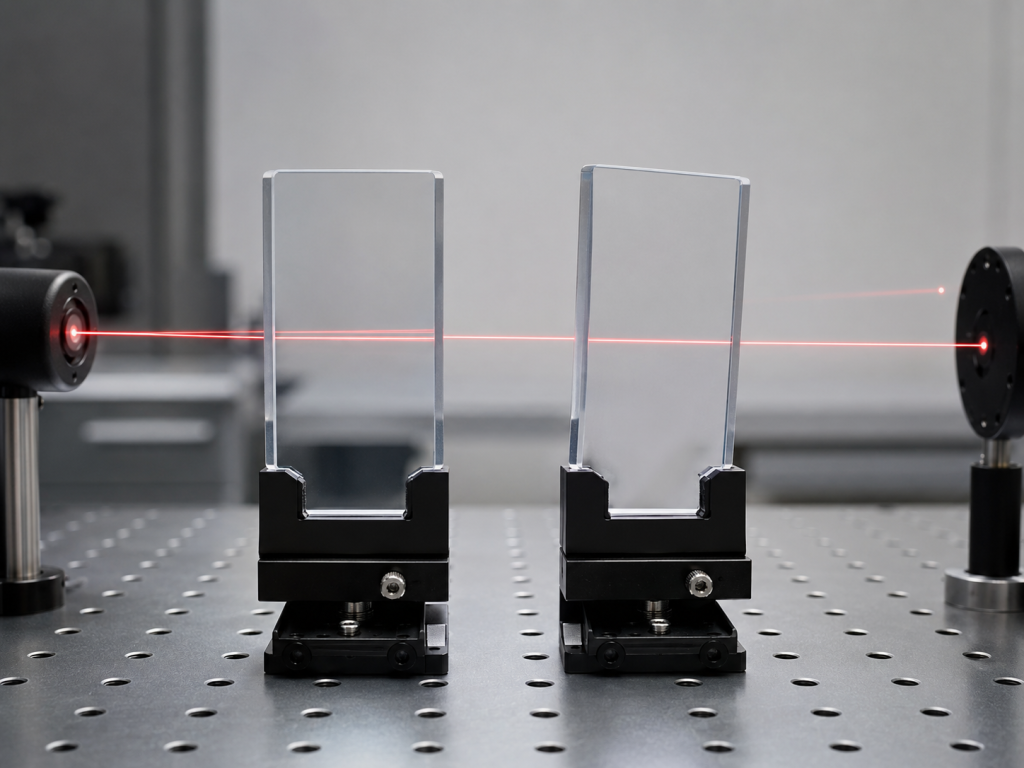
1. What Is Parallelism in a Sapphire Window?
Parallelism describes how closely the two major surfaces of a flat sapphire window remain parallel to each other.
If the front surface and rear surface are perfectly parallel, the angle between them is theoretically zero.
Real manufactured windows always have some residual angular difference. This may be specified in:
- degrees
- arcminutes
- arcseconds
For precision optical windows, arcminutes and arcseconds are normally more useful than degrees.
For example, a drawing might specify:
Surface Parallelism: ≤30 arcsec
This means the angular difference between the front and back surfaces must remain within 30 arcseconds.
From a geometrical perspective, the residual non-parallelism can also be considered a very small wedge.
Therefore, parallelism tolerance and wedge angle are closely related specifications rather than completely independent characteristics.
2. What Is Wedge?
Wedge is the intentional or residual angle between the two optical surfaces.
Instead of attempting to make both surfaces perfectly parallel, the manufacturer produces a controlled angle between them.
For a small wedge angle α, the angular deviation of a transmitted beam can be approximated by:
Beam deviation ≈ (n − 1) × α
where:
- n = refractive index of the optical material
- α = wedge angle
This small-angle relationship is commonly used for wedge prisms and shows why even a relatively small surface angle can steer a transmitted beam.
For sapphire, the exact optical behavior should be evaluated at the operating wavelength and with the specified crystal orientation because sapphire is an anisotropic crystalline material.
3. Parallelism vs Wedge: What Is the Practical Difference?
The easiest way to understand the difference is through the optical system requirement.
| Требование | High Parallelism | Controlled Wedge |
|---|---|---|
| Minimize transmitted beam angular deviation | Превосходно | Usually worse |
| Maintain optical axis alignment | Превосходно | Requires compensation |
| Reduce separated secondary images | Depends on system | Often better |
| Separate front/back surface reflections | Бедный | Превосходно |
| Reduce etalon interference | Less effective | Often preferred |
| Laser ghost-beam control | Ограниченный | Very useful |
| Precision imaging | Often preferred | Application-dependent |
| Interferometer applications | Requires careful analysis | Frequently useful |
A window should therefore not automatically be specified with the tightest possible parallelism.
In some laser applications, making the two surfaces intentionally non-parallel can actually improve system performance.
4. How Parallelism Affects Beam Deviation
Consider a collimated beam passing through a sapphire window.
With an ideal plane-parallel plate, refraction occurs at the first surface and is essentially reversed at the second surface. The exiting beam can remain parallel to the incoming beam, although it may experience lateral displacement when the window is used at an angle.
When the two surfaces are not parallel, the window behaves more like a weak prism.
The outgoing beam may therefore have an angular deviation relative to the incoming beam.
This matters in applications such as:
- laser alignment
- optical encoders
- imaging systems
- long-distance beam delivery
- spectrometers
- optical sensors
- scanning systems
- metrology equipment
Even a small angular error can become significant over a long propagation distance.
For example, a tiny beam angle that appears negligible immediately after the sapphire window can translate into measurable beam displacement several meters farther down the optical path.
For systems where pointing stability matters, specifying adequate parallelism is therefore important.
5. Why Extremely Parallel Surfaces Can Create Ghost Reflections
There is another side to the problem.
Every uncoated optical interface reflects part of the incident light.
A sapphire window contains two major interfaces:
Air → Sapphire
и
Sapphire → Air
Even when an anti-reflection coating is applied, some residual reflection normally remains.
If the two sapphire surfaces are highly parallel, the reflected beams from the two interfaces can propagate along nearly the same optical path.
The result may be:
- ghost images
- stray light
- detector artifacts
- interference fringes
- reduced measurement contrast
- laser feedback
Parallel reflective surfaces can also behave as a weak Fabry–Pérot-type etalon, allowing multiple reflected beams to interfere.
This is one reason highly parallel surfaces are not always desirable in laser and detector systems.
6. How Wedge Helps Control Ghost Reflections
A controlled wedge changes the direction of the secondary reflection.
Instead of allowing the front-surface and rear-surface reflected beams to overlap, the wedge introduces an angular separation between them.
This can allow the unwanted beam to:
- miss the detector
- be intercepted by an aperture
- enter a beam dump
- leave the imaging field
- avoid coupling back into the laser source
The same principle is widely used in wedged optical plates and plate beamsplitters.
For example, plate beamsplitters commonly use a wedged rear surface specifically to reduce unwanted ghost reflections from the second interface.
Thus, when ghost reflection control is more important than absolute transmitted-beam alignment, a controlled wedge sapphire window may be preferable to an extremely parallel sapphire window.
7. AR Coating and Wedge Solve Different Problems
A common mistake when specifying sapphire windows is assuming that an AR coating eliminates the need to consider wedge.
AR coatings and wedge perform different functions.
Anti-Reflection Coating
AR coating primarily reduces the intensity of the reflected light.
High-performance AR coatings are commonly used to reduce back reflection and glare in optical systems.
Wedge
Wedge changes the direction of the reflected light.
Therefore, demanding applications may use both:
AR coating + controlled wedge
This combination reduces the power of unwanted reflections while also steering the remaining reflected energy away from the critical optical path.
This can be particularly useful for:
- мощные лазеры
- sensitive photodetectors
- interferometric systems
- precision spectroscopy
- optical communication equipment
- narrow-field imaging systems
8. How Much Parallelism Does a Sapphire Window Need?
There is no universal parallelism specification suitable for every optical window.
The correct limit depends on the optical system.
The following ranges should be treated only as engineering starting points rather than universal acceptance standards:
| Заявка | Example Starting Requirement |
| Mechanical protection window | ≤3–5 arcmin may be sufficient |
| General optical sensor | ≤1–3 arcmin |
| Imaging optical window | ≤1 arcmin |
| Precision imaging / beam delivery | ≤30–60 arcsec |
| Precision laser system | ≤10–30 arcsec |
| Specialized interferometric application | Application-specific |
Tighter parallelism generally means:
- more precision grinding
- more controlled polishing
- additional metrology
- lower manufacturing yield
- higher cost
Therefore, specifying ≤5 arcsec when the optical system only requires ≤1 arcmin may unnecessarily increase sapphire window cost and lead time.
The best RFQ specification is not the smallest achievable value.
It is the tolerance that satisfies the actual optical requirement.
9. How Much Wedge Should Be Specified?
For intentionally wedged sapphire windows, simply writing:
“Wedged window”
is not sufficient.
The drawing should preferably define:
- nominal wedge angle
- wedge tolerance
- wedge direction if important
- reference edge or clocking orientation
- чистый диаметр
- transmitted beam requirement
- operating wavelength
- angle of incidence
- coating requirement
Например:
Wedge: 30 ±5 arcmin
или
Wedge: 1° ±0.05°
If the wedge direction must align with a mechanical housing or detector geometry, the drawing should also identify the wedge orientation relative to a datum or flat.
Otherwise, the manufacturer may meet the wedge magnitude while placing the wedge direction in an unsuitable orientation.
10. Parallelism Is Not the Same as Flatness
Another common RFQ problem is mixing parallelism with surface flatness.
They control different characteristics.
Surface Flatness
Flatness describes how much an individual surface deviates from its ideal plane.
It may be specified in:
- λ
- fractions of λ
- nanometers
ISO 10110 includes methods for specifying surface form deviation in optical drawings.
Параллелизм
Parallelism describes the angular relationship between the two major surfaces.
A sapphire window can therefore have:
- excellent flatness but poor parallelism
- good parallelism but insufficient flatness
For precision applications, both may need to be specified independently.
11. Parallelism Is Also Different from Transmitted Wavefront Error
Parallelism mainly influences angular beam direction.
Transmitted wavefront quality considers broader optical distortion introduced through the complete window.
Potential contributors include:
- surface figure
- thickness variation
- material homogeneity
- crystal orientation
- residual stress
- coating stress
- mounting stress
Optical drawing standards distinguish surface-form requirements from transmitted wavefront requirements. ISO 10110-14, for example, addresses permissible wavefront deformation of optical elements and systems.
For high-performance sapphire windows, specifying parallelism alone therefore does not guarantee a low transmitted wavefront error.
12. Sapphire Crystal Orientation Should Also Be Considered
Sapphire differs from common isotropic optical glasses because it is a single-crystal material.
Depending on:
- crystal orientation
- beam direction
- polarization
- wavelength
the optical response can differ.
For demanding imaging, polarization, or laser applications, the RFQ should therefore identify the required sapphire orientation when it affects the optical design.
Examples may include:
- C-plane sapphire
- A-plane sapphire
- R-plane sapphire
- custom crystallographic orientation
This is especially important when beam deviation or polarization performance must be tightly controlled.
13. How Is Sapphire Window Parallelism Inspected?
Several optical metrology techniques can be used depending on the required tolerance and part geometry.
Typical methods may include:
Autocollimator Measurement
An autocollimator can accurately measure small angular differences between reflective surfaces and is commonly used for precision angular alignment measurements.
Interferometric Inspection
Optical interference can be used to evaluate surface form and the relative geometry of precision surfaces.
Optical Reflection Measurement
Reflections from the front and rear surfaces can be analyzed to determine their angular separation.
For production orders, buyers should confirm whether the supplier can provide:
- inspection reports
- interferograms
- measured parallelism values
- coating test data
- dimensional inspection records
- material traceability
rather than relying only on nominal drawing requirements.
14. Example RFQ for a High-Parallelism Sapphire Window
A practical RFQ might look like this:
Material: Optical-grade single-crystal sapphire
Диаметр: 50.00 ±0.05 mm
Толщина: 2.00 ±0.05 mm
Orientation: C-plane
Surface Quality: 20-10 scratch-dig
Surface Flatness: λ/4 @ 632.8 nm
Parallelism: ≤30 arcsec
Clear Aperture: ≥90% of diameter
Edge: Fine ground, safety bevel
Coating: AR coating
Operating Wavelength: 1064 nm
AOI: 0°
Quantity: 20 pcs
Inspection: Dimensional and optical inspection report required
This type of RFQ gives the sapphire manufacturer significantly more useful information than simply requesting a “precision sapphire window.”
15. Example RFQ for a Wedged Sapphire Window
For a laser application where ghost reflections are a concern:
Material: Optical-grade sapphire
Диаметр: 40.00 mm
Center Thickness: 3.00 mm
Orientation: C-plane
Wedge: 30 ±5 arcmin
Wedge Orientation: Referenced to mechanical datum
Surface Quality: 10-5 scratch-dig
Surface Flatness: λ/4 @ 632.8 nm
Clear Aperture: ≥90%
Coating: Dual-side AR
Operating Wavelength: 532 nm
AOI: 0–5°
Application: Laser protection window
Требования: Minimize backward ghost reflection into laser path
Providing the application requirement is valuable because it allows the manufacturer to review whether the requested wedge and coating are consistent with the intended optical function.
16. Common Sapphire Window Specification Mistakes
Several problems repeatedly appear in custom sapphire RFQs.
Specifying “High Precision” Without Numerical Limits
Terms such as:
- precision
- optical grade
- high parallelism
- laser quality
are subjective.
Numerical tolerances should be provided wherever possible.
Specifying Both Very Tight Parallelism and Large Wedge
These requirements conflict unless different surfaces or zones are being referenced.
If a deliberate wedge is required, specify its nominal angle and tolerance rather than demanding near-zero parallelism.
Over-Specifying Parallelism
Extremely tight tolerances can significantly increase manufacturing complexity without improving system performance.
Ignoring Ghost Reflections
A perfectly parallel window may create undesirable secondary reflections in laser systems.
Relying Only on AR Coating
AR coating reduces reflection intensity, while wedge provides angular separation. In sensitive systems, both may be needed.
Omitting Operating Wavelength
Coating performance and optical behavior depend on wavelength, making this essential information for precision optical procurement.
17. When Should You Choose High Parallelism?
High-parallelism sapphire windows are typically preferred when the system requires:
- accurate transmitted beam direction
- minimal angular deviation
- stable optical alignment
- precise imaging geometry
- limited downstream beam displacement
Typical applications include imaging systems, alignment optics, precision sensors, metrology equipment, and some laser beam-delivery systems.
18. When Should You Choose a Wedged Sapphire Window?
A controlled wedge is often useful when the system is sensitive to:
- ghost images
- back reflections
- optical feedback
- parasitic interference
- detector artifacts
- etalon effects
Applications may include:
- laser systems
- spectroscopy equipment
- interferometers
- high-sensitivity photodetectors
- high-power optical systems
- precision measurement instruments
The exact wedge angle should be selected based on the optical layout rather than copied from another window specification.
Заключение
Parallelism and wedge are two of the most important—and frequently misunderstood—specifications for precision sapphire windows.
A highly parallel sapphire window minimizes the angular deviation of the transmitted beam and can help maintain alignment through the optical system.
However, highly parallel surfaces can also allow secondary reflections to remain close to the main optical path, increasing the possibility of ghost reflections, interference effects, and optical feedback.
A controlled wedge intentionally introduces a small angle between the surfaces, allowing unwanted secondary reflections to be spatially or angularly separated from the primary beam.
For this reason, the correct specification depends on the application:
Choose tighter parallelism when transmitted beam alignment is the priority.
Choose a controlled wedge when ghost-reflection separation is the priority.
For demanding applications, sapphire window drawings should define not only parallelism or wedge, but also surface flatness, surface quality, crystal orientation, clear aperture, operating wavelength, AOI, AR coating, dimensions, and inspection requirements.
Providing these parameters at the RFQ stage helps avoid unnecessary over-specification while allowing the sapphire manufacturer to select an appropriate polishing, coating, and inspection process for the final optical system.
ЧАСТО ЗАДАВАЕМЫЕ ВОПРОСЫ
1. Are sapphire window parallelism and wedge the same specification?
They describe the same basic geometric relationship between the two surfaces but are normally used differently. Parallelism specifies the maximum allowable departure from parallel surfaces, while wedge usually describes an intentional non-zero angle.
2. Does better parallelism always mean better optical performance?
No. Better parallelism helps reduce transmitted beam angular deviation, but nearly parallel surfaces may increase overlapping ghost reflections or interference effects in some laser systems.
3. Can AR coating eliminate ghost reflections completely?
AR coating can significantly reduce reflection intensity but does not necessarily eliminate all residual reflected light. A controlled wedge can additionally redirect remaining ghost reflections away from the critical optical path.
4. Should parallelism be specified in arcminutes or arcseconds?
Both are commonly used. General optical windows may use arcminute-level tolerances, while precision laser and imaging components may require arcsecond-level tolerances.
5. What information should be included when ordering a wedged sapphire window?
The RFQ should ideally include wedge angle and tolerance, wedge orientation, diameter, thickness, crystal orientation, flatness, surface quality, clear aperture, wavelength, AOI, coating, quantity, and the intended application.