
Optical windows used in extreme environments—such as aerospace systems, high-pressure chambers, laser equipment, and infrared imaging—must maintain both high optical performance and exceptional mechanical durability. Among advanced materials, sapphire and diamond are often considered the top-tier options. Although both are extremely hard and chemically stable, their optical and mechanical behaviors differ significantly in real-world engineering applications.
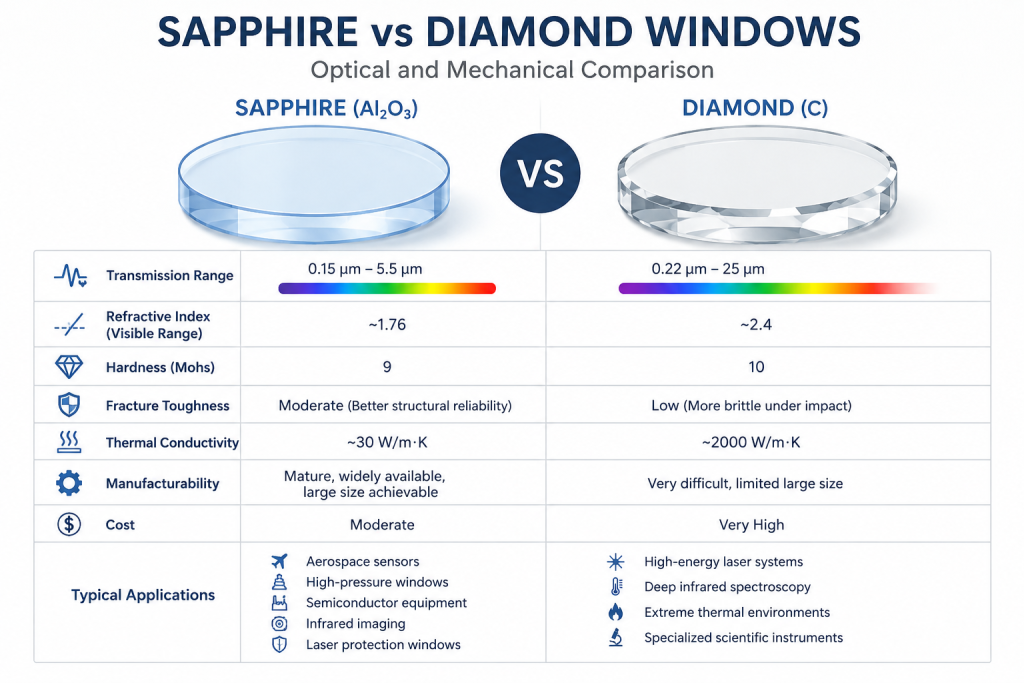
1. Material Overview
Sapphire (Al₂O₃ single crystal)
Sapphire is a crystalline form of aluminum oxide. It is widely used in 광학 창 due to its:
- High hardness (Mohs 9)
- Excellent thermal stability
- Broad optical transmission range
- Relatively mature industrial processing
It is currently one of the most commonly used materials for high-performance optical windows in industrial and defense systems.
Diamond (C)
Diamond is a carbon-based crystal and the hardest known natural material. Synthetic diamond is increasingly used in advanced optical applications due to:
- Extreme hardness (Mohs 10)
- Outstanding thermal conductivity
- 뛰어난 화학적 불활성
- High resistance to abrasion and erosion
However, optical-grade diamond is significantly more expensive and more difficult to manufacture in large sizes.
2. Optical Performance Comparison
전송 범위
- Sapphire: ~0.15 μm to 5.5 μm
- Diamond: ~0.22 μm to 25 μm (very wide infrared range)
👉 Key insight:
Diamond has a much wider infrared transmission range, making it superior for deep IR and thermal imaging systems.
Refractive Index & Reflection
- Sapphire: ~1.76 (visible range)
- Diamond: ~2.4
Higher refractive index in diamond leads to:
- Higher Fresnel reflection losses
- Stronger need for anti-reflective coatings
Sapphire, although not perfect, is easier to optimize for optical clarity in practical systems.
3. Mechanical Properties Comparison
Hardness & Wear Resistance
- Sapphire: Extremely hard, highly scratch-resistant
- Diamond: Highest hardness of any known material
👉 In pure wear resistance, diamond is superior. However, sapphire already exceeds most industrial requirements.
Fracture Toughness (Critical Engineering Factor)
- Sapphire: Moderate brittleness, better structural reliability
- Diamond: Extremely brittle in certain crystallographic directions
👉 주요 엔지니어링 인사이트:
Despite its hardness, diamond can be more fragile under impact or edge stress conditions. Sapphire often performs better in real structural window applications.
열 전도성
- Sapphire: ~30 W/m·K
- Diamond: up to ~2000 W/m·K
Diamond is unmatched in heat dissipation, making it ideal for:
- 고출력 레이저 시스템
- Thermal imaging windows
- Extreme heat flux environments
4. Manufacturing and Cost Considerations
| 요인 | 사파이어 | Diamond |
|---|---|---|
| Availability | High (industrial scale) | Limited (synthetic only) |
| Machinability | Mature CNC grinding/polishing | Extremely difficult |
| Size availability | Up to large diameters (including 8–12 inch) | Very limited large size |
| 비용 | 보통 | 매우 높음 |
👉 Sapphire dominates in scalable industrial production.
5. Application Differences
Sapphire Optical Windows Are Preferred In:
- 항공우주 센서
- High-pressure observation windows
- 반도체 장비
- Infrared imaging systems
- Industrial laser protection windows
Diamond Optical Windows Are Used In:
- High-energy laser research
- Deep infrared spectroscopy
- Extreme thermal environments
- Specialized scientific instruments
6. Engineering Conclusion
While diamond offers unmatched hardness and thermal conductivity, sapphire provides a more balanced combination of:
- Optical performance
- Mechanical reliability
- Manufacturability
- Cost efficiency
👉 For most industrial and aerospace optical window applications, sapphire remains the dominant engineering choice, while diamond is reserved for highly specialized extreme environments.
Summary
- Diamond = ultimate performance, extreme cost, limited scalability
- Sapphire = industrial standard, balanced performance, high reliability
In practical engineering systems, material selection is not about “best material,” but about best trade-off between performance, cost, and manufacturability.