
Ordering a custom ruby optical window requires more information than a diameter and thickness. Two windows with the same nominal dimensions can perform very differently if they use different chromium concentrations, crystal orientations, polishing grades, surface-quality standards or coatings.
Synthetic ruby is chromium-doped aluminum oxide, commonly written as Cr³⁺₂O₃. It combines the mechanical advantages of the corundum crystal structure with the characteristic optical absorption and red fluorescence introduced by chromium. Published research describes ruby as Cr³⁺-doped alumina with high hardness, strength, thermal conductivity and chemical stability. However, chromium also changes its spectral behavior compared with colorless sapphire.
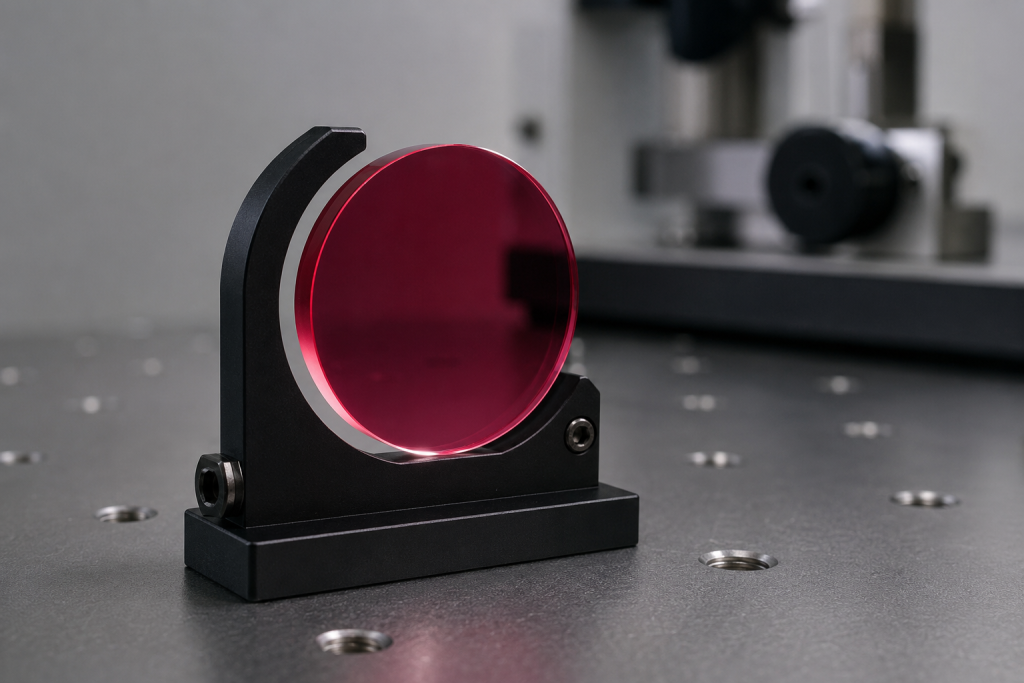
Therefore, an effective ruby optical window specification should define not only its physical dimensions, but also:
- Material grade and chromium concentration
- Orientace krystalů
- Čistá apertura
- Dimensional tolerances
- Surface polishing and roughness
- Flatness and transmitted wavefront
- Parallelism or wedge
- Surface imperfections
- Spectral transmission
- Coating requirements
- Operating environment
- Inspection and documentation
This guide explains how to define these parameters and prepare a complete RFQ for prototype or production quantities.
What Is a Ruby Optical Window?
A ruby optical window is normally manufactured from synthetic single-crystal ruby rather than natural gemstone material. Ruby and sapphire share the same aluminum oxide crystal host, but ruby contains chromium ions that create its pink-to-deep-red appearance and characteristic absorption and fluorescence.
The term “ruby glass” is sometimes used in general searches, but it can be misleading. Glass is amorphous, while synthetic ruby used for precision optical components is normally a crystalline material. An RFQ should clearly state whether the requirement is:
- Synthetic single-crystal ruby
- Polycrystalline transparent ruby
- Ruby-colored optical glass
- A colorless sapphire window with a red coating
These materials are not interchangeable.
Ruby optical windows may be used in protective viewports, optical instruments, sensor covers, inspection systems, pressure equipment, scientific devices and wavelength-selective applications. Ruby is also used as a laser gain material, but a passive ruby window and a ruby laser crystal require different specifications.
Start by Defining the Function of the Window
The application determines which parameters deserve the tightest control.
| Window function | Most important specifications |
|---|---|
| Protective cover or viewport | Diameter, thickness, clear aperture, edge condition, surface quality and environmental durability |
| Imaging or camera window | Flatness, transmitted wavefront, wedge, surface roughness and spectral transmission |
| Red spectral or visual window | Chromium concentration, thickness, color uniformity and measured transmission curve |
| Laser-related component | Crystal orientation, absorption, homogeneity, fluorescence, coating and laser-induced damage threshold |
| Pressure or vacuum window | Unsupported aperture, thickness, mounting method, pressure differential, temperature and safety factor |
Do not automatically apply laser-grade tolerances to a protective viewport. Unnecessarily tight specifications can increase machining time, reduce production yield and raise the unit price without improving the actual system.
1. Specify Diameter, Shape and Clear Aperture
Outside diameter
For a circular ruby window, provide the finished outside diameter and its tolerance. For example:
Diameter: Ø25.00 ±0.05 mm
The appropriate tolerance depends on the mounting method. A retaining ring or loose mechanical holder may accept a relatively open tolerance, while a precision metal housing or bonded assembly may require tighter dimensional control.
Illustrative starting points are:
| Requirement level | Example diameter tolerance |
| General protective window | ±0.10 mm |
| Precision mechanical fit | ±0.05 mm |
| Tight optical assembly | ±0.02 mm or tighter after manufacturing review |
These are not universal acceptance limits. Large diameters, very thin windows and unusual shapes may require different tolerances.
Non-circular windows
Ruby optical windows can also be manufactured as:
- Rectangular or square plates
- Oval windows
- Rings
- Stepped windows
- Slotted components
- Windows with flats or alignment features
- Custom shapes based on a CAD drawing
For non-circular parts, specify the length, width, corner radius, profile tolerance and datum structure.
Čistá apertura
The clear aperture is the area over which the optical requirements must be satisfied. It is different from the outside diameter.
Například:
Outside diameter: Ø25.00 mm
Clear aperture: Ø22.00 mm, centered on the outside diameter
If no clear aperture is stated, the manufacturer may not know whether the flatness, surface quality and transmission requirements apply to the full polished face or only to the central optical area.
The clear aperture should also account for:
- Retaining-ring overlap
- Adhesive or sealant width
- Gasket contact area
- Edge bevel
- Alignment tolerance
- Expected beam diameter and beam movement
Okrajová podmínka
Ruby is extremely hard but can still develop edge chips if the edge is left sharp or handled incorrectly. Define the required edge treatment, such as:
- Fine-ground edge
- Leštěná hrana
- Protective bevel
- Chamfer
- Zaoblená hrana
- Blackened or coated edge
An example drawing note could be:
Edge chamfer: 0.20–0.30 mm × 45°, unless otherwise specified
Also state the maximum permissible edge-chip size and whether edge chips are allowed outside the clear aperture.
2. Select the Correct Thickness
Thickness affects both mechanical performance and optical behavior. It should not be selected from the window diameter alone.
Mechanical considerations
For a pressure-bearing or vacuum window, thickness selection depends on:
- Unsupported optical diameter
- Maximum pressure differential
- Static, cyclic or impact loading
- Mounting and sealing method
- Maximum operating temperature
- Temperature gradient
- Surface damage and edge condition
- Required safety factor
- Proof-pressure requirements
A larger outside diameter does not necessarily mean a larger unsupported aperture. A window may have a 50 mm outside diameter but only a 30 mm exposed area after mounting.
For safety-critical pressure windows, the final thickness should be supported by mechanical analysis and, where required, a proof test. A general thickness chart should not replace application-specific engineering.
Optical considerations
Thickness also changes:
- Délka optické dráhy
- Focus position in converging beams
- Beam displacement at non-normal incidence
- Interference and ghost reflections
- Absorption through the ruby material
- Perceived red color
- Fluorescence intensity
- Overall external transmission
In absorbing wavelength regions, a thicker ruby window generally transmits less light than a thinner window of the same material and chromium concentration. Therefore, spectral transmission must always be associated with a defined finished thickness.
Thickness tolerance
A complete specification includes both nominal thickness and tolerance:
Thickness: 3.00 ±0.05 mm
General protective parts may tolerate ±0.10 mm, while precision optical assemblies may require ±0.05 mm, ±0.02 mm or tighter. Before choosing a very tight tolerance, determine whether the system actually depends on absolute thickness, parallelism, total thickness variation or transmitted wavefront.
3. Define the Ruby Material Grade
“Ruby” alone is not a complete material specification.
Synthetic single-crystal material
For precision optical windows, a typical material description is:
Synthetic single-crystal ruby, Cr³⁺₂O₃
If relevant, also specify the acceptable crystal-growth method. Common growth methods can produce different boule sizes, defect populations, residual stress and cost structures. If the growth method is not functionally important, it is usually better to define the required optical and internal quality instead of restricting the process.
Chromium concentration and color
Chromium concentration influences the color, absorption and fluorescence of ruby. Descriptions such as “light pink,” “standard red” or “dark ruby” are subjective and may vary between suppliers and production batches.
For a functional optical component, specify one or more of the following:
- Chromium or Cr₂O₃ concentration range
- Minimum transmission at the operating wavelength
- Complete transmission curve over a defined wavelength range
- Permitted color variation
- Approved physical color sample
- CIE L*a*b* color range with measurement conditions
- Maximum variation within one window
- Maximum batch-to-batch variation
For most optical applications, a measured transmission requirement is more useful than a visual color description.
Internal material quality
Depending on the application, define acceptance criteria for:
- Bubbles
- Inclusions
- Growth defects
- Striae
- Color zoning
- Stress birefringence
- Crystal boundaries
- Local transmission variation
- Refractive-index homogeneity
The inspection area and illumination method should be stated. A cosmetic visual inspection is not equivalent to interferometric homogeneity testing.
4. Specify Crystal Orientation
Ruby is an anisotropic and birefringent crystal. Crystal orientation can therefore affect polarization behavior, refractive index, wavefront performance and stress response.
A NIST study on a particular Czochralski-grown ruby sample reported ordinary and extraordinary refractive indices of 1.76569 and 1.75759 at 643.8 nm. These sample-specific values illustrate why crystal direction can matter in precision applications. NIST study on the photoelastic constants of ruby
Possible orientation requirements include:
- C-axis perpendicular to the optical faces
- C-axis parallel to the optical faces
- A-plane or R-plane orientation
- Custom axis direction relative to a mechanical flat
- Orientation tolerance, such as ±0.5° or ±1°
If the window is only a non-imaging protective cover, strict orientation control may not be necessary. For polarized light, imaging systems, interferometry or laser applications, orientation should be reviewed carefully.
5. Define the Polishing Requirements
The phrase “optically polished” is not sufficiently precise by itself. The specification should explain which surfaces are polished and how polishing quality will be evaluated.
Jednostranné nebo oboustranné leštění
Most transmissive ruby windows require both optical faces to be polished. Single-side polishing may be acceptable when one side is intentionally ground, bonded or used only as a mechanical reference.
A normal drawing note is:
Surface 1 and Surface 2: double-side optical polish
If the two sides have different requirements, identify them individually as S1 and S2.
Drsnost povrchu
Surface roughness describes microscopic texture rather than visible scratches or overall surface flatness. Excessive roughness increases scattered light and can reduce performance in imaging and laser systems.
Specify:
- Ra or Rq value
- Maximum permitted value
- Measurement instrument
- Scan length or evaluation area
- Spatial-frequency or filtering conditions, when critical
- Whether the requirement applies over the clear aperture
Illustrative requirements may include:
- Rq ≤ 2 nm for a general optical viewport
- Rq ≤ 1 nm for precision sensor or imaging use
- Rq ≤ 0.5 nm for low-scatter or demanding laser applications
The correct value depends on wavelength and system sensitivity. ISO 10110-8:2019 provides rules for indicating optical surface texture.
Plochost
Flatness describes the low-spatial-frequency form of an individual surface. It should include:
- Maximum surface-form error
- Clear aperture or test area
- Test wavelength
- Whether power is included or removed
- Measurement and reporting method
Příklady zahrnují:
Surface flatness: ≤λ/2 at 632.8 nm over the clear aperture
or:
Surface-form deviation: ≤150 nm PV over the clear aperture
The current ISO 10110-5:2026 uses nanometres as the preferred unit for surface-form deviation. If flatness is specified in waves or fringes, the reference wavelength must be stated.
Parallelism and wedge
Parallelism defines the angular relationship between the two polished surfaces. Insufficient parallelism can produce:
- Odchylka paprsku
- Image shift
- Focus error
- Uneven optical path
- Alignment problems
Conversely, some optical systems intentionally require a small wedge to separate ghost reflections.
Example requirements include:
Parallelism: ≤1 arcminute
or:
Wedge angle: 30 ±5 arcseconds, wedge direction marked on the edge
Do not request both “parallel surfaces” and a deliberate wedge without clarifying which requirement takes priority.
6. Define Optical Surface Quality
Surface quality addresses localized imperfections such as scratches, pits and digs. It is different from surface roughness and flatness.
Common scratch-dig grades include:
- 60-40 for commercial or protective optical windows
- 40-20 for general precision optics
- 20-10 for demanding imaging or laser components
- 10-5 for highly sensitive optical systems
These grades should be treated as application-dependent starting points. Specifying 10-5 when 40-20 is sufficient can significantly increase polishing and inspection costs.
A drawing should not state only “40-20.” It should identify the governing inspection standard or mutually agreed comparison method.
ISO 10110-7:2017 addresses localized surface imperfections, long scratches and edge chips within a defined test region. ISO and traditional scratch-dig systems should not be assumed to be directly interchangeable without an agreed inspection method.
Also define whether the surface-quality requirement applies to:
- The full polished surface
- Only the clear aperture
- Coated surfaces after coating
- Both sides individually
- Internal defects as well as surface defects
7. Flatness Is Not the Same as Transmitted Wavefront
A window can have acceptable surface flatness on each face but still introduce unacceptable wavefront error because of:
- Thickness variation
- Unequal surface curvature
- Material inhomogeneity
- Residual stress
- Orientace krystalů
- Birefringence
- Mounting stress
For imaging, interferometry or collimated laser-beam transmission, specify transmitted wavefront deformation directly.
An example is:
Transmitted wavefront error: ≤λ/2 PV at 632.8 nm over the clear aperture
For more demanding systems, RMS wavefront error may be more useful than a PV value. The measurement wavelength, polarization, aperture, mounting condition and whether tilt or power is removed should be stated.
ISO 10110-14:2018 defines drawing indications for transmitted or reflected wavefront deformation.
8. Specify Spectral Transmission
Ruby should not be treated as colorless sapphire with a red appearance. Chromium creates wavelength-dependent absorption and fluorescence, so spectral performance must be defined for the actual application.
A complete transmission requirement should include:
- Operating wavelength or wavelength range
- Minimum, average or nominal transmission
- Internal or external transmission
- Finished window thickness
- Úhel dopadu
- Polarization, when relevant
- Test temperature, if performance is temperature-sensitive
- Measurement resolution
- Acceptance over the full aperture or at selected points
Například:
External transmission: ≥X% at 694 nm, measured at normal incidence through the finished 3.00 mm thick window
or:
Provide a measured external transmission curve from 400 to 900 nm for each production lot
Internal versus external transmission
External transmission includes reflection at both air-to-ruby interfaces. Internal transmission excludes these surface-reflection losses.
Ruby has a relatively high refractive index. Using an approximate refractive index of 1.76, normal-incidence Fresnel reflection is about 7.6% at each uncoated air interface. Therefore, even a low-absorption uncoated window will not provide 100% external transmission. Chromium absorption reduces transmission further in affected spectral bands.
Always clarify whether an acceptance value refers to internal or external transmission.
Fluorescence considerations
Ruby can emit strong red fluorescence when excited at suitable wavelengths. This may be desirable in sensing or laser-related applications, but it can also create unwanted background in imaging or detection systems.
If fluorescence could affect the system, define:
- Excitation wavelength
- Detection band
- Permitted fluorescence intensity
- Decay-time requirements
- Chromium concentration
- Measurement geometry
9. Decide Whether an Optical Coating Is Required
An antireflection coating can improve external transmission and reduce ghost images, but the coating must be designed for the actual operating conditions.
Provide the following information:
- Coating on S1, S2 or both surfaces
- Center wavelength or wavelength range
- Required average or maximum reflectance
- Required minimum transmission
- Úhel dopadu
- Polarizace
- Provozní teplota
- Humidity and chemical exposure
- Abrasion or cleaning requirements
- Laser power and pulse parameters, if applicable
Example:
BBAR coating on both sides, average reflectance ≤0.5% from 650 to 750 nm at 0° angle of incidence
For high-power laser use, also provide wavelength, pulse duration, repetition rate, beam diameter and peak fluence so that an appropriate laser-induced damage threshold can be specified.
10. Include the Operating Environment
The same ruby window may require a different design depending on how it is mounted and used.
An RFQ should describe:
- Minimum and maximum operating temperatures
- Tepelné cykly
- Temperature gradients
- Vacuum level
- Internal and external pressure
- Humidity
- Water or steam exposure
- Acids, alkalis or cleaning chemicals
- Salt spray
- Dust and abrasive particles
- Mechanical impact
- Vibrace
- Radiation exposure
- Outdoor UV exposure
- Required service life
Mounting information is particularly important. Excessive clamping force, a hard point contact or an unsuitable adhesive can introduce stress and wavefront distortion even when the unmounted window meets its optical specification.
11. Recommended Inspection and Documentation
The inspection package should match the component’s function and risk level.
Available documentation may include:
- Material certificate
- Chromium concentration report
- Crystal-orientation certificate
- Dimensional inspection report
- Surface-quality inspection
- Surface-roughness report
- Flatness interferogram
- Transmitted-wavefront interferogram
- Spectral transmission curve
- Coating performance report
- Coating adhesion or durability test
- Stress-birefringence inspection
- First Article Inspection report
- Lot traceability
- Individual serial numbers
- Certificate of Conformance
Requesting every report for a simple protective window may add unnecessary cost. For critical optical assemblies, however, lot-specific measurement data can reduce qualification risk.
Example Ruby Optical Window Specification
The following example can be adapted to a prototype RFQ:
| Parametr | Example requirement |
| Materiál | Synthetic single-crystal ruby, Cr³⁺₂O₃ |
| Tvar | Circular plano-plano window |
| Průměr | Ø25.00 ±0.05 mm |
| Tloušťka | 3.00 ±0.05 mm |
| Čistá apertura | Ø22.00 mm, centered |
| Orientace krystalů | C-axis normal to the optical faces within ±0.5°, if required |
| Polishing | Both optical faces polished |
| Kvalita povrchu | 40-20 scratch-dig per agreed inspection standard |
| Drsnost povrchu | Rq ≤1.0 nm over the clear aperture |
| Rovinnost povrchu | ≤λ/2 at 632.8 nm over the clear aperture |
| Paralelismus | ≤1 arcminute |
| Transmitted wavefront | Define if required by the optical system |
| Spectral requirement | External transmission ≥[value]% at [wavelength] |
| Povlak | Uncoated, or specify AR coating range and reflectance |
| Okraj | 0.20–0.30 mm × 45° protective chamfer |
| Čipy Edge | No chips in clear aperture; outside-aperture limit to be defined |
| Životní prostředí | State temperature, pressure, vacuum and chemical exposure |
| Množství | Prototype quantity and expected annual volume |
| Documentation | Material certificate and dimensional inspection report |
The numerical values above are examples, not universal recommendations. Final tolerances should be selected according to the optical function, mounting design and inspection budget.
Common RFQ Mistakes
Specifying only diameter and thickness
A request such as “ruby window, Ø25 × 3 mm, polished” leaves the material grade, tolerances, aperture and optical performance undefined.
Using color as the only transmission requirement
“Dark red” is subjective. Specify a transmission curve, wavelength-specific requirement or approved reference sample.
Treating ruby as standard colorless sapphire
Ruby uses the same corundum host, but chromium changes absorption and fluorescence. A colorless-sapphire transmission curve should not be used to approve a ruby window.
Confusing surface quality with roughness
A 40-20 scratch-dig requirement controls visible localized defects. An Rq requirement controls microscopic surface texture. One does not replace the other.
Confusing flatness with transmitted wavefront
Flatness controls individual surface form. Transmitted wavefront evaluates the optical effect of the complete window.
Omitting the clear aperture
Without a defined clear aperture, the supplier may inspect a different area from the one used by the optical system.
Omitting the test wavelength
A flatness or wavefront value stated only as “λ/4” is incomplete. The wavelength must be specified.
Choosing the tightest available tolerance for every parameter
Ultra-tight dimensional, polishing and surface-quality requirements can sharply reduce production yield. Tighten only the parameters that affect system performance.
What Affects Ruby Optical Window Price?
The main cost drivers include:
- Window diameter and material utilization
- Finished thickness and aspect ratio
- Ruby color or chromium concentration
- Crystal-growth method
- Crystal-orientation requirement
- Internal defect and homogeneity limits
- Diameter and thickness tolerances
- Rovinnost povrchu
- Transmitted wavefront
- Drsnost povrchu
- Scratch-dig grade
- Parallelism or wedge tolerance
- Custom optical coating
- Environmental testing
- Individual inspection reports
- Prototype quantity and annual volume
Large-diameter, thin ruby windows can be particularly challenging because they require careful handling during grinding, polishing and coating.
Často kladené otázky
Is a ruby optical window the same as a sapphire window?
Ruby and sapphire share the Al₂O₃ corundum crystal structure. Ruby contains chromium, which creates its red color, optical absorption and fluorescence. Their mechanical characteristics may be similar, but their spectral performance should not be assumed to be identical.
Can I specify the window only by its red color?
Visual color alone is not sufficient for a functional optical component. Specify chromium concentration, a transmission curve, wavelength-specific transmission or a controlled color range.
Should both surfaces be polished?
Both surfaces are normally optically polished when the part transmits an imaging or collimated beam. A single polished surface may be sufficient for certain bonded or non-imaging applications.
Is 20-10 surface quality always better than 40-20?
It is a tighter cosmetic and defect requirement, but it is not always necessary. A protective viewport may perform perfectly with 40-20 or 60-40 quality. The correct grade depends on beam size, image plane location, laser power and system sensitivity.
How should I choose the thickness?
Consider the pressure differential, unsupported aperture, mounting design, temperature, safety factor and optical absorption. Safety-critical pressure windows should be evaluated through mechanical analysis rather than a generic diameter-to-thickness rule.
Does an uncoated ruby window have high transmission?
External transmission is reduced by both chromium absorption and Fresnel reflection from the two high-index surfaces. If higher transmission is required at a specific wavelength, an AR coating may be necessary.
What additional information is needed for a laser application?
Provide the wavelength, power or pulse energy, pulse duration, repetition rate, beam diameter, polarization, angle of incidence, required wavefront quality and laser-induced damage threshold. Also clarify whether the ruby is a passive window or an active laser medium.
Závěr
A reliable ruby optical window specification must connect the mechanical drawing with the actual optical function. Diameter and thickness define only the basic geometry. Crystal orientation, chromium concentration, polishing quality, clear aperture, flatness, transmitted wavefront, spectral transmission and coating determine whether the finished window will work in the intended system.
For an accurate quotation, send the supplier:
- A dimensioned drawing
- Material and orientation requirements
- Provozní vlnová délka
- Čistá apertura
- Polishing and surface-quality requirements
- Transmission or coating targets
- Operating environment
- Požadavky na kontrolu
- Prototype and production quantities
If some parameters are still undecided, provide the application, mounting design and optical performance goal. The manufacturer can then recommend production-capable tolerances without adding unnecessary cost.