
Metal additive manufacturing relies on controlled energy delivery and accurate monitoring inside a demanding process chamber. In laser powder bed fusion (LPBF), a focused laser melts selected regions of a metal powder layer while the optical train remains separated from the build environment. The protective window between those environments may be small, but its condition can strongly influence laser transmission, monitoring accuracy and maintenance intervals.
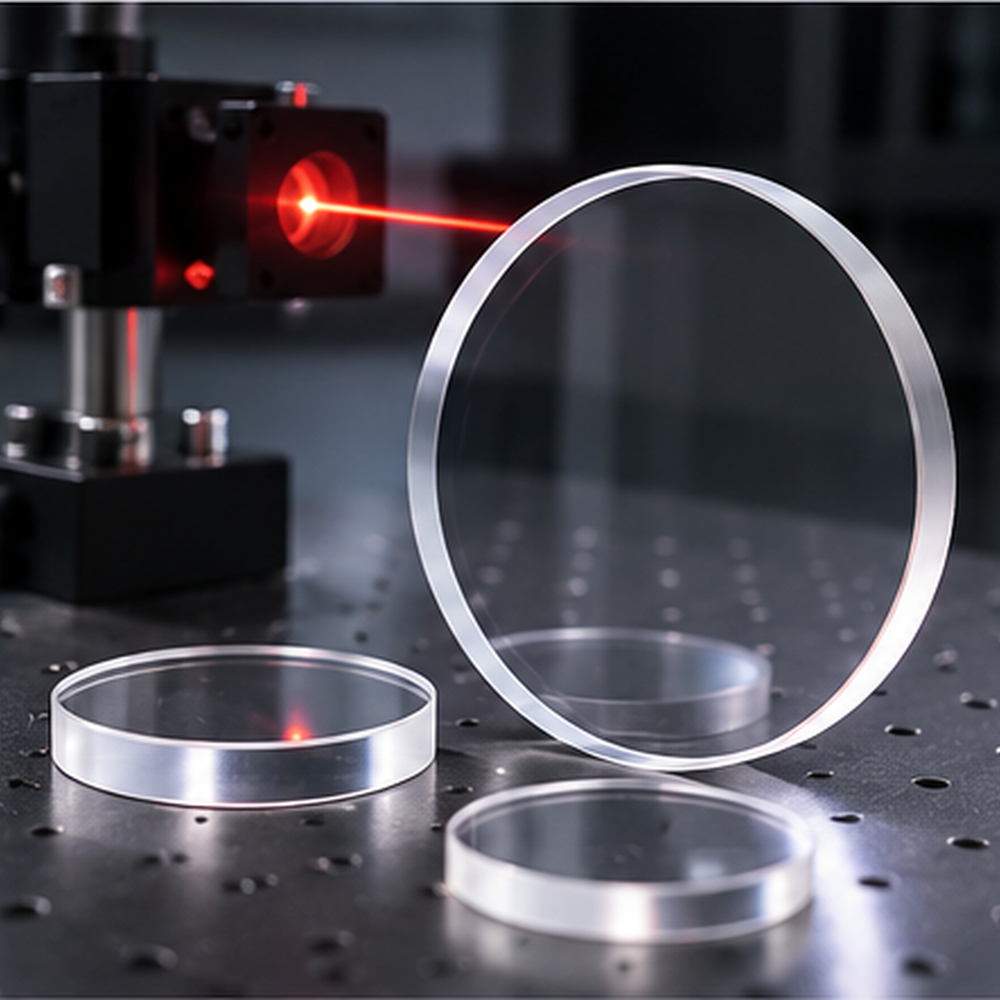
Sapphire is an interesting candidate for selected protective optical interfaces because single-crystal aluminum oxide combines high hardness, thermal stability and a broad transmission range. It can be useful where repeated cleaning, abrasion or harsh environmental exposure are important. However, sapphire is not automatically the best optical material for every LPBF system. Fused silica is widely used in high-performance laser optics, and material selection must be justified by the actual wavelength, beam quality, contamination behavior and replacement strategy.
This article examines how engineers should evaluate sapphire protective windows in metal additive manufacturing systems and related laser-based production equipment.
1. The Role of a Protective Window in an LPBF Machine
A powder bed fusion system typically includes a laser source, beam-shaping optics, scanning mirrors or other beam-positioning components, a process atmosphere and a build chamber. A protective window may separate the laser optics from metal vapor, condensate, ejected particles and process gases.
The window must transmit the processing beam without introducing unacceptable absorption, wavefront distortion or scattering. In monitored systems, a separate optical port may also transmit visible or infrared light from the build process to cameras or detectors. These two functions can place very different requirements on the window.
A high-power beam-delivery window should be qualified against laser power, beam diameter, fluence, angle of incidence and coating durability. A camera protection window may instead prioritize imaging contrast, field of view and resistance to cleaning-related wear. It is important not to treat the two as interchangeable.
2. Metal Spatter, Condensate and Powder Contamination
The melt pool produces intense local heating, and the process may generate vapor, condensate and ejected particles. Some particles can reach nearby optical surfaces or chamber walls. Depending on temperature, geometry and gas flow, material may deposit as a thin film or localized spots on a window.
Deposits can absorb incident laser energy and create local hot spots. They may also scatter the process beam or block part of a monitoring image. Even a very hard substrate does not prevent metal contamination from adhering to its surface, and cleaning an inappropriate way can damage a deposited optical coating.
The first line of defense is good chamber and purge-gas design, not solely the choice of a hard window material. Gas flow paths, protective shields and window placement should be coordinated so that the optical surface is exposed to as little process debris as practical.
3. Why Consider Sapphire Instead of Conventional Glass?
Sapphire has Mohs hardness 9, making it highly resistant to many forms of scratching and abrasion. It also maintains useful mechanical properties at elevated temperatures and has good chemical resistance in numerous industrial environments. These attributes can be valuable for exposed viewing ports or removable inspection windows that undergo frequent cleaning.
Nevertheless, hardness does not measure laser-induced damage threshold, thermal lensing, absorption at the operating wavelength or coating reliability. A transparent sapphire component can perform poorly in a high-power beam path if the optical design is unsuitable. Optical-grade fused silica, for example, may have advantages for particular laser beam delivery arrangements.
A rational selection process compares candidate materials based on beam requirements, surface durability, operating environment, available coatings and life-cycle cost. The decision should be based on system testing rather than a blanket claim that one material is always superior.
4. Laser Wavelength, Reflection and Beam Quality
Many LPBF systems operate near the infrared wavelengths used by industrial fiber lasers, although exact configurations vary. The protective window must be compatible with the machine’s specified wavelength, power and beam characteristics.
Sapphire has a relatively high refractive index, resulting in meaningful Fresnel reflections at uncoated surfaces. Reflected light can reduce transmission and may create stray-light or feedback concerns. Anti-reflection coatings can improve throughput when designed for the actual wavelength, angle and polarization.
At the same time, coatings can introduce their own damage thresholds and cleaning limitations. Their suitability must be demonstrated under realistic beam and contamination conditions. A clean-window laboratory transmission number should not be interpreted as a lifetime guarantee in a powder-bed production chamber.
5. Thermal Loading and Localized Hot Spots
Even a small absorbed fraction of high-power laser radiation can create local heating. The risk increases when contamination accumulates, because metal deposits may absorb energy more strongly than the clean optical substrate. Hot spots can produce thermal stress, coating changes and optical distortion.
Sapphire is thermally conductive compared with many optical glasses, but thermal conductivity alone does not eliminate the risk of cracking or distortion. Crystal orientation, edge constraints, window thickness, heat extraction and nonuniform illumination all influence the temperature field.
When the process is sensitive to focus shift or beam profile, designers should verify thermal effects under representative laser exposure. Predictive modeling can help identify risk areas, but system-level qualification remains important.
6. Optical Monitoring Through a Sapphire Window
In addition to beam delivery, additive manufacturing systems may employ coaxial cameras, off-axis cameras, pyrometers and other optical sensors. These instruments observe light generated or reflected during processing to assess build conditions.
For a visible-light inspection window, scratch resistance may be valuable when the surface is cleaned frequently. For an infrared monitoring port, the relevant transmission band and sensor response must be reviewed carefully. Sapphire transmits across a broad range, but its transmission is not uniform at every wavelength, and optical coatings or contaminants can further change the response.
Camera windows should be specified for usable clear aperture, image distortion, surface quality and mounting geometry. For calibrated measurements, engineers should also account for attenuation and reflections introduced by the window.
7. Surface Finish, Orientation and Coating Specification
A sapphire protective window may be supplied as a circular disc, rectangular plate or custom profile. Mechanical dimensions are only the starting point. Optical requirements can include double-side polishing, flatness, transmitted wavefront quality, parallelism or a deliberate wedge, and surface defect limits.
Because sapphire is birefringent, crystal orientation may matter in precision beam paths or polarization-sensitive arrangements. C-plane and other orientations should be selected against optical design requirements, not simply listed as optional catalog features.
A coating drawing should identify the coated surface, wavelength, angle of incidence, polarization condition, clear aperture and applicable laser damage testing method. A generic “AR coating” callout is often insufficient for demanding laser use.
8. Cleaning Strategy: What Hardness Can and Cannot Solve
Sapphire’s scratch resistance can support practical maintenance, but it is not permission to rub dry metal powder across an optical surface. Abrasive particles, contamination chemistry and coating fragility can all affect cleaning outcomes.
A maintenance procedure should define how loose powder is removed, which solvents or cleaning agents are compatible with the assembly, what contact methods are allowed and how the window is inspected afterward. A coated sapphire surface must be treated according to the coating supplier’s instructions rather than the sapphire substrate’s bulk hardness alone.
Where process deposits cannot be cleaned without altering transmission or surface quality, replacement may be the safer option. Tracking optical condition over time can support evidence-based maintenance intervals.
9. When Should a Protective Window Be Replaced?
Replacement criteria should be tied to process performance and documented inspection limits. Possible indicators include persistent haze, visible pitting, coating deterioration, increased scatter, measurable transmission loss or recurring deviations in laser power delivered to the build plane.
Some systems monitor power or optical signals directly; others rely on scheduled visual inspections and process qualification. There is no universal number of build hours after which every sapphire window must be replaced. Build materials, gas flow, machine architecture and cleaning practices vary substantially.
A qualified replacement part should retain the agreed material grade, orientation, geometry, optical surface specification and coating requirements. Changes in window thickness or wedge can alter the beam path even when the replacement fits mechanically.
10. Custom Sapphire Window Specification for Equipment Manufacturers
| Parameter | What should be specified |
|---|---|
| Function | Laser beam protection, camera port or sensor viewport |
| Optical wavelength | Laser and/or monitoring band |
| Laser conditions | Power, beam diameter, pulse parameters and angle of incidence |
| Shape and size | Diameter or length × width, thickness, edge profile |
| Material orientation | C-plane or other specified orientation, if required |
| Surface requirements | Polish, flatness, surface quality, clear aperture |
| Coatings | AR wavelength/band, surface, angle, polarization, durability |
| Environment | Metal powders, inert gas, temperature, condensate and cleaning cycles |
| Inspection | Transmission, cosmetic limits, coating checks or agreed tests |
| Quantity | Development samples and production volumes |
Equipment manufacturers should identify whether a part is in the primary laser beam path or only in a viewing port. This distinction has major implications for optical and safety qualification.
11. Related Custom Sapphire Optical Components
Sapphire Windows offers custom optical windows for industrial and laser equipment. Its high-precision sapphire optical window components provide a suitable starting point for discussing geometry, polishing and coating requirements for protective or monitoring applications.
A request for an LPBF window should include the full optical specification and intended service environment. Actual laser-damage performance, coating suitability and operational lifetime require application-specific testing; product availability alone does not establish certification for a particular laser power or machine model.
Frequently Asked Questions
Does sapphire eliminate the need for a chamber purge or protective gas flow?
No. Gas management and deposit control remain essential. Sapphire is hard, but deposits and absorbed laser energy can still damage optical performance.
Can a sapphire window replace any fused-silica laser window?
No. Replacement requires checking wavelength, refractive index, birefringence, beam quality, geometry, coatings and thermal behavior. An optical redesign may be necessary.
Is an uncoated sapphire window suitable for a high-power laser?
Suitability depends on reflection loss, beam power, absorption, thermal design and system requirements. Uncoated interfaces may introduce unacceptable reflections even where the substrate itself is suitable.
What is the most useful information for quotation?
Provide the exact laser wavelength and operating regime, window drawing, optical specifications, environmental conditions, cleaning method and desired quantity.
Conclusion
Sapphire protective windows can be valuable for selected metal additive manufacturing and laser-monitoring tasks where abrasion resistance, optical access and equipment durability are important. Their success depends on controlling contamination, specifying the relevant optical properties and validating performance under representative laser exposure.
Developing a custom protective sapphire window for an industrial laser or additive-manufacturing sensor? Send your drawing and operating parameters through the Sapphire Windows contact page for a manufacturing feasibility review.