
Cryogenic instruments often need an optical path between an extremely cold internal environment and an external detector, laser or imaging system. This optical interface may be part of a cooled sensor package, scientific measurement chamber, vacuum enclosure or low-temperature photonic assembly. A window that performs well at room temperature does not necessarily retain the same seal integrity after repeated cooling and warming.
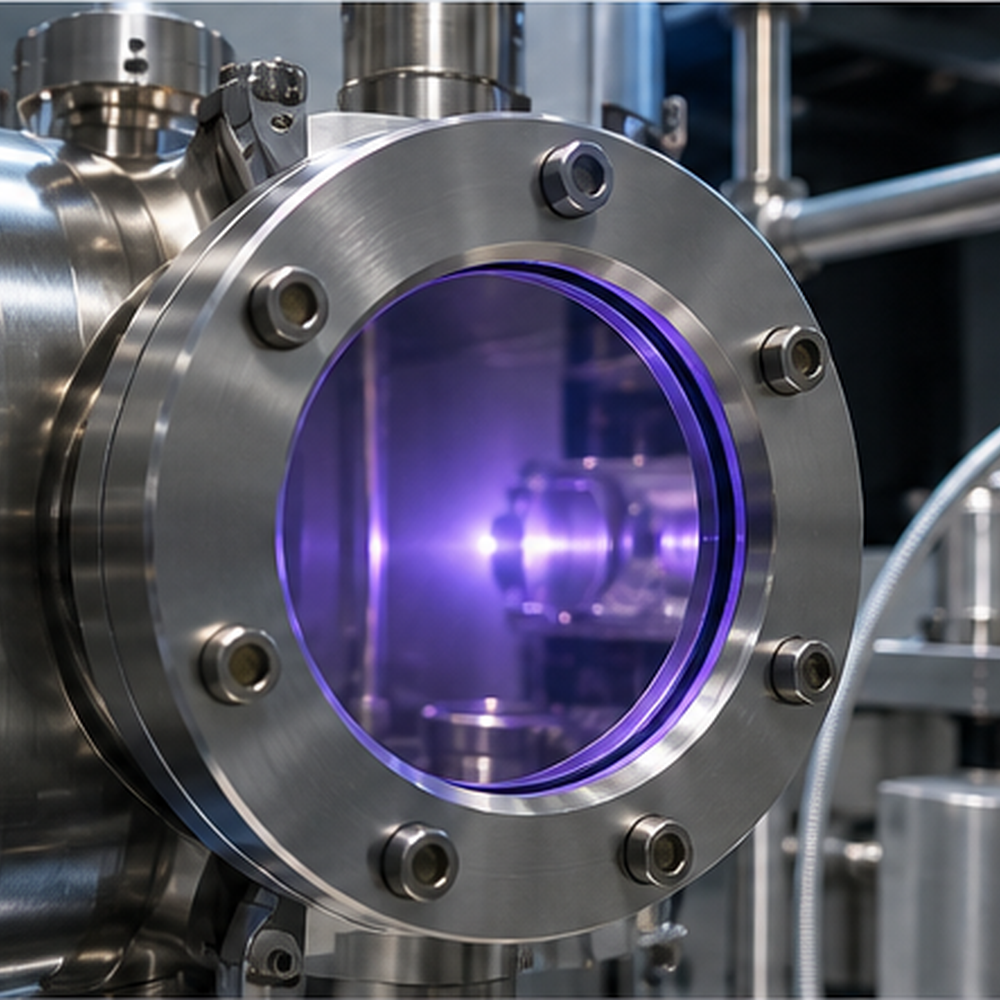
Metallized sapphire windows offer one potential route to integrating a durable single-crystal optical component into a metal package. A selected perimeter region can receive a metal layer intended for joining, while the central region remains transparent. The concept is useful for hermetic packaging, but successful operation at cryogenic temperatures requires careful management of differences in thermal contraction, metallization adhesion, joining method and leak testing.
This article focuses on engineering decisions for cryogenic optical packaging rather than suggesting that all metallized sapphire windows are automatically qualified for liquid-nitrogen or lower-temperature service.
1. Why Cryogenic Optical Packages Need Specialized Windows
Optical access is important for cooled infrared detectors, laboratory sensors, spectroscopy systems and photonic experiments. In many cases, a low-temperature device must be isolated from moisture or ambient air while light passes through a defined aperture.
When an optical window forms part of the package boundary, it may need to support vacuum integrity, survive thermal cycling and maintain optical alignment. The surrounding housing is often metallic, while the transparent component is a ceramic or crystal. These materials do not expand and contract identically.
A room-temperature seal that appears tight may experience changed stress during cooldown. In addition, residual stresses from brazing or other joining operations can interact with thermal contraction. The design must therefore account for the entire operating temperature history, including assembly, cooldown, steady-state use, warmup and storage.
2. The Material Advantages and Limits of Sapphire
Sapphire is single-crystal aluminum oxide, Al₂O₃. It combines useful optical transmission with high hardness, chemical durability and good mechanical properties. These characteristics make it attractive for specialized sensors, although the optical material must always match the detector’s actual wavelength band.
Sapphire is anisotropic: its thermal expansion and refractive indices depend on crystallographic direction. Consequently, crystal orientation can influence both optical performance and mechanical behavior during temperature changes. C-plane, A-plane and other orientations should be evaluated for the full assembly rather than chosen only from catalog availability.
Material data are often reported at room temperature or over a limited temperature range. Engineers should use appropriate temperature-dependent properties when modeling cryogenic service. Extrapolating a single room-temperature coefficient down to extremely low temperatures may lead to incorrect stress predictions.
3. What Is a Metallized Sapphire Window?
A metallized sapphire window is an optically polished sapphire component with a controlled metal pattern on selected regions, usually outside the usable optical aperture. The pattern can be a peripheral ring, rectangular frame, edge area or custom outline.
A metallized region provides an interface that may support a selected soldering, brazing or package-bonding approach. Depending on the joining design, the metal stack may include an adhesion layer, an intermediate barrier and a finish layer. Examples of material systems discussed in precision packaging include titanium/gold or other engineered multilayers, but no stack is universally appropriate.
The joining system must be compatible with the braze or solder alloy, joining temperature, cleaning process, package metal and long-term environment. The appearance of a shiny metal layer is not evidence of adequate adhesion or hermetic performance.
4. Thermal Contraction and Coefficient-of-Expansion Mismatch
When an assembly cools from room temperature toward cryogenic temperatures, each material contracts according to its temperature-dependent thermal expansion. Sapphire, stainless steel, titanium alloys, Kovar and common joining alloys may change dimensions by different amounts.
This mismatch can create tensile or shear stress at the interface, particularly when the window is restrained by a rigid metal ring. Brittle materials such as sapphire have limited tolerance for localized tensile stress, even though their hardness is high.
The amount and distribution of stress depend on the complete geometry: window diameter, thickness, metallization ring width, joint thickness, housing stiffness, corner geometry and cooling profile. A compliant intermediate structure may be appropriate for some designs, whereas another design may favor a different housing alloy or joining approach.
Selection of a metal with a similar room-temperature expansion coefficient is not enough; designers must compare integrated contraction over the entire temperature range.
5. Housing Alloys and Intermediate Transitions
A cryogenic sensor package may use stainless steel, Kovar, titanium or another engineered alloy for structural and manufacturing reasons. Each choice has implications for mechanical stiffness, thermal contraction, weldability, corrosion resistance and joining compatibility.
Kovar is frequently associated with matched-expansion sealing systems, but its suitability cannot be presumed for a particular sapphire orientation or cryogenic temperature. Stainless steel may provide manufacturing convenience and structural durability while creating larger differential contraction in some configurations.
In certain designs, a transition ring or tailored joint geometry helps manage strain. The mechanical seat and metal ring must also prevent direct point loads at the sapphire edge. Sharp corners, poorly supported edges and excessive assembly preload can substantially increase fracture risk.
For this reason, the package designer should provide a cross-sectional assembly drawing, not just a top view of the optical window.
6. Brazing, Soldering and Alternative Joining Approaches
Joining a metallized sapphire window to a package can involve brazing, soldering or other engineered processes. Brazing typically requires elevated process temperatures and places demands on metallization stability and residual-stress control.
The braze alloy should be selected against the actual metal stack, housing material, wetting behavior and service temperature. Excessive joint rigidity may increase stress during cryogenic contraction, while inadequate wetting or porosity can lead to leakage.
Solder joints may have different processing temperatures and compliance characteristics, but their long-term reliability also depends on alloy choice and thermal history. Adhesive bonding can be useful in certain non-hermetic or specially qualified systems, yet it should not automatically be substituted where stringent hermeticity is required.
A production process needs validated controls for surface preparation, alignment, heat treatment or heating cycle, joint geometry and post-join inspection.
7. Designing a Metallization Ring Around the Optical Aperture
The optical clear aperture should remain available after metallization and integration into the surrounding housing. Drawings should distinguish overall sapphire diameter, clear aperture diameter, metal-ring inner and outer limits, edge exclusion and permissible alignment error.
Too narrow a metallized ring may provide insufficient joining area, while an unnecessarily wide ring can reduce useful optical access or increase stress. The proper width depends on joining method, mechanical design and applicable inspection requirements.
If a coating such as an anti-reflection layer is required, its placement must be coordinated with the metallization. Overlapping incompatible coating and metallization processes may compromise adhesion or require changes to the manufacturing sequence.
For compact detector modules, small dimensional errors can be critical. Explicit datums and tolerances are therefore useful for repeatable production.
8. Optical Performance at Low Temperature
Cryogenic optical systems may be sensitive to wavefront error, birefringence and alignment drift. Cooling can affect the window’s mechanical boundary conditions and therefore its optical behavior, even when the sapphire remains structurally intact.
A transmissive package window should be specified for the relevant UV, visible or infrared band. Bulk material transmission is only one factor; the assembled window also includes surface reflections, coatings, stress-induced optical changes and any contamination from joining.
Where a system is especially sensitive to polarization, sapphire crystal orientation and mechanical stress should be included in optical qualification. The final acceptance plan may require checking transmission or optical performance at the operating temperature rather than only at ambient conditions.
9. Helium Leak Testing and Thermal-Cycle Qualification
A metallized ring is an enabler for joining, not proof of hermeticity. The whole package should be tested using a method appropriate to its required leak specification. Helium mass-spectrometer testing is commonly used for leak-sensitive assemblies when suitable test fixtures and acceptance criteria are available.
A reliable qualification plan should specify whether testing is performed before thermal cycling, after a defined number of cycles, or both. A package that passes an initial room-temperature leak test can still develop a defect under thermal contraction or repeated temperature excursions.
The acceptable leak rate must be defined with appropriate units and test conditions. Different package volumes and service requirements may call for different criteria. Visual inspection alone cannot establish the required hermetic performance.
Other useful assessments can include thermal-cycle monitoring, metallization adhesion evaluation, cross-sectional joint inspection and optical tests after cycling.
10. Common Failure Modes and Practical Prevention
Edge fracture: Sharp or damaged sapphire edges can become crack initiation sites under high local stress. A suitable edge finish and well-supported mount help reduce risk.
Metallization delamination: Poor adhesion, incompatible processing or thermal mismatch may separate the coating from the sapphire surface. The chosen stack must be qualified with the selected joining method.
Joint porosity or incomplete wetting: Defects in the braze or solder can compromise seal continuity. Process control and leak testing are essential.
Thermal fatigue: Repeated cooldown and warmup can accumulate damage in vulnerable interfaces. Qualification should reflect expected cycling conditions.
Optical contamination: Residues, spatter or excessive overlap of joining materials can reduce transmission or contaminate the clear aperture. Cleaning and masking processes should be specified.
11. Technical Specification Checklist for Custom Orders
| Item | Information required |
|---|---|
| Sapphire | Crystal grade, orientation, outside dimensions and thickness |
| Optical region | Clear aperture, wavelength, flatness and surface quality |
| Metallization | Ring or frame dimensions, pattern tolerance, metal-stack requirements |
| Joining | Solder or braze method, alloy and processing-temperature constraints |
| Housing | Mating alloy, interface geometry and cross-sectional drawing |
| Temperature | Lowest service temperature, highest temperature and cycle profile |
| Hermeticity | Test standard or method, required leak criterion and test state |
| Reliability | Number of thermal cycles and required optical checks |
| Documentation | Drawings, inspection records and sample qualification plan |
| Quantity | Prototype batch and forecast production quantity |
For a custom package, the most effective starting point is often a joint engineering review of the entire assembly rather than a request for a bare “gold-coated sapphire disc.”
12. Related Metallized Sapphire Products
Sapphire Windows offers metallized sapphire windows for hermetic sealing, brazing and precision packaging, including customer-defined perimeter patterns and optical aperture designs. These products provide a relevant base for assessing specialized low-temperature sensor package requirements.
The presence of a metallization capability should not be interpreted as confirmation of a particular cryogenic rating, thermal-cycle lifetime or leak limit. Such performance must be established for the completed package and agreed operating conditions. Prototype fabrication and customer-level qualification are advisable before production release.
Frequently Asked Questions
Can a metallized sapphire window be used at liquid-nitrogen temperature?
It may be feasible for a suitable engineered package, but the metallization, joining material, housing and overall stress design must be validated for the required temperature and cycle conditions.
Is a gold ring enough to make a sapphire window hermetic?
No. Hermeticity depends on adhesion, interface structure, joining process, package design and verified leak testing.
Should the window be leak tested before or after thermal cycling?
For critical designs, testing before and after a defined cycling program can provide useful evidence of seal integrity. The exact protocol should be agreed during qualification planning.
What files should accompany a quotation request?
Provide the sapphire drawing, metallization pattern, housing section, joining method, service temperature range, optical specification, leak criterion and quantity.
Conclusion
Metallized sapphire windows can help integrate high-performance optical access into specialized low-temperature sensor packages. The challenge lies in coordinating the crystal, metal layers, joint and housing so the optical interface remains mechanically stable and leak-tight across the required thermal history.
For a drawing-based review of custom metallized sapphire windows, submit the package details using the Sapphire Windows contact page. Any cryogenic or hermetic performance claims should be based on tests of the final assembly under the intended conditions.