
Raman spectroscopy can identify molecular structures and follow chemical changes without withdrawing a large sample from a process. In a laboratory instrument, a sample is often placed directly in front of a collection objective. In a production reactor, however, the optical system may need to operate through a transparent barrier that separates sensitive optics from process liquids, vapors or pressurized gases. That barrier is a critical optical component, not merely a protective cover.
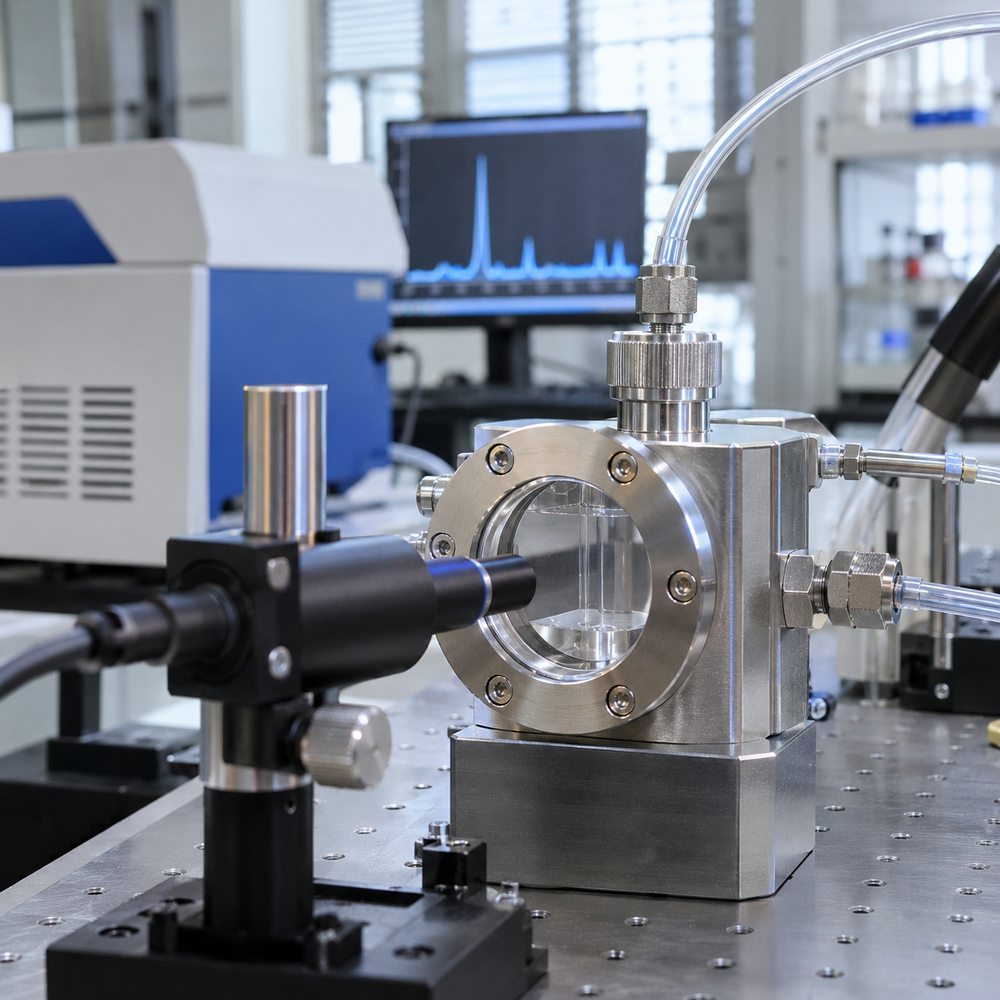
Single-crystal sapphire is a candidate window material for selected in-situ Raman systems because it combines optical transmission, high hardness, chemical durability and mechanical strength. Its advantages are especially relevant when ordinary optical glass is exposed to abrasive particles, aggressive cleaning cycles or demanding mechanical conditions. Yet sapphire also has its own Raman features and birefringence. An excellent protective window can still be a poor spectroscopic choice if its background interferes with weak sample signals.
This guide explains how engineers can evaluate sapphire windows for process Raman spectroscopy, specify the right optical and mechanical parameters, and prepare a practical request for a custom optical component.
1. Why an In-Situ Raman System Needs an Optical Process Window
Raman analysis measures the small fraction of incident light scattered with a wavelength shift associated with molecular vibrations. Since the Raman signal is usually much weaker than the illuminating laser, optical losses and unwanted background signals are important. In process equipment, the probe or free-space beam may be separated from the reaction mixture by a viewport fitted to a sampling head, pipe or reactor.
The window performs several jobs at once. It must pass the excitation wavelength and the Raman-shifted light, tolerate contact with the process medium where exposed, and maintain a stable physical separation between the optical system and the process environment. Its surfaces must also remain clean enough for repeatable measurement. Changes in contamination, alignment or temperature can affect the recorded spectrum even when the chemistry has not changed.
A sapphire window may be appropriate for particular systems, but the optical configuration and the chemical environment should always be reviewed together.
2. Sapphire Material Properties Relevant to Raman Measurement
Sapphire is single-crystal aluminum oxide, commonly written as α-Al₂O₃. It offers a broad optical transmission range, strong abrasion resistance and good dimensional stability. These properties can be useful for industrial optical ports with repetitive cleaning or particle exposure.
Material purity and crystal quality matter. Trace impurities, inclusions, strain and growth-related features can influence optical background and scattering. Because sapphire is anisotropic, its refractive index depends on polarization relative to the crystal axes. As a result, the optical response of a window is not fully defined by its diameter and thickness.
For high-sensitivity spectroscopy, a suitable optical-grade material specification should include the working wavelength range and any limits on fluorescence, inclusions or background intensity that matter to the instrument. General-purpose transparent sapphire should not automatically be assumed to satisfy low-background Raman requirements.
3. Distinguishing the Sample Raman Signal from the Window Background
A Raman spectrometer is intended to measure spectral bands generated by the sample. The sapphire window can contribute its own crystalline Raman bands, elastic scattering and, depending on material and excitation conditions, luminescent background. These features may overlap part of the sample spectrum.
The severity of interference depends on laser wavelength, window thickness, collection geometry, focus location, material grade and sample signal strength. A high-intensity sample band may be unaffected in practice, while low-concentration measurements can be more sensitive to background from the optical interface.
A good qualification procedure includes a blank measurement through the complete installed window. Engineers should record a reference spectrum with the same laser wavelength, optical settings and measurement geometry used during production. Where feasible, compare a candidate sapphire window with a reference material, then verify whether background correction remains stable after temperature changes and cleaning cycles.
No universal statement that sapphire is “Raman-free” is technically sound. Its suitability depends on the measurement target and the achievable signal-to-background ratio.
4. Excitation Wavelength and Optical Transmission
Common Raman instruments use excitation wavelengths such as 532 nm, 633 nm, 785 nm or 1064 nm. These are examples rather than a complete list. Window selection must account for the excitation beam and the broader wavelength region containing the Raman-shifted return signal.
The relevant issue is not only nominal bulk transmission. Reflections at the front and rear sapphire surfaces also affect throughput. Sapphire has a relatively high refractive index, so uncoated interfaces can contribute appreciable Fresnel reflection. For some instruments, anti-reflection coatings tailored to the laser and detection range can improve usable transmission.
Coating selection must consider the incident angle, polarization, process-side exposure, cleaning chemicals and laser power density. A coating suitable for a laboratory optical bench may not be suitable on a wetted reactor surface. Where coatings cannot tolerate the process medium, the design may use an uncoated process face and a separately optimized external face, subject to feasibility.
5. Crystal Orientation and Polarization Effects
Single-crystal sapphire is birefringent. The ordinary and extraordinary optical indices differ, and the effective optical response depends on beam direction and polarization. In polarization-sensitive Raman experiments, an inappropriate orientation can modify the polarization state reaching the sample or detector.
C-plane windows are frequently considered where a defined optical axis orientation is beneficial, but the best choice depends on the actual beam path and instrument geometry. A-plane, R-plane or other orientations may be requested for specific assemblies. Do not rely on an orientation name alone: drawings should specify the crystallographic orientation, permitted deviation and reference face.
The collection numerical aperture and angle of incidence also matter. Wide-angle rays can interact differently from a near-normal collimated beam. If the measurement depends on polarization ratios, the final window should be assessed within the assembled optical system rather than in isolation.
6. Thickness, Flatness, Parallelism and Beam Quality
A thicker window may provide greater structural capacity in some designs, but it also increases optical path through sapphire and can create more opportunity for background and internal reflections. Thickness should be chosen using the pressure boundary design, clear aperture, support geometry and optical performance requirements.
Flatness and transmitted wavefront quality influence focusing and collection. Parallel surfaces can create back-reflections, while a slight intentional wedge may redirect ghost reflections away from a sensitive optical path. Whether a wedge is useful depends on the spectrometer arrangement, and it may not be acceptable in a tightly aligned imaging system.
Surface quality should define allowable scratches, digs, chipping and polishing defects. For quantitative monitoring, dimensional tolerances should also account for mounting stresses that can introduce wavefront errors after assembly.
7. Chemical Compatibility and Fouling Control
A Raman process window may contact acids, solvents, slurries, reaction intermediates or cleaning fluids. Sapphire resists many common environments, but it is not chemically immune under all conditions. Severe acids, aggressive bases, elevated temperatures, erosion and deposits can create risks depending on the actual process.
The service review should distinguish continuous exposure from intermittent cleaning. A cleaning agent used briefly at room temperature may behave differently from the same reagent at elevated temperature. Where deposits build on the optical face, transmission can decline and the Raman baseline can drift even if the sapphire itself remains intact.
Practical maintenance strategies may involve controlled flushing, a suitable purge arrangement, approved cleaning steps or a planned inspection interval. The window should never be assumed to be self-cleaning simply because sapphire is hard.
8. Process Pressure, Seals and Mechanical Integration
A sapphire window installed in a reactor port can be part of a pressure-retaining assembly. The complete design includes the window, supporting seat, gasket or seal, retaining hardware and metal housing. Window performance must be evaluated as an assembly, not extrapolated from a catalog hardness value.
Support width, edge condition, mounting preload and temperature gradients influence fracture risk. Tightening hardware unevenly can introduce concentrated stress in a brittle component. The allowable operating pressure and proof-testing requirements must be established for the specific window geometry and service conditions.
Where the window interfaces with a stainless-steel reactor body, differential thermal expansion also deserves attention. An appropriate sealing concept should provide sufficient compliance while retaining optical alignment and leak integrity.
9. Quality Inspection for Spectroscopy-Grade Sapphire Windows
A measurement-oriented acceptance plan should go beyond dimensional inspection. Relevant checks may include diameter or length and width, thickness, orientation, surface flatness, parallelism or wedge, clear aperture, cosmetic surface quality and coating performance where applicable.
The actual Raman background is often best assessed by an application-specific optical test. An engineered blank spectrum, measured at the intended wavelength and collection settings, may be more informative than a general transmission figure. The customer should agree on which characteristics will be certified by the window manufacturer and which will be validated at instrument level.
Clean handling and appropriate packaging are also important: residues from processing or shipping can compromise an otherwise acceptable optical surface.
10. Engineering Specification Checklist
| Design parameter | Information to provide |
|---|---|
| Sapphire grade | Optical-grade single-crystal Al₂O₃ and relevant purity requirements |
| Crystal orientation | C-plane, A-plane, R-plane or drawing-defined orientation |
| Overall geometry | Diameter or length × width, thickness and tolerances |
| Optical wavelength | Excitation laser and Raman collection range |
| Optical quality | Clear aperture, flatness, surface quality and wavefront criteria |
| Coating | AR requirement, wavelength, angle, polarization and exposed surface |
| Process environment | Temperature, pressure, sample composition and cleaning reagents |
| Interface | Housing drawing, seal design, edge profile and mounting constraints |
| Testing | Background-spectrum, transmission, dimensional or leakage criteria |
| Quantity | Engineering samples and projected production volume |
For nonstandard assemblies, STEP drawings and a cross-section of the optical port help the manufacturer understand the relationship between the transparent aperture and the mechanical seal.
11. Custom Sapphire Windows for Analytical Instruments
Sapphire Windows supplies custom single-crystal optical components with selectable geometry, thickness, polishing and coating requirements. For instruments requiring carefully specified optical surfaces, its high-purity sapphire optical windows are a relevant product category for technical evaluation.
A Raman monitoring project should be reviewed against the customer’s actual beam geometry, process conditions and signal-background targets. Not every sapphire grade or coating will meet every requirement, and the final system should be qualified under its intended conditions. Where dimensions or mounting interfaces are unusual, drawing-based customization can help coordinate the optical and mechanical design.
Frequently Asked Questions
Will sapphire always produce a lower Raman background than fused silica?
No. The answer depends on excitation wavelength, sample spectrum, glass or crystal grade and the measurement configuration. Sapphire has its own Raman-active vibrational modes, so comparative blank measurements are important.
Should the window always receive an anti-reflection coating?
Not necessarily. Coatings can reduce reflection but must survive the laser, chemical exposure, cleaning method and temperature range. Uncoated sapphire may be preferable in some process environments.
Does a C-plane sapphire window eliminate birefringence concerns?
A defined orientation can simplify optical design, but off-axis rays, mounting effects and polarization-sensitive measurements still require evaluation.
What should a buyer send for a quotation?
Provide a dimensioned drawing, sapphire orientation, laser and collection wavelength, surface requirements, chemical and pressure conditions, mounting details, required tests and quantity.
Conclusion
A sapphire window can provide durable optical access for selected in-situ Raman process instruments, but its value depends on the complete optical and mechanical design. The most reliable approach is to specify the intended wavelength, investigate the window’s spectral background, account for polarization effects, and validate compatibility with the process medium and sealing system.
Need a customized sapphire optical window for a Raman instrument or industrial spectroscopic port? Submit the optical specifications and mechanical drawings through the Sapphire Windows contact page for a technical feasibility and quotation review.