
1. Введение
Optical windows are fundamental components in modern optoelectronic systems, serving as both transmission interfaces and protective barriers. In demanding environments—such as aerospace, high-power laser systems, deep-sea exploration, and semiconductor processing—the choice of window material critically influences system performance, durability, and reliability.
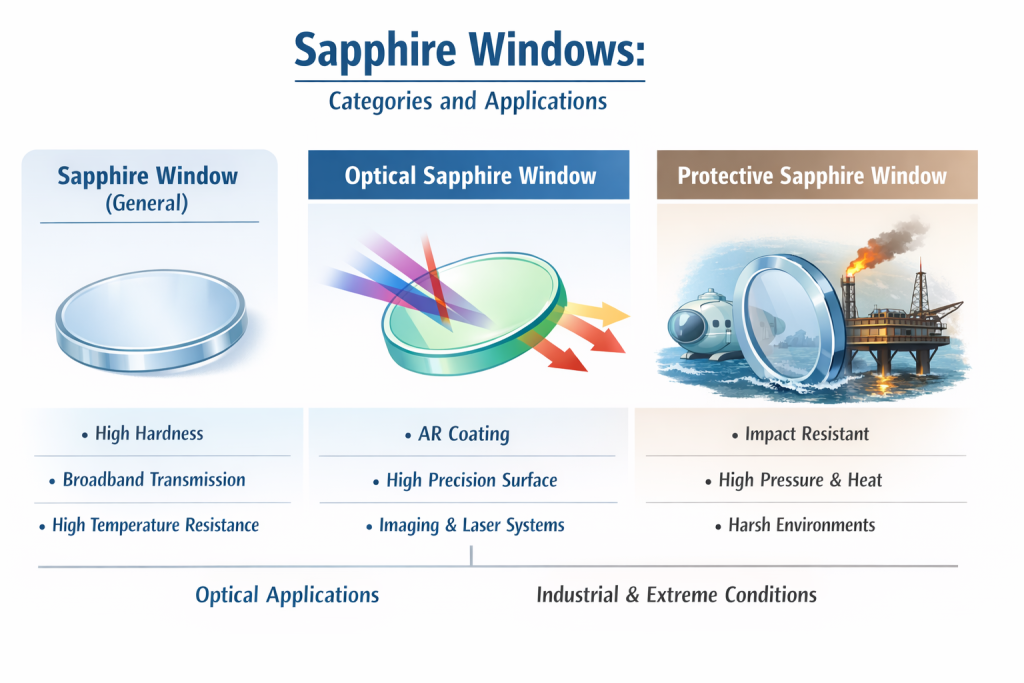
Among various materials, single-crystal sapphire (Al₂O₃) has emerged as a preferred candidate due to its exceptional combination of optical transparency, mechanical strength, and thermal stability. However, the terms сапфировое окно, sapphire optical window, and protective sapphire window are often used interchangeably, despite referring to distinct application-oriented categories.
This article provides a systematic and academically grounded explanation of these three terms, clarifying their definitions, performance requirements, and key differences.
2. General Definition of Optical Windows
An optical window is typically defined as a plane-parallel plate designed to transmit electromagnetic radiation while isolating different physical environments. Unlike lenses or prisms, optical windows do not alter the magnification or direction of light propagation; instead, their primary functions include:
- Transmission of specific wavelength ranges
- Protection of internal components from environmental exposure
- Maintenance of system integrity under mechanical or thermal stress
Common materials used for optical windows include optical glass (e.g., BK7/K9), fused silica, calcium fluoride (CaF₂), magnesium fluoride (MgF₂), zinc selenide (ZnSe), germanium (Ge), and silicon (Si). Each material is selected based on its spectral transmission range and environmental compatibility.
3. Sapphire Window: A General Category
A сапфировое окно refers broadly to any window component fabricated from single-crystal sapphire. This is a generic classification encompassing all sapphire-based window products, regardless of their specific application.
Sapphire exhibits several intrinsic properties that make it highly suitable for advanced applications:
| Недвижимость | Value / Characteristic |
|---|---|
| Crystal structure | Hexagonal (α-Al₂O₃) |
| Mohs hardness | 9 (уступает только бриллианту) |
| Температура плавления | ~2030°C |
| Transmission range | ~150 nm to 5.5 μm |
| Refractive index | ~1.76 (visible range) |
| Теплопроводность | ~25–46 W/m·K |
These properties enable sapphire windows to operate reliably in extreme conditions involving high temperature, abrasive particles, and corrosive media.
4. Optical Sapphire Windows
An оптическое сапфировое окно specifically refers to sapphire windows designed for precision optical applications, where wavefront quality and spectral performance are critical.
4.1 Application Scope
Типичные области применения включают:
- Imaging systems (cameras, sensors)
- Laser transmission and beam delivery
- Optical scanning and detection systems
- Aerospace optical payloads
Because sapphire offers broadband transmission from the ultraviolet (UV) to the near-infrared (NIR), it is especially valuable in multi-spectral systems.
4.2 Optical Performance Considerations
Despite its wide transmission range, uncoated sapphire has a relatively high refractive index (~1.76), resulting in surface reflection losses. The theoretical transmission of a bare sapphire window is typically around 82–85% in the visible range.
To optimize performance, optical sapphire windows often require specialized coatings, such as:
- Anti-reflection (AR) coatings to enhance transmission
- High-reflection (HR) coatings for selective reflection
- Bandpass or dichroic coatings for spectral filtering
- Laser-damage-resistant coatings for high-power applications
4.3 Fabrication Requirements
Optical-grade sapphire windows demand stringent manufacturing tolerances, including:
- Parallelism (wedge control): Ensures minimal beam deviation and optical path consistency
- Surface flatness: Typically specified as λ/4 or better (where λ is the wavelength of light)
- Качество поверхности: Scratch-dig specifications (e.g., 40-20 or better)
- Thickness uniformity: Critical for minimizing optical distortion
These requirements ensure that the transmitted wavefront remains undistorted, which is essential for high-resolution imaging and precision laser systems.
5. Protective Sapphire Windows
A protective sapphire window is designed primarily for mechanical protection and environmental isolation, rather than high-precision optical performance.
5.1 Application Scope
Protective sapphire windows are widely used in:
- Оборудование для глубоководных наблюдений
- Oil and gas exploration systems
- High-pressure and vacuum chambers
- Explosive or hazardous environments
- High-temperature industrial reactors
5.2 Mechanical and Environmental Advantages
The defining characteristics of protective sapphire windows include:
- Exceptional hardness: Provides superior scratch and abrasion resistance compared to glass
- High compressive strength: Enables resistance to extreme conditions
- Thermal stability: Maintains structural integrity at temperatures up to ~2000°C
- Chemical inertness: Resistant to acids, alkalis, and corrosive gases
These properties make sapphire an ideal material for environments where conventional glass or quartz would fail.
5.3 Design Priorities
Unlike optical sapphire windows, protective variants prioritize:
- Mechanical strength over optical precision
- Thickness optimization for pressure
- Edge strength and mounting reliability
- Resistance to thermal shock and chemical attack
Surface polishing and coatings may still be applied, but the tolerances are generally less stringent than those required for optical applications.
6. Key Differences Between Optical and Protective Sapphire Windows
| Aspect | Оптическое сапфировое окно | Protective Sapphire Window |
|---|---|---|
| Primary function | Optical transmission and imaging | Physical protection and isolation |
| Surface quality | High (λ/4 or better) | Умеренный |
| Параллелизм | Strictly controlled | Less critical |
| Coating requirements | Essential (AR, HR, etc.) | Optional |
| Механическая прочность | Important | Critical |
| Typical applications | Lasers, sensors, imaging | High-pressure, high-temperature environments |
7. Заключение
The term сапфировое окно serves as a broad classification encompassing both optical and protective variants. The distinction between optical sapphire windows и защитные сапфировые стекла lies primarily in their application focus and performance priorities.
Optical sapphire windows are engineered for high-precision light transmission, requiring tight control over surface quality, flatness, and coatings. In contrast, protective sapphire windows emphasize mechanical robustness and environmental resistance, making them indispensable in harsh operating conditions.
Understanding these differences is essential for selecting the appropriate sapphire window type in advanced engineering systems, ensuring optimal performance, longevity, and cost-effectiveness.