
Szafirowe okna optyczne are widely used in high-performance optical systems due to their exceptional hardness, thermal stability, chemical resistance, and broad optical transmission range. However, despite these advantages, uncoated sapphire surfaces inherently exhibit relatively high Fresnel reflection losses because of sapphire’s high refractive index. To overcome this limitation, anti-reflective (AR) coatings are commonly applied to sapphire optical windows to improve transmission efficiency and optical performance.
This article examines the working principles, coating technologies, material selection, and industrial applications of anti-reflective coatings for sapphire optical windows from an academic and engineering perspective.
Introduction to Sapphire Optical Windows
Sapphire is a single-crystal form of aluminum oxide (Al₂O₃) with excellent mechanical and optical properties. It is extensively used in:
- Systemy laserowe
- Infrared optics
- Czujniki lotnicze i kosmiczne
- Sprzęt półprzewodnikowy
- Wysokociśnieniowe rzutnie
- UV optical instruments
- Optyka wojskowa i obronna
Its Mohs hardness of 9 makes sapphire one of the hardest transparent materials available, second only to diamond. Additionally, sapphire demonstrates:
- Wysoka przewodność cieplna
- Doskonała odporność na zużycie
- Superior corrosion resistance
- Wide spectral transmission from UV to mid-IR regions
However, sapphire’s refractive index is relatively high, typically around 1.76 at visible wavelengths. As a result, each polished sapphire-air interface can reflect approximately 7–8% of incident light.
For double-sided sapphire windows, total reflection losses may exceed 14%, significantly reducing system efficiency in precision optical applications.
Fundamentals of Optical Reflection
When light encounters the boundary between two media with different refractive indices, part of the light is reflected and part is transmitted.
The Fresnel reflection at normal incidence can be approximated by:
R=(n1+n2n1−n2)2
Gdzie:
- R = reflectance
- n1 = refractive index of air
- n2 = refractive index of sapphire
Because sapphire possesses a relatively large refractive index difference compared to air, optical reflection becomes substantial.
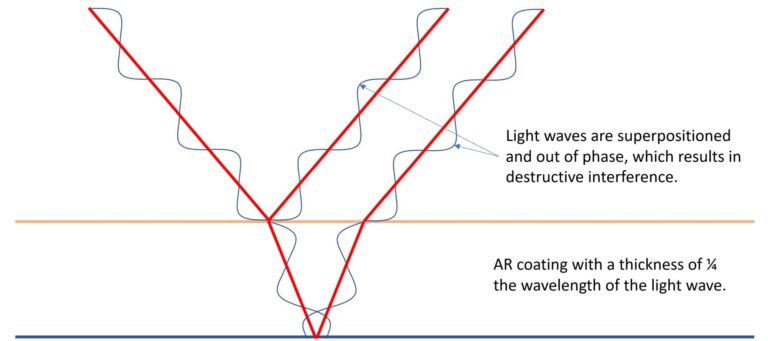
Anti-reflective coatings are designed to reduce this reflection through thin-film interference principles.
Working Principle of Anti-Reflective Coatings
AR coatings function by depositing one or multiple thin dielectric layers onto the sapphire surface.
These coatings create destructive interference between reflected light waves. When properly designed:
- Reflected waves cancel each other
- Transmission increases
- Surface glare decreases
- Optical efficiency improves
For a single-layer quarter-wave coating, the optimal refractive index is approximately:
nc=nsna
Gdzie:
- nc = coating refractive index
- ns = sapphire refractive index
- na = air refractive index
Since ideal coating materials rarely exist naturally, practical AR systems usually employ multilayer thin-film structures.
Common AR Coating Materials for Sapphire Windows
Several dielectric materials are widely used for sapphire AR coatings.
Magnesium Fluoride (MgF₂)
MgF₂ is one of the most common single-layer AR coating materials because of its relatively low refractive index.
Do zalet należą:
- Good visible-light performance
- Excellent environmental stability
- Cost-effective deposition
However, single-layer MgF₂ coatings are typically optimized only for narrow wavelength ranges.
Silicon Dioxide (SiO₂)
SiO₂ is frequently used in multilayer coatings.
Key properties:
- High chemical stability
- Low absorption
- Good UV transmission
- Strong adhesion
Hafnium Oxide (HfO₂)
HfO₂ is widely used in high-power laser optics due to:
- Wysoki próg uszkodzenia lasera
- Doskonała stabilność termiczna
- High refractive index
Titanium Dioxide (TiO₂)
TiO₂ provides high refractive index contrast for multilayer stacks.
Aplikacje obejmują:
- Broadband AR coatings
- Visible-spectrum optics
- Precision imaging systems
Types of Anti-Reflective Coatings
Single-Layer AR Coatings
Single-layer coatings are simple and economical.
Typical characteristics:
- Narrow spectral optimization
- Moderate reflection reduction
- Lower manufacturing complexity
These are suitable for:
- Standard optical instruments
- Cost-sensitive applications
Multilayer Broadband AR Coatings
Broadband AR coatings utilize multiple dielectric layers with alternating refractive indices.
Do zalet należą:
- Extremely low reflectance
- Broad wavelength coverage
- Higher transmission efficiency
Such coatings are widely used in:
- Optyka lotnicza i kosmiczna
- Semiconductor lithography
- Systemy laserowe
- Obrazowanie w podczerwieni
Dual-Band AR Coatings
Certain advanced optical systems require high transmission at two distinct wavelength bands simultaneously.
Przykłady obejmują:
- Visible + infrared systems
- Laser alignment systems
- Multispectral sensors
These coatings require sophisticated thin-film design and precise deposition control.
AR Coating Deposition Technologies
Several thin-film deposition methods are employed in sapphire optics manufacturing.
Electron Beam Evaporation
E-beam evaporation is widely used because of:
- High deposition rates
- Good optical quality
- Industrial scalability
However, film density may be lower compared to ion-assisted methods.
Ion-Assisted Deposition (IAD)
IAD improves coating density and adhesion by bombarding the growing film with energetic ions.
Korzyści obejmują:
- Enhanced durability
- Improved environmental resistance
- Better thermal stability
Magnetron Sputtering
Magnetron sputtering produces highly dense and uniform films.
Advantages:
- Excellent coating consistency
- Strong adhesion
- High precision
This process is frequently used in advanced semiconductor and aerospace optics.
Challenges in AR Coating Sapphire
Although sapphire is mechanically robust, coating sapphire surfaces presents several engineering challenges.
Thermal Expansion Mismatch
Differences in thermal expansion coefficients between sapphire and coating materials may induce stress during temperature cycling.
Potential problems include:
- Film cracking
- Delamination
- Reduced coating lifetime
High Surface Hardness
Sapphire’s extreme hardness complicates polishing and surface preparation.
Surface defects can lead to:
- Reduced coating adhesion
- Increased scattering losses
- Zniekształcenia optyczne
Trwałość środowiskowa
Certain applications expose sapphire windows to:
- High humidity
- Vacuum environments
- Plasma exposure
- Salt fog
- Cząstki ścierne
Therefore, AR coatings must maintain long-term stability under harsh operating conditions.
Industrial Applications of AR-Coated Sapphire Windows
Systemy laserowe
AR-coated sapphire windows are used in:
- High-power laser cavities
- Beam delivery systems
- Laser protective windows
Low reflectance minimizes optical loss and reduces unwanted thermal effects.
Sprzęt półprzewodnikowy
Plasma-resistant sapphire windows are widely employed in semiconductor processing systems.
AR coatings improve:
- Optical monitoring accuracy
- Sensor efficiency
- Process stability
Infrared Imaging Systems
Sapphire windows are suitable for infrared applications because of their durability and transmission properties.
Do typowych zastosowań należą:
- Kamery termowizyjne
- Głowice naprowadzające
- Industrial IR sensors
Przemysł lotniczy i obronny
Military and aerospace systems demand optics capable of surviving:
- Extreme temperatures
- High vibration
- High-speed particle impact
AR-coated sapphire windows are used in:
- Aircraft sensors
- Kopuły rakietowe
- Spaceborne optical systems
Future Trends in AR Coatings for Sapphire Optics
Research in optical thin films continues to evolve toward:
- Ultra-broadband coatings
- Nanostructured moth-eye surfaces
- High-power laser-resistant coatings
- Environmentally adaptive optical films
- AI-assisted thin-film optimization
Emerging nanostructured AR surfaces may eventually reduce dependence on conventional multilayer coatings while improving durability and transmission simultaneously.
Wnioski
Anti-reflective coatings play a critical role in maximizing the performance of sapphire optical windows. Although sapphire already offers outstanding mechanical and thermal properties, uncoated sapphire surfaces suffer from relatively high reflection losses that can limit optical system efficiency.
By applying carefully engineered thin-film coatings, manufacturers can significantly enhance transmission, reduce glare, and optimize optical performance across UV, visible, and infrared wavelengths.
As optical systems continue advancing in aerospace, semiconductor, defense, and laser industries, the demand for durable, high-performance AR-coated sapphire windows is expected to grow substantially in the coming years.