
Infrared (IR) technology plays a critical role in thermal imaging, semiconductor manufacturing, aerospace systems, environmental monitoring, defense equipment, and industrial sensing. At the heart of many infrared optical systems is the infrared window—a component designed to protect sensitive internal optics while transmitting radiation from the target with minimal loss.
Selecting the right infrared window material is a complex engineering challenge. These windows are often exposed to harsh operating conditions, including high temperatures, pressure fluctuations, sand erosion, humidity, chemical corrosion, and thermal shock. As a result, no single material can satisfy every application requirement.
An ideal infrared window material must not only provide excellent optical transmission in the desired wavelength range but also offer high mechanical strength, thermal stability, environmental durability, and cost-effectiveness.
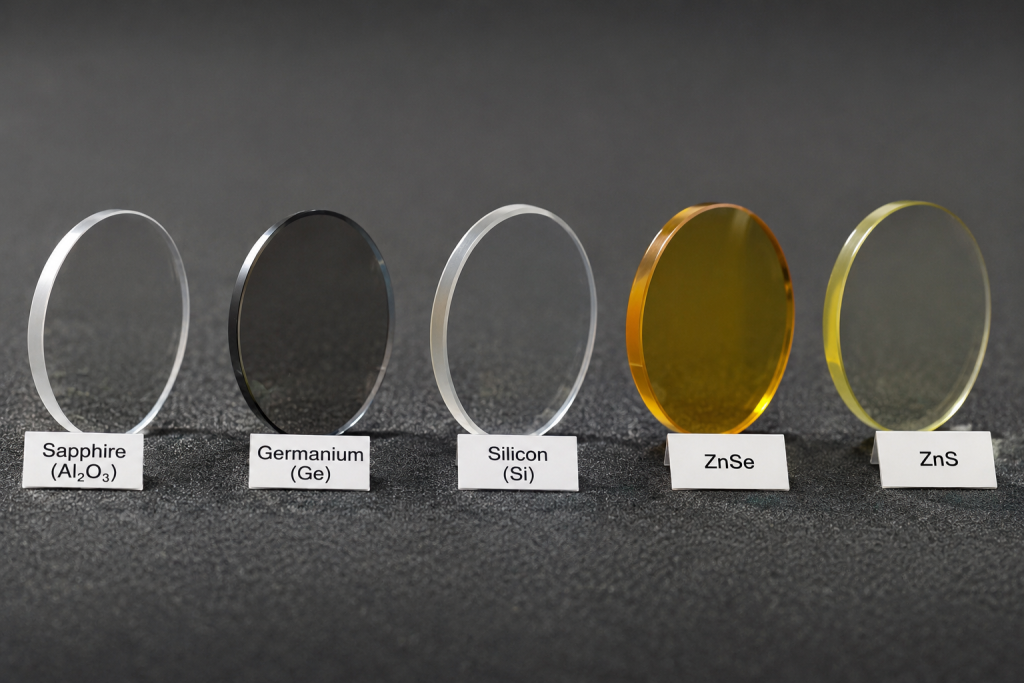
Key Requirements for Infrared Window Materials
When evaluating infrared optical materials, engineers typically consider the following properties:
Optical Performance
- Infrared transmission range
- 굴절률
- Optical absorption
- Dispersion characteristics
Mechanical Properties
- 경도
- Wear resistance
- Fracture strength
- Impact resistance
Thermal Properties
- 열 전도성
- Thermal expansion coefficient
- Thermal shock resistance
- High-temperature stability
Environmental Durability
- 내화학성
- Moisture resistance
- Salt-fog resistance
- 장기적인 신뢰성
Common Infrared Window Materials
Germanium (Ge)
Germanium has long been one of the most widely used infrared optical materials.
장점
- Excellent transmission from approximately 1.8 μm to 25 μm
- High refractive index (~4.0)
- Low optical dispersion
- Good mechanical strength
- Excellent infrared imaging performance
애플리케이션
- Thermal imaging systems
- 야간 투시경 장치
- Missile seekers
- 적외선 센서
제한 사항
Germanium is highly temperature-sensitive. As temperature increases, its transmission decreases significantly. At around 300°C, transmission in the 8–12 μm long-wave infrared region drops dramatically, making germanium unsuitable for high-temperature environments.
Silicon (Si)
Silicon is another Group IV semiconductor commonly used in infrared optics.
장점
- Lower density than germanium
- Excellent thermal conductivity
- High mechanical strength
- Relatively low cost
- Good transmission in the 3–5 μm MWIR band
애플리케이션
- Infrared windows
- Protective domes
- Industrial sensing systems
- Mid-wave infrared optics
제한 사항
Silicon exhibits a strong absorption band near 9 μm, which restricts its usefulness in the long-wave infrared region (8–12 μm). Therefore, it is generally preferred for MWIR applications rather than LWIR systems.
Zinc Sulfide (ZnS)
Zinc sulfide is one of the most important multispectral infrared materials.
주요 기능
Multispectral ZnS offers transmission across a broad wavelength range:
0.4–12 μm
This allows a single optical element to support:
- 가시광선
- Near infrared
- Mid-wave infrared
- Long-wave infrared
장점
- Wide spectral coverage
- Good mechanical strength
- Mature manufacturing technology
- Relatively low cost
애플리케이션
- Multispectral imaging systems
- 항공우주 센서
- Surveillance optics
- Infrared windows and domes
제한 사항
Compared with sapphire, ZnS has lower hardness and reduced resistance to abrasion and thermal shock.
Zinc Selenide (ZnSe)
ZnSe is widely recognized for its use in CO₂ laser systems.
장점
- Transmission from approximately 0.48 μm to 14 μm
- Low optical absorption
- Low dispersion
- Excellent laser compatibility
애플리케이션
- CO₂ laser optics
- Infrared windows
- Thermal imaging systems
- 광학 렌즈
제한 사항
ZnSe has significantly lower hardness and flexural strength than ZnS, limiting its use in harsh environments where mechanical durability is critical.
Sapphire (α-Al₂O₃): A Unique Broad-Spectrum Optical Material
사파이어 is a high-purity single-crystal form of aluminum oxide (Al₂O₃). Unlike many traditional infrared materials, sapphire offers transmission across multiple spectral regions, including:
- Ultraviolet (UV)
- 가시광선
- Near infrared (NIR)
- Mid-wave infrared (MWIR)
This broad spectral capability makes sapphire unique among optical window materials.
Exceptional Mechanical Strength
One of sapphire’s greatest advantages is its extraordinary mechanical performance.
Key Properties
- Mohs hardness of 9
- Outstanding scratch resistance
- 뛰어난 내마모성
- 높은 압축 강도
- 긴 서비스 수명
Among naturally occurring materials, only diamond is significantly harder than sapphire.
This exceptional durability makes sapphire highly attractive for applications exposed to severe environmental conditions.
일반적인 애플리케이션
- Aerospace windows
- 미사일 돔
- Underwater cameras
- Industrial inspection systems
- Sensor protection windows
Superior Thermal Shock Resistance
Infrared windows often experience rapid temperature fluctuations.
Research comparing various optical materials has shown that sapphire possesses one of the highest thermal shock resistance factors among transparent materials, second only to diamond.
Benefits
- Reduced risk of cracking
- Improved reliability under thermal cycling
- Excellent performance in high-temperature environments
- Suitability for aerospace and defense systems
These characteristics are particularly important for high-speed aircraft, missiles, and industrial process monitoring equipment.
Outstanding Chemical Stability
Environmental durability is another area where sapphire excels.
Sapphire is Resistant To:
- Most acids
- Most alkalis
- Salt-fog exposure
- Moisture-related degradation
- Chemical corrosion
This stability enables sapphire windows to operate reliably in marine, industrial, and chemically aggressive environments.
Emerging Transparent Ceramic Alternatives
Recent advances in transparent ceramics have introduced new candidates for infrared windows, including:
- Magnesium Aluminate Spinel (MgAl₂O₄)
- Aluminum Oxynitride (AlON)
- Yttria-Magnesia Nanocomposites (Y₂O₃-MgO)
These materials offer:
- High optical transparency
- Large-size manufacturing capability
- Good mechanical strength
- Potential cost advantages
Among them, Y₂O₃-MgO nanocomposites have demonstrated transmission levels in the 3–5 μm range approaching theoretical limits.
However, sapphire remains one of the most mature and thoroughly characterized optical materials available today, benefiting from decades of manufacturing experience and extensive performance databases.
적외선 창 소재의 미래 트렌드
As infrared imaging, multispectral sensing, and advanced photonic systems continue to evolve, future optical window materials are expected to deliver:
- Wider spectral transmission ranges
- Higher mechanical durability
- Better thermal shock resistance
- Larger component sizes
- Improved manufacturing efficiency
For systems requiring simultaneous transmission across UV, visible, and mid-wave infrared wavelengths, sapphire continues to be one of the most attractive solutions available.
결론
Selecting an infrared window material involves balancing optical performance, mechanical strength, thermal stability, environmental durability, and cost.
Germanium remains a leading choice for thermal imaging systems, silicon is widely used in MWIR applications, while ZnS and ZnSe play important roles in multispectral and laser optics.
Sapphire, however, stands out because of its exceptional hardness, thermal shock resistance, chemical stability, and broad spectral transmission. These unique characteristics have established sapphire as one of the most important high-performance window materials for aerospace, defense, industrial sensing, semiconductor equipment, and advanced optical systems.