
A precision sapphire window can meet all dimensional and optical specifications before assembly and still perform poorly after it is installed into a housing.
The reason is simple:
An optical window is not used in isolation.
Once a sapphire window is clamped by a retaining ring, compressed against a gasket, bonded into a metal frame, or exposed to temperature changes, mechanical stresses can be transferred into the sapphire.
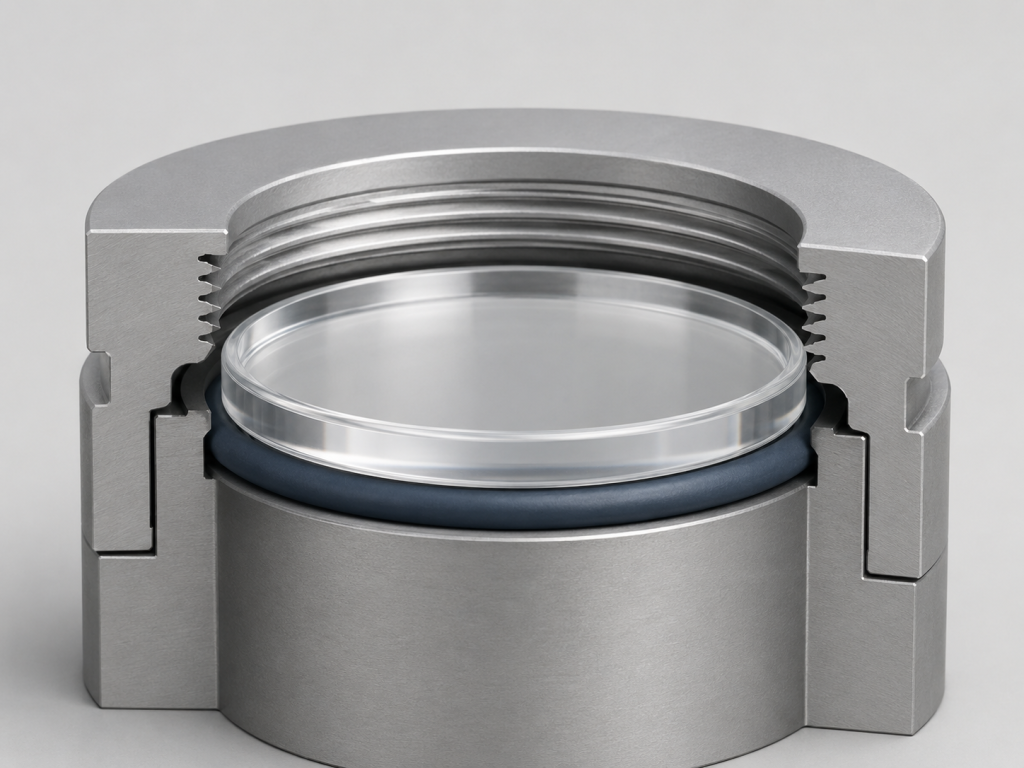
These stresses may cause:
- local deformation
- transmitted wavefront distortion
- birefringence changes
- edge damage
- coating damage
- cracking
- seal failure
- optical alignment drift
- reduced long-term reliability
Sapphire has high stiffness and mechanical strength, but it is still a brittle single-crystal material. Meller Optics lists a Young’s modulus of approximately 74 × 10⁶ psi for sapphire, illustrating its high stiffness.
For this reason, a sapphire window mounting design should not simply attempt to hold the optic as tightly as possible.
A better objective is:
Hold the window securely while controlling mechanical preload and allowing dimensional changes to occur without generating excessive stress.
This guide explains three particularly important factors:
- gasket compression
- retaining-ring preload
- coefficient of thermal expansion, or CTE, mismatch
It also provides practical recommendations for sapphire window drawings, housings and RFQs.
1. Why Does Mounting Stress Matter for Sapphire Windows?
A sapphire window may be manufactured with excellent:
- flatness
- parallelism
- surface quality
- dimensional accuracy
- coating performance
But those measurements are normally performed with the component in a relatively free state.
After installation, forces may be introduced through:
- an O-ring
- a flat elastomer gasket
- a metal retaining ring
- spring washers
- threaded components
- adhesive
- housing shoulders
- mechanical clips
- differential pressure
If the forces are uneven, the sapphire window can deform slightly.
For a general protective cover, a very small deformation may not matter.
For applications involving:
- imaging
- laser transmission
- interferometry
- spectroscopy
- precision sensors
- high-power optics
even small mounting-induced distortions can become important.
The optical specification therefore needs to be considered together with the mechanical mounting structure.
2. Sapphire Is Hard, but That Does Not Mean It Should Be Rigidly Clamped
One common misunderstanding is:
“Sapphire is extremely hard, so we can clamp it tightly.”
Hardness primarily describes resistance to scratching and indentation.
It does not mean that the material is immune to:
- tensile stress
- edge cracks
- point loading
- thermal stress
- brittle fracture
Sapphire is also extremely stiff. Because it does not elastically conform as easily as a soft polymer, uneven contact from a rigid metal mount can create localized stresses.
For this reason, the best mounting designs usually distribute the load over a controlled area.
3. Three Major Sources of Sapphire Window Mounting Stress
Most mounting-related problems can be traced to three interacting factors.
3.1 Axial Compression
This is the force applied perpendicular to the optical surfaces.
It may come from:
- retaining rings
- screw clamps
- compressed gaskets
- spring-loaded mounts
3.2 Radial Constraint
This occurs around the outside diameter or perimeter of the window.
Problems can occur when:
- housing clearance is too small
- the sapphire contacts metal directly
- adhesive completely restrains the perimeter
- thermal expansion closes the radial clearance
3.3 Thermal Expansion Mismatch
Different materials expand by different amounts when temperature changes.
If sapphire is rigidly trapped inside a metal housing, the difference in expansion can generate mechanical stress.
These three effects should be evaluated together rather than independently.
4. What Is Gasket Compression?
A gasket is commonly placed between a sapphire window and its metal housing.
Typical materials may include:
- silicone
- fluorosilicone
- FKM
- EPDM
- nitrile rubber
- PTFE-based materials
- custom elastomer compounds
The gasket may serve several functions:
- sealing
- load distribution
- shock absorption
- vibration isolation
- preventing sapphire-to-metal contact
- accommodating dimensional tolerances
- compensating for thermal movement
When an elastomer gasket or O-ring is compressed between the sapphire and housing, this deformation is commonly called compression vagy squeeze.
Parker defines O-ring squeeze as compression of the O-ring cross-section between the gland surfaces.
The amount of compression should therefore be intentionally designed rather than determined accidentally by how tightly someone turns a retaining ring.
5. Why Too Little Gasket Compression Is a Problem
Insufficient gasket compression can result in:
- poor sealing
- window movement
- vibration
- rattling
- unstable optical position
- leakage under pressure or vacuum
- loss of environmental protection
If the sapphire window can move inside the housing, shock loads may also produce edge impact.
Therefore, some controlled preload is normally necessary.
6. Why Too Much Gasket Compression Is Also a Problem
Increasing compression does not indefinitely improve performance.
Excessive gasket compression can generate a large axial load against the sapphire.
Possible consequences include:
- window bending
- localized surface stress
- edge loading
- gasket extrusion
- permanent elastomer deformation
- coating damage
- higher retaining-ring load
- difficult assembly
- premature seal degradation
Parker’s sealing guidance emphasizes that seal compression must be designed as part of the gland geometry; higher squeeze can also require substantially higher flange loads.
Therefore:
Do not specify gasket compression independently from gasket material, cross-section, hardness, groove geometry and pressure requirement.
7. Gasket Hardness Also Matters
Two gaskets compressed by the same dimensional amount can generate very different forces.
Important variables include:
- elastomer hardness
- cross-sectional thickness
- gasket width
- temperature
- material formulation
- compression percentage
- compression set
- environmental aging
A harder gasket usually resists compression more strongly than a softer gasket.
For sensitive optical windows, the mounting force therefore cannot be predicted only from the physical compression distance.
The gasket material specification should be part of the mechanical design.
8. Full-Face Gasket vs O-Ring Mounting
Two common approaches are flat gaskets and O-rings.
Flat Gasket
A flat gasket can provide a relatively large contact area.
Potential advantages include:
- distributed pressure
- simple geometry
- good environmental sealing
- reduced direct contact with the housing
However, a wide gasket can generate significant total force when heavily compressed.
O-Ring
An O-ring provides a narrower contact region and can be integrated into a controlled groove.
Advantages may include:
- repeatable gland geometry
- defined sealing region
- accommodation of dimensional variation
- easy replacement
The correct solution depends on the application rather than on a universal preference.
9. Avoid Point Loading
One of the most important mounting rules for sapphire windows is:
Avoid concentrated point loads whenever possible.
For example, directly tightening three metal set screws against the perimeter of a sapphire disk can create highly localized stresses.
A more suitable design may use:
- a retaining ring
- compliant pads
- elastomer interfaces
- spring-loaded retention
- distributed clamps
Thorlabs notes in optical mounting applications that retaining rings can apply less mechanical stress to an optic than direct setscrew loading, helping reduce bending of optical surfaces.
This principle is particularly relevant for thin sapphire windows.
10. How Retaining Rings Hold Sapphire Windows
A common sapphire window housing contains:
- a machined shoulder
- a gasket or O-ring
- the sapphire window
- another compliant layer if required
- a threaded retaining ring
The retaining ring applies axial preload and keeps the optic in the pocket.
This is compact, serviceable and widely used.
However, problems arise when the retaining ring is treated like an ordinary structural fastener.
The goal is usually not maximum torque.
The goal is controlled preload.
11. Why Retaining-Ring Torque Requires Control
When a threaded retaining ring is tightened, torque is converted into axial force.
The relationship can vary substantially depending on:
- thread geometry
- friction
- lubrication
- material
- surface finish
- retaining-ring diameter
- gasket stiffness
Therefore, simply specifying:
“Tighten firmly”
provides poor process control.
For production assemblies, better approaches may include:
- specified torque
- specified gasket compression
- mechanical stop
- controlled axial gap
- spacer
- calibrated assembly fixture
A mechanical stop is particularly useful when consistent gasket compression is required across many units.
12. Do Not Let the Retaining Ring Directly Crush the Optical Surface
A metal retaining ring directly contacting polished sapphire may create:
- concentrated load
- scratches
- coating damage
- chipping
- stress concentration
A compliant interface can help distribute the force.
Thorlabs offers “stress-free” retaining-ring designs using an elastomer O-ring to reduce stress on the optical surface, demonstrating this general mounting principle.
For custom industrial sapphire windows, similar concepts can be incorporated into OEM housing design.
13. Retaining Rings Should Contact the Non-Critical Area
The mounting area should normally remain outside the optical clear aperture.
For example, a drawing may specify:
Clear Aperture: ≥90% of diameter
with the outer perimeter reserved for:
- gasket contact
- retaining-ring loading
- coating transition
- edge bevel
This prevents mounting hardware from entering the functional optical area.
It also provides space for tolerances and edge defects that are acceptable outside the clear aperture.
14. What Is CTE Mismatch?
CTE means Coefficient of Thermal Expansion.
It describes how much a material changes dimension as temperature changes.
For a simplified linear model:
ΔL ≈ α × L × ΔT
where:
- ΔL = dimensional change
- α = coefficient of thermal expansion
- L = original dimension
- ΔT = temperature change
The critical problem occurs when the sapphire and surrounding housing have different CTE values.
The differential dimensional movement can be approximated conceptually by:
Differential expansion ≈ L × (αhousing − αsapphire) × ΔT
This difference must be accommodated somewhere in the assembly.
15. Why CTE Mismatch Matters
Imagine a sapphire disk installed tightly inside a metal ring.
At the assembly temperature, everything fits perfectly.
The system is then heated.
If the housing and sapphire expand by different amounts, several things may happen.
If sufficient clearance and gasket compliance exist, the assembly can accommodate the dimensional change.
If the sapphire is rigidly restrained, the differential movement can instead become mechanical stress.
Edmund Optics specifically notes that temperature changes can cause metal structures and retaining rings to generate stress on mounted optical elements.
Therefore, temperature range should be considered during housing design rather than only during optical coating selection.
16. Sapphire Properties Depend on Crystal Orientation
Sapphire is a single-crystal material rather than an isotropic optical glass.
Its properties can vary with crystallographic direction.
Kyocera specifically notes that characteristics of single-crystal sapphire change depending on crystal orientation.
For demanding thermal-mechanical calculations, designers should therefore use appropriate sapphire material data for:
- crystal orientation
- temperature range
- supplier material
rather than assuming one universal value for every sapphire window.
17. Metal Housing Material Matters
Common sapphire-window housings may use:
- aluminum
- stainless steel
- titanium
- nickel alloys
- other engineering metals
Each material has different:
- CTE
- stiffness
- weight
- corrosion resistance
- machinability
- operating-temperature capability
A housing material should therefore not be selected only because it is easy to machine.
For wide-temperature applications, CTE compatibility may become an important design criterion.
18. Radial Clearance Is Important
A sapphire disk should generally not be designed as a zero-clearance press fit into a rigid metal housing unless a specialized interference design has been thoroughly analyzed.
Some radial clearance can allow:
- assembly
- dimensional tolerances
- temperature expansion
- manufacturing variation
- gasket movement
For example, if the sapphire outer diameter is nominally 50 mm, the housing bore should not automatically also be specified as exactly 50 mm.
A proper tolerance stack should consider:
- maximum sapphire OD
- minimum housing ID
- temperature extremes
- coating or plating
- assembly process
- required centering accuracy
19. Clearance Should Be Checked at Temperature Extremes
Room-temperature clearance is not enough.
The designer should evaluate the worst-case condition at:
- minimum operating temperature
- maximum operating temperature
The basic question is:
Will the housing ever contract or expand relative to the sapphire enough to produce unwanted interference?
This becomes increasingly important as:
- window diameter increases
- temperature range increases
- CTE difference increases
20. Large Sapphire Windows Are More Sensitive to CTE Differences
Differential thermal expansion scales with dimension.
Therefore, the same CTE mismatch creates more absolute movement across:
- a 150 mm sapphire window
than across:
- a 10 mm sapphire window.
This is one reason large sapphire viewports require more careful mechanical design.
Az alkalmazások közé tartoznak:
- industrial observation windows
- aerospace sensor windows
- vacuum chambers
- semiconductor equipment
- high-temperature furnace windows
- underwater systems
21. Thin Sapphire Windows Are More Sensitive to Axial Clamping
Thickness affects structural stiffness.
A thin sapphire plate can be more susceptible to bending under uneven axial loading than a thick window of the same diameter.
Therefore, for thin optical windows, mounting control becomes particularly important.
Potential design measures include:
- softer compliant interfaces
- wider load distribution
- lower preload
- rigid housing shoulder
- improved flatness of support surfaces
22. Housing Shoulder Flatness Matters
Even a carefully controlled retaining ring cannot solve a poor support surface.
If the mounting shoulder is uneven, tilted or contains machining burrs, tightening the sapphire against it can introduce local loading.
The support surface should therefore be:
- flat
- clean
- burr-free
- concentric where necessary
- compatible with the gasket
Foreign particles trapped beneath a sapphire window can also behave as point loads.
Assembly cleanliness is therefore part of the mechanical reliability strategy.
23. Edge Geometry and Mounting Stress Are Related
Sapphire edge geometry should be considered together with the mount.
Common edge treatments include:
- chamfer
- bevel
- radius
- corner radius
A perfectly sharp edge can be more vulnerable to chipping.
However, an excessively large bevel may reduce the area available for:
- gasket contact
- retaining-ring contact
- sealing
The housing shoulder and gasket should therefore contact an appropriate full-thickness region rather than accidentally loading only the bevel.
24. Adhesive Bonding Can Also Create Stress
Some sapphire windows are bonded directly into housings.
Adhesive mounting can simplify assembly and provide sealing, but the adhesive becomes part of the mechanical system.
Important variables include:
- adhesive modulus
- bond-line thickness
- cure shrinkage
- operating temperature
- adhesion to sapphire
- adhesion to housing material
- chemical resistance
- moisture exposure
A very rigid adhesive layer may transfer more CTE mismatch into the sapphire.
A more compliant bond may accommodate differential movement, but it may provide lower positional rigidity.
Therefore, adhesive selection requires an application-specific tradeoff.
25. Mounting Stress Can Affect Optical Performance
Mechanical stress does not have to crack the sapphire before it becomes a problem.
A stressed sapphire window may experience:
- surface deformation
- transmitted wavefront error
- polarization changes
- stress-related birefringence effects
Sapphire itself is birefringent, and high-end sapphire windows are specifically manufactured with crystal orientation and optical quality controlled for demanding applications.
For laser or precision-imaging systems, mounted optical performance may therefore need to be verified after assembly.
26. Free-State Flatness vs Mounted Flatness
This distinction is very important.
A supplier may certify:
Surface Flatness: λ/4 @ 632.8 nm
on the unmounted sapphire window.
After installation, excessive gasket or retaining-ring force may alter the optical surface.
Therefore, for extremely demanding applications, there may actually be two relevant requirements:
Component flatness
és
Mounted-system wavefront performance
The second requirement belongs to the complete optomechanical assembly rather than only the sapphire supplier.
27. Pressure Windows Need Additional Analysis
If the sapphire window separates two different pressures, mounting design becomes even more critical.
Példák:
- vacuum systems
- pressure vessels
- underwater equipment
- process chambers
- reactor viewports
The assembly must handle:
- differential pressure
- gasket sealing force
- retaining-ring preload
- thermal expansion
- mechanical safety factor
These forces can act simultaneously.
For pressure-bearing sapphire windows, generic rules of thumb should not replace engineering analysis.
28. A Better Sapphire Window Mounting Concept
A robust mounting concept often follows these principles:
1. Provide radial clearance
Allow for dimensional tolerances and thermal expansion.
2. Use compliant contact
Avoid direct rigid metal loading where possible.
3. Control gasket compression
Do not rely on arbitrary operator torque.
4. Distribute retaining-ring force
Avoid concentrated loading.
5. Keep mounting outside the clear aperture
Reserve a defined peripheral mechanical zone.
6. Evaluate the full temperature range
Check CTE mismatch at hot and cold extremes.
7. Protect the sapphire edge
Use suitable chamfers or radii.
8. Keep mounting surfaces clean and flat
Avoid particles and burrs.
29. Example Sapphire Window Mounting Specification
For a general optical sensor window, an assembly specification might include:
Zafír ablak
Material: Optical-grade single-crystal sapphire
Diameter: 50.00 ±0.05 mm
Thickness: 3.00 ±0.05 mm
Orientation: C-plane
Surface Quality: 20-10 Scratch-Dig
Flatness: λ/4 @ 632.8 nm
Parallelism: ≤30 arcsec
Clear Aperture: ≥90%
Edge: 0.20–0.30 mm × 45° chamfer
Mounting
Housing: Machined metal housing
Retention: Threaded retaining ring
Interface: Elastomer gasket/O-ring
Radial Fit: Clearance fit, not rigid interference fit
Optical Contact: No direct metal contact within clear aperture
Retaining Preload: Controlled by gasket compression or mechanical stop
Operating Temperature: Defined by system requirement
Inspection: Visual inspection after assembly
For sensitive optical systems, mounted wavefront or transmission testing may also be specified.
30. Information to Include in an RFQ
When ordering sapphire windows for a known mechanical assembly, sending only the sapphire dimensions may not be enough.
Useful RFQ information includes:
- sapphire diameter or length × width
- thickness
- dimensional tolerances
- crystal orientation
- surface flatness
- surface quality
- parallelism
- tiszta nyílás
- edge bevel
- coating
- operating wavelength
- housing material
- mounting method
- gasket material
- operating temperature range
- pressure differential
- shock/vibration requirement
- sealing requirement
- quantity
This information allows the sapphire manufacturer to review whether the component geometry is compatible with the intended mounting design.
31. Common Sapphire Window Mounting Mistakes
Mistake 1: Tightening the Retaining Ring as Much as Possible
More torque does not automatically produce a better assembly.
Excessive preload may distort or damage the optic.
Mistake 2: Direct Metal-to-Sapphire Contact
Rigid contact increases the possibility of concentrated loads, scratches and edge damage.
Mistake 3: Zero Radial Clearance
A room-temperature fit may become an interference fit after temperature changes.
Mistake 4: Ignoring Gasket Hardness
Compression distance alone does not define gasket force.
Mistake 5: Loading the Edge Bevel
The sealing and support surfaces should be intentionally defined.
Mistake 6: Ignoring Temperature
A sapphire window that performs perfectly at 20°C may behave differently at elevated or sub-zero temperatures.
Mistake 7: Assuming Free-State Flatness Equals Mounted Performance
Mounting stress can change the optical performance of the finished assembly.
Mistake 8: Copying O-Ring Compression From Another Product
Gasket compression should match the actual seal material, hardness, cross-section, groove and pressure conditions.
32. Questions to Ask Before Finalizing the Mount
Before approving a sapphire-window mechanical design, consider:
What is the operating temperature range?
What material is the housing?
How much radial clearance remains at both temperature extremes?
How is axial preload controlled?
What is the gasket material and hardness?
Can the retaining ring contact the sapphire directly?
Does the mounting area remain outside the optical clear aperture?
Is the window pressure loaded?
Does the application require mounted wavefront verification?
Can the sapphire be replaced without damaging the coating or edge?
If these questions cannot be answered, the mounting design may require further review.
Következtetés
Sapphire window reliability depends on more than the sapphire itself.
The mechanical interface between the window and its housing can strongly influence both structural and optical performance.
Three factors are especially important:
Gasket compression controls sealing force and load distribution.
Retaining-ring preload determines how securely the optic is held and how much axial stress enters the sapphire.
CTE mismatch determines how the assembly behaves as temperature changes.
A robust sapphire window mount should therefore avoid excessive rigid constraint.
In many applications, the preferred strategy is to provide:
- controlled radial clearance
- compliant gasket contact
- distributed axial preload
- controlled retaining-ring compression
- appropriate edge geometry
- sufficient mechanical mounting area outside the clear aperture
For wide-temperature, pressure-loaded, laser or precision-imaging systems, the complete sapphire-window assembly should be treated as an optomechanical system rather than as a simple piece of transparent material.
Providing the sapphire supplier with information about the housing, gasket, operating temperature and mounting method during the RFQ stage can help identify potential problems before production.
GYIK
1. Should a sapphire window be clamped tightly in its housing?
It should be secured sufficiently for the application, but excessive clamping force should be avoided. Controlled preload is preferable to simply applying maximum retaining-ring torque.
2. Should metal retaining rings contact sapphire directly?
For sensitive optical or mechanically demanding applications, a compliant interface is often preferable because it helps distribute the load and reduces concentrated contact stress.
3. Why is radial clearance needed around a sapphire window?
Radial clearance accommodates manufacturing tolerances, assembly variation and differential thermal expansion between the sapphire and housing.
4. Can excessive O-ring compression damage a sapphire window?
Potentially yes. Excessive compression can create high axial load, particularly with hard elastomers or large sealing areas. Gland and compression should be designed according to the sealing system.
5. What is CTE mismatch?
CTE mismatch is the difference in thermal expansion behavior between sapphire and surrounding materials such as aluminum or stainless steel. If the window is rigidly constrained, temperature changes can convert that dimensional difference into mechanical stress.
6. Does crystal orientation matter for thermal mounting design?
For demanding applications, yes. Sapphire is a single crystal and some material properties depend on crystallographic orientation, so appropriate orientation-specific engineering data should be used.
7. Can mounting stress affect sapphire optical flatness?
Yes. Excessive or uneven mechanical preload can deform an optical component even without causing visible damage, potentially affecting transmitted wavefront performance.
8. What information should be sent to a sapphire window supplier?
For custom projects, provide dimensions, tolerances, orientation, surface specifications, coating, clear aperture, edge geometry, operating temperature, housing material, sealing method and relevant pressure or mechanical requirements.