
Sapphire windows are widely used in demanding optical and industrial environments such as laser systems, vacuum chambers, semiconductor equipment, aerospace sensors, and high-temperature observation systems. Their exceptional hardness, thermal stability, and optical transmission make them a premium material choice.
However, when requesting a quotation or placing an order, many buyers only provide basic dimensions, which often leads to incorrect pricing, long lead times, or unsuitable products.
To ensure accurate manufacturing and smooth procurement, here are 10 critical specifications you should clearly define before buying zafír ablakok.
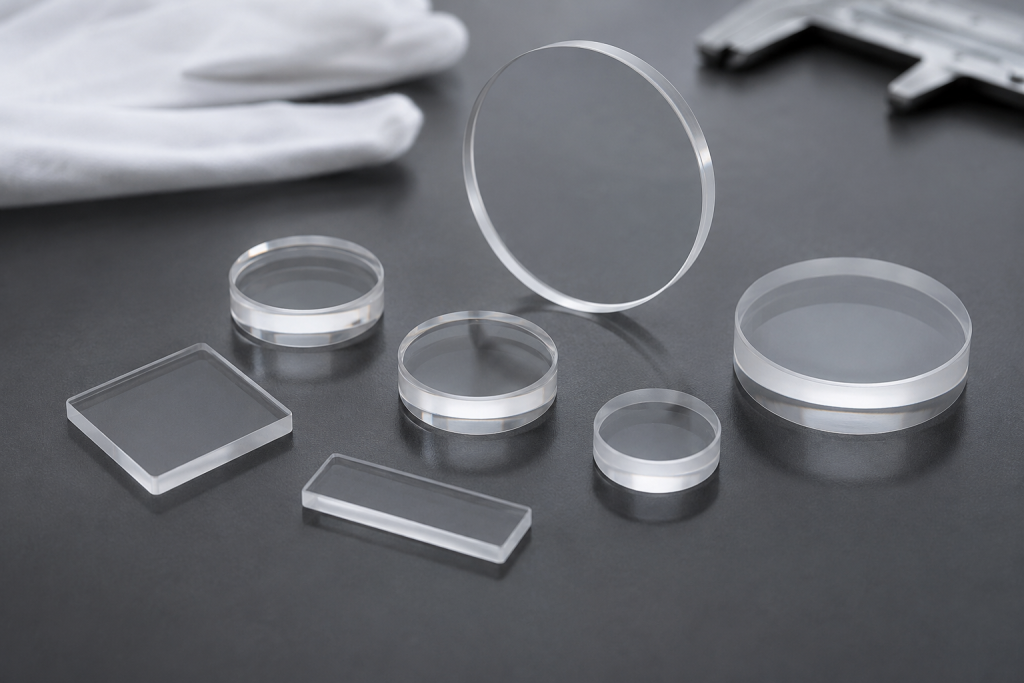
1. Dimensions (Diameter / Length / Width)
The most fundamental parameter is size. Sapphire windows can be round, square, rectangular, or custom-shaped. Always specify exact dimensions, including tolerances if required.
2. Vastagság
Thickness directly affects mechanical strength, optical performance, and cost. Common ranges vary from 0.3 mm to over 20 mm depending on application.
3. Surface Quality (Scratch-Dig)
Surface quality defines optical clarity and defect levels. Common standards include 60/40, 40/20, and 20/10. High-end laser or imaging systems often require tighter specifications.
4. Flatness
Flatness is critical for optical performance, especially in imaging and laser systems. Typical requirements range from λ/4 to λ/10 depending on precision level.
5. Parallelism
For double-sided polished sapphire windows, parallelism ensures uniform optical transmission and mechanical alignment. Tight control is required in high-precision applications.
6. Orientation (C-plane, A-plane, R-plane)
Sapphire is a single crystal material, and orientation affects optical, mechanical, and thermal properties. The most common is C-plane, but specific applications may require alternative orientations.
7. Surface Finish (Polished / Ground / Lapped)
Different finishing levels impact optical clarity and cost. Optical-grade applications require double-side polishing, while protective windows may use simpler finishes.
8. Coating Requirements
Anti-reflective (AR), high-reflective (HR), or custom optical coatings may be required depending on wavelength and application environment.
9. Edge Treatment
Edges can be chamfered, rounded, or left sharp depending on mounting structure and mechanical stress conditions. Proper edge design helps prevent chipping.
10. Application Environment
Operating conditions such as temperature, pressure (vacuum or atmospheric), chemical exposure, and laser wavelength should always be clarified. These factors influence material processing and coating selection.
Következtetés
Providing complete and accurate specifications when requesting sapphire window quotations significantly reduces communication errors and ensures better performance in the final application. For engineers and procurement teams, a detailed RFQ checklist is the key to faster lead times and optimized cost control.
If you are sourcing custom sapphire windows, always share full technical drawings and application conditions with your supplier to get the most accurate solution.
GYIK
What is the most important parameter when ordering sapphire windows?
There is no single “most important” parameter. For optical applications, surface quality, flatness, and coating are critical. For mechanical protection, thickness and edge treatment are often more important. A complete specification is always required for accurate quotation.
Can sapphire windows be customized into complex shapes?
Yes. Sapphire windows can be machined into round, square, rectangular, stepped, or custom geometries. However, complex shapes may increase cost and lead time due to the hardness of sapphire material.
Why does sapphire window pricing vary so much between suppliers?
Pricing differences are usually caused by variations in surface quality requirements, polishing grade, dimensional tolerance, crystal orientation, and coating requirements. Even small changes in specifications can significantly affect manufacturing difficulty and cost.