
Vacuum viewports provide optical access to sealed chambers used in semiconductor manufacturing, scientific research, laser processing, analytical instrumentation, and industrial inspection. Although the window itself may appear simple, its performance depends on the complete assembly: optical substrate, mounting geometry, flange interface, sealing method, and resistance to mechanical and thermal stress.
Synthetic sapphire is an attractive viewport material when equipment requires high mechanical strength, scratch resistance, chemical stability, and reliable optical performance in demanding environments. However, selecting a sapphire vacuum viewport involves more than choosing a transparent disk. Engineers must consider flange compatibility, helium leak rates, bakeout temperatures, pressure differential, thermal expansion, optical wavelength, and surface specifications.
This guide explains how to select and specify sapphire vacuum viewports for reliable operation in high-vacuum and ultrahigh-vacuum systems.
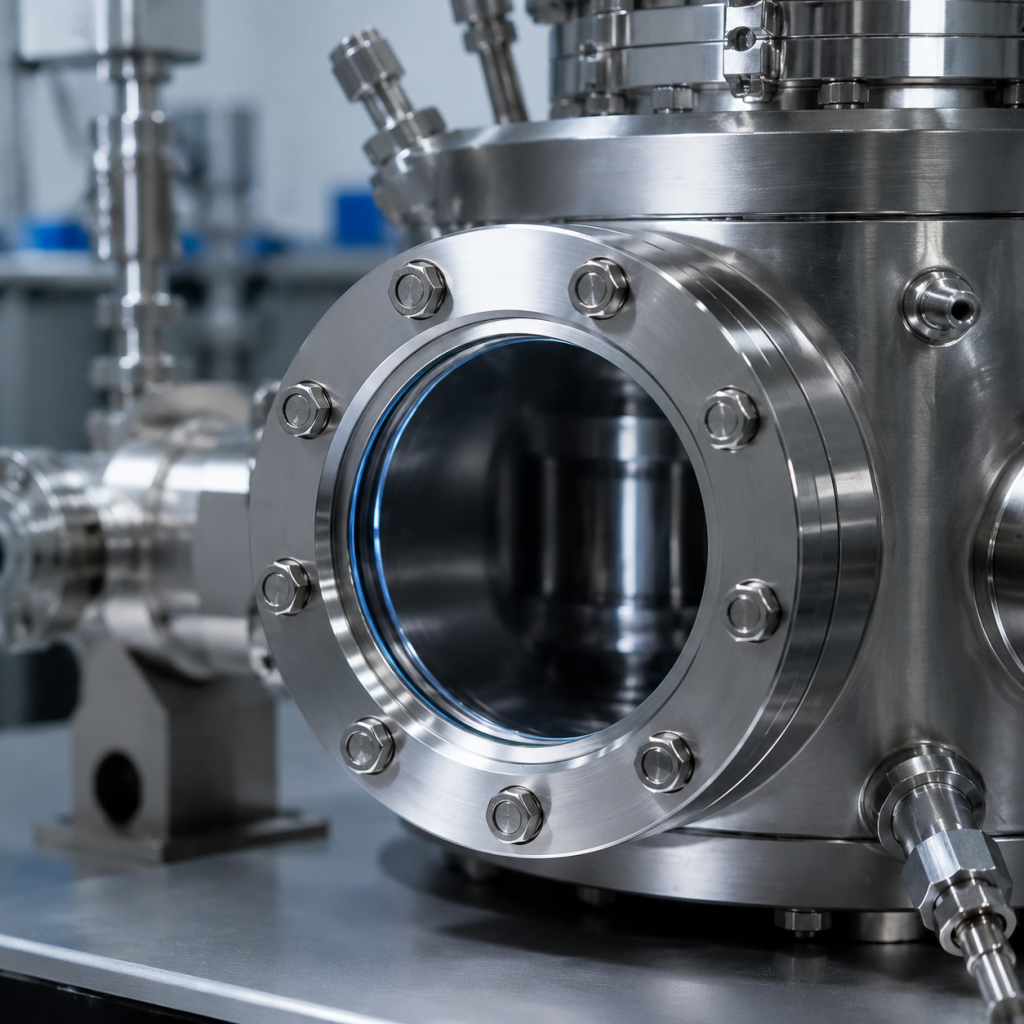
What Is a Sapphire Vacuum Viewport?
A sapphire vacuum viewport is an optical access assembly that incorporates a synthetic sapphire window into a vacuum-compatible housing or flange.
The viewport allows light to enter or exit a sealed chamber while maintaining the pressure boundary between the vacuum environment and the surrounding atmosphere.
Depending on the application, sapphire viewports may be used for:
- Visual inspection of vacuum processes.
- Laser delivery into a chamber.
- Optical spectroscopy.
- Plasma observation.
- Semiconductor process monitoring.
- Infrared sensing.
- Camera-based inspection.
- Scientific imaging.
- Optical alignment.
- High-temperature process observation.
A complete viewport generally consists of:
- A polished sapphire optical window.
- A supporting metal housing or flange.
- A sealing structure between the sapphire and its mount.
- A flange connection to the vacuum chamber.
- Optional optical coatings or protective features.
The complete assembly must provide both optical access and vacuum integrity.
Proč používat safír pro vakuová průhledová okénka?
Synthetic sapphire is a single-crystal form of aluminum oxide. Compared with many conventional optical glasses, it offers a useful combination of mechanical durability and resistance to harsh operating conditions.
Key advantages include:
- High hardness and scratch resistance.
- Strong resistance to abrasion and repeated cleaning.
- Good chemical stability.
- High mechanical stiffness.
- Compatibility with elevated temperatures when appropriately mounted.
- Optical transmission across selected ultraviolet, visible, and infrared wavelengths.
- Availability in custom sizes and geometries.
- Suitability for demanding industrial and scientific environments.
Sapphire is particularly valuable when a viewport may encounter abrasive particles, high temperatures, reactive gases, frequent maintenance, or mechanical contact.
However, its advantages do not eliminate the need for careful engineering. The mounting structure, seal, and flange often determine whether the complete viewport can meet vacuum and thermal requirements.
Typical Applications for Sapphire Vacuum Viewports
Zařízení pro zpracování polovodičů
Semiconductor systems frequently require optical access for:
- Plasma monitoring.
- Wafer inspection.
- Laser alignment.
- Optical emission spectroscopy.
- Process endpoint detection.
- Temperature measurement.
- Chamber observation.
Sapphire can be advantageous where the viewport is exposed to heat, process gases, or cleaning procedures.
The suitability of sapphire depends on the specific chemistry, plasma conditions, coating requirements, and acceptable contamination levels.
Research and Laboratory Vacuum Chambers
Research systems may use sapphire viewports for:
- Laser experiments.
- Surface analysis.
- Vacuum spectroscopy.
- Optical measurement.
- Atomic physics experiments.
- Materials characterization.
- Beamline instrumentation.
These applications often require precise control over optical flatness, parallelism, birefringence, and coating performance.
High-Temperature Vacuum Systems
Sapphire may be used in systems involving:
- Vacuum furnaces.
- Thermal processing chambers.
- High-temperature materials testing.
- Optical monitoring of heated samples.
- Industrial deposition equipment.
However, the maximum operating temperature of the assembly depends on the seal, flange, housing material, and coating—not solely on the sapphire substrate.
Industrial Inspection and Imaging
Camera-based inspection systems may require viewports that withstand:
- Dust and abrasive particles.
- Mechanical handling.
- Repeated cleaning.
- Thermal cycling.
- Vibration.
- Exposure to process contamination.
Sapphire provides a durable optical barrier when standard glass would be more vulnerable to scratching or surface damage.
Selecting the Correct Vacuum Flange
The flange determines how the viewport connects to the vacuum chamber. Choosing the correct flange type is essential for compatibility, leak tightness, maintenance, and temperature performance.
Common vacuum flange families include KF, ISO, and CF.
| Flange type | Typical sealing method | General application | Main consideration |
|---|---|---|---|
| KF | Elastomer O-ring and centering ring | Rough vacuum and many high-vacuum systems | Convenient installation but limited by elastomer performance |
| ISO | Elastomer seal with clamp or bolt connection | Larger vacuum connections and industrial chambers | Suitable for larger apertures; temperature and outgassing depend on seal selection |
| CF | Metal gasket compressed by knife-edge flanges | High-vacuum and ultrahigh-vacuum applications | Strong sealing performance and compatibility with higher-temperature bakeout |
| Custom flange | Application-specific seal or joining method | Specialized instruments and proprietary equipment | Requires detailed dimensional and operating information |
KF Flanges
KF flanges are widely used because they are compact, easy to assemble, and convenient for equipment that requires frequent maintenance.
A typical KF connection uses:
- Two mating flange surfaces.
- A centering ring.
- An elastomer O-ring.
- A clamp.
This approach is practical for many vacuum systems, but the elastomer introduces limitations related to:
- Outgassing.
- Permeation.
- Chemical compatibility.
- Maximum operating temperature.
- Long-term compression set.
For applications requiring ultrahigh vacuum or repeated high-temperature bakeout, an elastomer-sealed KF viewport may not be appropriate.
ISO Flanges
ISO flanges are commonly used for larger openings and industrial vacuum equipment.
Depending on the configuration, they can use clamps or bolts together with an elastomer seal.
ISO viewport designs are useful when a larger clear aperture is needed for cameras, process observation, or optical access.
However, as with KF connections, the vacuum and temperature limits depend heavily on the sealing material and installation quality.
CF Flanges
CF flanges are frequently selected for high-vacuum and ultrahigh-vacuum systems because they typically use a metal gasket rather than an elastomer.
The flange knife edges deform the gasket to create a vacuum seal.
Mezi výhody patří:
- Low outgassing.
- Strong vacuum integrity.
- Compatibility with demanding vacuum environments.
- Suitability for elevated-temperature bakeout when the complete viewport assembly is rated accordingly.
A CF flange does not automatically guarantee that the sapphire-to-metal seal can tolerate the same temperature as the flange. The viewport assembly must be qualified as a complete system.
Sapphire-to-Metal Sealing Methods
The seal between the sapphire window and its housing is separate from the flange-to-chamber seal.
For example, a CF viewport may use a copper gasket to connect the flange to the chamber while relying on a different joining method to attach the sapphire window to the metal housing.
Common sapphire-to-metal sealing approaches include:
- Compression seals.
- Elastomer seals.
- Adhesive bonding.
- Glass or ceramic intermediate seals.
- Metalized and brazed joints.
- Application-specific hermetic joining methods.
Elastomer-Sealed Sapphire Windows
An elastomer seal can provide a practical solution for moderate vacuum applications where maintenance and cost are important.
Advantages may include:
- Replaceable windows.
- Simpler assembly.
- Lower initial cost.
- Tolerance for some dimensional variation.
Limitations can include:
- Outgassing.
- Gas permeation.
- Restricted bakeout temperature.
- Reduced compatibility with certain chemicals.
- Long-term aging.
The actual suitability depends on the selected elastomer, process environment, temperature, and vacuum level.
Adhesive-Bonded Viewports
Adhesive bonding can be useful for selected optical assemblies, but it requires careful evaluation in vacuum systems.
Potential concerns include:
- Outgassing.
- Chemical degradation.
- Temperature limitations.
- Creep under mechanical stress.
- Changes in optical alignment.
- Long-term vacuum contamination.
Vacuum-compatible adhesives may be suitable for specific applications, but they should not be assumed to meet ultrahigh-vacuum requirements without qualification.
Brazed Sapphire-to-Metal Assemblies
Brazing is commonly considered when a viewport requires a durable, hermetic connection between sapphire and a metal housing.
Depending on the design, the sapphire surface may receive a metalized layer before brazing, or the assembly may use an active brazing approach suitable for ceramic-to-metal joining.
Potential advantages include:
- Strong mechanical attachment.
- Hermetic sealing.
- Improved resistance to demanding vacuum conditions.
- Compatibility with elevated temperatures when properly engineered.
- Reduced dependence on elastomer materials.
The key challenge is managing thermal expansion differences between sapphire and the metal housing.
A poorly designed brazed joint can crack the sapphire, distort the window, or fail after repeated thermal cycling.
Understanding Vacuum Leak Tightness
Leak tightness describes the ability of the viewport assembly to prevent gas from entering the vacuum chamber through unintended openings.
A viewport may leak through:
- The sapphire-to-metal interface.
- A damaged sapphire window.
- The flange gasket.
- A contaminated sealing surface.
- Weld defects.
- Porosity in a joining material.
- Assembly damage.
- Improper bolt tightening.
Leak performance is often evaluated using helium leak detection.
Helium is useful because it is a small gas molecule and can be detected at very low concentrations.
Leak rates are commonly expressed in units such as:
The acceptable leak rate depends on the vacuum level and application.
For demanding high-vacuum or ultrahigh-vacuum assemblies, requirements may be specified at approximately:
or lower, depending on the equipment design and customer requirements.
This value should not be treated as a universal standard. The required acceptance limit must be agreed upon for the specific application.
Leak Rate Versus Outgassing
Leakage and outgassing are different issues.
A leak allows external gas to enter the vacuum chamber through a physical opening.
Outgassing occurs when materials inside the vacuum environment release absorbed or trapped gases.
A viewport can pass a helium leak test while still contributing excessive outgassing if it contains unsuitable adhesives, elastomers, coatings, or contaminated surfaces.
For sensitive vacuum systems, both leak tightness and material cleanliness must be evaluated.
Pressure Differential and Mechanical Loading
A vacuum viewport typically experiences a pressure difference between atmospheric pressure outside the chamber and reduced pressure inside.
Even when the internal chamber pressure approaches a high-vacuum condition, the maximum differential is approximately one atmosphere unless additional pressure loads are present.
However, the total mechanical force acting on the window increases with its exposed area.
For a circular viewport:
Kde:
- is the total applied force.
- is the pressure differential.
- is the unsupported window area.
A larger window therefore experiences a greater total load than a smaller window under the same pressure difference.
Window strength depends on more than thickness alone. Relevant factors include:
- Unsupported diameter.
- Window thickness.
- Edge condition.
- Surface defects.
- Mounting geometry.
- Clamping pressure.
- Crystal orientation.
- Thermal stress.
- Safety factor.
- Pressure cycling.
- Manufacturing quality.
Sapphire is mechanically strong, but it is still a brittle material. Localized defects, edge chips, or excessive clamping forces can significantly affect reliability.
Final thickness selection should be based on application-specific engineering calculations and verification rather than a generic thickness recommendation.
Thermal Cycling and Bakeout Considerations
Vacuum systems are often heated during bakeout to remove moisture and volatile contaminants from internal surfaces.
A sapphire vacuum viewport must tolerate the thermal cycle without:
- Cracking.
- Losing vacuum integrity.
- Delaminating coatings.
- Developing excessive optical distortion.
- Damaging the gasket.
- Creating stress at the sapphire-to-metal interface.
Thermal Expansion Mismatch
Sapphire and metal housings generally expand at different rates when heated.
If the sapphire is rigidly constrained, differential expansion can create stress at the window perimeter.
This is especially important for:
- Brazed assemblies.
- Large-diameter windows.
- Thick metal housings.
- Rapid heating or cooling.
- Repeated temperature cycles.
- Systems with substantial temperature gradients.
Possible engineering approaches include:
- Selecting compatible housing materials.
- Incorporating compliant intermediate layers.
- Optimizing joint geometry.
- Limiting thermal ramp rates.
- Controlling mounting preload.
- Reducing abrupt temperature gradients.
Maximum Bakeout Temperature
The maximum allowable bakeout temperature should be specified for the complete viewport assembly.
The limiting component could be:
- An elastomer seal.
- An adhesive.
- A brazed joint.
- An optical coating.
- A metalized interface.
- The flange gasket.
- The supporting housing.
It is not sufficient to state that sapphire can tolerate high temperatures. The relevant question is whether the assembled viewport can maintain its optical and vacuum performance at the required temperature.
Tepelný šok
Rapid temperature changes can create uneven expansion across the sapphire window.
Thermal shock risk increases when:
- One side of the window is heated more rapidly than the other.
- A cold window is exposed to intense process radiation.
- A hot assembly is rapidly cooled.
- The edge is tightly constrained.
- Localized heating occurs near the mounting interface.
Controlled heating and cooling procedures can help reduce mechanical stress and extend service life.
Optical Transmission and Wavelength Requirements
Sapphire is used in optical systems because it can transmit light across a broad range of wavelengths, depending on material grade, crystal quality, thickness, and surface condition.
However, a viewport should always be specified for its actual operating wavelength.
Příklady zahrnují:
- Visible-light observation.
- Near-infrared imaging.
- Ultraviolet optical access.
- Laser transmission.
- Optical emission spectroscopy.
- Infrared temperature measurement.
Transmission can be affected by:
- Sapphire thickness.
- Material purity.
- Surface polish.
- Reflection at each interface.
- Optical coatings.
- Contamination.
- Radiation exposure.
- Operating temperature.
A viewport intended for visible-light imaging may not be appropriate for a specific infrared wavelength without verification.
Reflection Losses
Sapphire has a relatively high refractive index compared with many optical glasses.
As a result, uncoated sapphire surfaces can produce noticeable reflection losses.
For applications where maximum transmission is important, anti-reflective coatings may be applied to one or both surfaces.
The coating should be designed for:
- Operating wavelength.
- Angle of incidence.
- Polarization requirements.
- Vacuum compatibility.
- Temperature exposure.
- Cleaning procedures.
- Environmental durability.
A standard visible-light AR coating may not perform well for ultraviolet lasers, near-infrared detectors, or broadband spectroscopy.
Surface Quality Requirements
Surface quality affects image clarity, scattered light, measurement accuracy, and laser performance.
Important specifications may include:
- Scratch-dig quality.
- Surface roughness.
- Flatness.
- Parallelism.
- Wedge.
- Clear aperture.
- Edge finish.
Scratch-Dig Quality
Scratch-dig specifications define allowable visible surface imperfections.
Common examples include:
- 60-40 for general optical observation.
- 40-20 for more demanding imaging applications.
- 20-10 for high-performance optical systems.
The appropriate specification depends on the application.
A simple chamber observation viewport may not require the same surface quality as a window used for high-resolution imaging or laser beam delivery.
Drsnost povrchu
Low surface roughness reduces optical scattering and can support better coating performance.
It may be particularly important for:
- Laser systems.
- Sensitive imaging equipment.
- High-resolution spectroscopy.
- Low-scatter optical measurements.
- Precision detector assemblies.
The required roughness should be defined according to the actual optical function of the window.
Plochost
Surface flatness influences wavefront quality and imaging accuracy.
Excessive deviation from flatness can cause:
- Image distortion.
- Beam deformation.
- Focus changes.
- Measurement error.
- Reduced optical system performance.
Flatness should normally be specified over the functional clear aperture.
Parallelism and Wedge
If the two polished surfaces are not sufficiently parallel, the viewport can deviate a transmitted beam.
This matters in applications such as:
- Laser alignment.
- Precision spectroscopy.
- Interferometry.
- Optical metrology.
- Imaging systems with strict positional tolerances.
In some cases, a deliberate wedge may be useful to reduce unwanted interference fringes or back reflections. The correct approach depends on the optical design.
Sapphire Birefringence and Crystal Orientation
Sapphire is an anisotropic crystal, which means its optical behavior can depend on crystal orientation and light polarization.
This becomes important when the viewport is used in:
- Polarization-sensitive measurements.
- Interferometry.
- Laser experiments.
- Optical sensing.
- Precision spectroscopy.
Depending on the application, crystal orientation may influence:
- Birefringence.
- Polarization behavior.
- Optical retardation.
- Transmission characteristics.
- Mechanical properties.
For polarization-sensitive systems, the sapphire orientation should be specified during the design stage.
Common orientation terminology may include:
- C-plane sapphire.
- A-plane sapphire.
- M-plane sapphire.
- Other custom crystal orientations.
A viewport intended only for visual inspection may not require tightly controlled orientation. A precision optical experiment may require detailed orientation and polarization specifications.
Clear Aperture and Edge Exclusion
The physical window diameter is not the same as the usable optical aperture.
The clear aperture is the area through which the required optical performance is guaranteed.
The outer edge may contain:
- Mounting contact.
- Metalized regions.
- Brazed joints.
- Seal compression zones.
- Edge chamfers.
- Coating exclusions.
- Cosmetic imperfections outside the optical area.
For example, a viewport may have a relatively large sapphire disk but a smaller effective optical opening because part of the perimeter is occupied by the seal and support structure.
The specification should define:
- Overall sapphire diameter.
- Visible or clear aperture.
- Coating coverage.
- Edge exclusion.
- Mounting width.
- Acceptable cosmetic defects outside the clear aperture.
This prevents misunderstandings between optical designers and mechanical engineers.
Contamination and Vacuum Compatibility
A viewport can introduce contamination if its materials, coatings, or assembly procedures are not suitable for vacuum service.
Potential contamination sources include:
- Polishing residue.
- Adhesive outgassing.
- Elastomer compounds.
- Fingerprints.
- Particles.
- Cleaning solvent residue.
- Packaging materials.
- Coating contamination.
- Corrosion products.
Vacuum-compatible manufacturing and cleaning procedures may include:
- Controlled cleaning.
- Particle inspection.
- Appropriate packaging.
- Low-outgassing material selection.
- Clean assembly.
- Protected handling.
- Preconditioning or bakeout where appropriate.
For semiconductor equipment, additional contamination requirements may apply to particles, metallic impurities, and residues.
Sapphire Versus Fused Silica for Vacuum Viewports
Sapphire and fused silica are both used in vacuum optical systems, but they offer different advantages.
| Consideration | Sapphire | Fused silica |
|---|---|---|
| Odolnost proti poškrábání | Velmi vysoká | Nižší než safír |
| Mechanical stiffness | Vysoká | Generally lower |
| Optical birefringence | Can be significant depending on orientation | Generally not subject to sapphire’s crystal-orientation effects |
| Tepelná roztažnost | Higher than fused silica and orientation-dependent | Very low |
| Thermal shock behavior | Depends strongly on design and mounting | Often favorable due to low thermal expansion |
| Náklady na materiál | Typically higher | Often more economical |
| Harsh mechanical environments | Particularly suitable | May require additional protection |
| Optical selection | Depends on wavelength, orientation, and coatings | Widely used for ultraviolet, visible, and near-infrared systems |
Sapphire is often preferred when mechanical durability and scratch resistance are especially important.
Fused silica may be preferable when low thermal expansion, reduced birefringence, or cost are more important.
The best choice depends on the complete optical and mechanical requirements.
Common Causes of Sapphire Viewport Failure
Typical failure mechanisms include:
Excessive Mounting Stress
Overtightening a retaining ring or applying uneven compression can create localized stress and cause cracking.
Edge Damage
Small edge chips introduced during handling may act as stress-concentration points.
Thermal Expansion Mismatch
Differences between sapphire and housing expansion can damage the seal or fracture the window during heating and cooling.
Inadequate Flange Installation
Damaged gaskets, contaminated sealing surfaces, or improper tightening can cause vacuum leakage.
Coating Degradation
A coating that is not suitable for the operating temperature or process chemistry may degrade or delaminate.
Pressure Cycling
Repeated changes in chamber pressure can fatigue the seal or expose mechanical weaknesses.
Process Contamination
Deposits on the window surface may reduce transmission and make optical measurements unreliable.
A well-designed viewport should address these risks before production rather than relying on corrective maintenance after installation.
Information to Include in a Sapphire Viewport RFQ
To obtain an accurate technical proposal or quotation, provide:
- Flange type: KF, ISO, CF, or custom.
- Flange size and dimensional drawing.
- Sapphire window diameter or overall dimensions.
- Required clear aperture.
- Window thickness.
- Dimensional tolerances.
- Operating vacuum range.
- Maximum allowable helium leak rate.
- Pressure differential.
- Operating temperature.
- Maximum bakeout temperature.
- Heating and cooling cycle requirements.
- Optical wavelength range.
- Required transmission.
- Surface quality.
- Surface flatness.
- Parallelism or wedge.
- Crystal orientation, if relevant.
- AR coating requirements.
- Sapphire-to-metal sealing method, if specified.
- Housing material.
- Chemical or plasma exposure.
- Cleaning requirements.
- Prototype quantity.
- Expected production volume.
For custom equipment, a mechanical drawing and a description of the optical path are particularly helpful.
If the viewport is intended for ultrahigh vacuum, identify acceptable materials for gaskets, adhesives, coatings, and joining processes.
Často kladené otázky
Are sapphire viewports suitable for ultrahigh vacuum?
They can be suitable when the complete assembly uses appropriate low-outgassing materials, a qualified sapphire-to-metal seal, and a compatible flange connection. The sapphire substrate alone does not determine ultrahigh-vacuum suitability.
Can sapphire viewports be baked?
Many sapphire viewport assemblies can be designed for bakeout, but the allowable temperature depends on the seal, flange, coating, housing, and joining method. Always confirm the complete assembly rating.
Is a CF flange better than a KF flange?
Neither is universally better. CF flanges are generally preferred for demanding high-vacuum and ultrahigh-vacuum applications, while KF flanges are convenient for systems requiring easier installation and maintenance.
Does a thicker sapphire window always perform better?
No. Increased thickness may improve mechanical robustness, but it can also affect optical transmission, cost, weight, and thermal behavior. Thickness should be determined from the clear aperture, pressure differential, mounting method, and safety requirements.
Does crystal orientation matter?
Crystal orientation can be important for polarization-sensitive optical systems, laser applications, and precision measurements. For general observation, it may be less critical.
How is viewport leak tightness verified?
Helium leak detection is commonly used to evaluate the assembled viewport. The acceptance limit should be defined according to the required vacuum performance and equipment specifications.
Závěr
Sapphire vacuum viewports provide durable optical access for semiconductor tools, research chambers, industrial inspection systems, and demanding high-temperature equipment.
Successful selection requires more than specifying a sapphire disk. Flange integration, sapphire-to-metal sealing, helium leak tightness, thermal cycling, pressure loading, optical quality, and vacuum cleanliness must all be considered together.
A properly engineered viewport balances mechanical strength with reliable sealing and application-specific optical performance. By defining the operating environment, clear aperture, flange type, leak-rate requirements, bakeout conditions, and optical specifications early in the design process, equipment manufacturers can select a sapphire viewport that supports dependable long-term operation.