
Hydrogen energy, high-pressure gas research, fuel cell testing, gas compression, pressure vessels, and optical diagnostics all require reliable observation or sensing access. In many systems, engineers need a transparent window that can separate a pressurized gas environment from the outside while still allowing light, laser beams, cameras, sensors, or spectrometers to work through the chamber wall.
This is where sapphire windows become valuable. Sapphire is not a common glass. It is single-crystal aluminum oxide, Al₂O₃, with high hardness, strong wear resistance, thermal stability, chemical resistance, and broad optical transparency. These properties make it suitable for harsh environments where ordinary glass, polymer windows, or lower-strength optical materials may not provide enough long-term reliability.
However, using sapphire in hydrogen or high-pressure gas systems is not only a material selection decision. It is also a design safety decision. Hydrogen service requires careful evaluation of pressure, temperature, sealing method, metal housing, gasket material, pressure cycling, leakage risk, and inspection standards. Hydrogen compatibility guidance emphasizes that materials exposed to hydrogen must be selected carefully because pressure, temperature, mechanical loading, and the specific material all influence performance and potential deterioration.
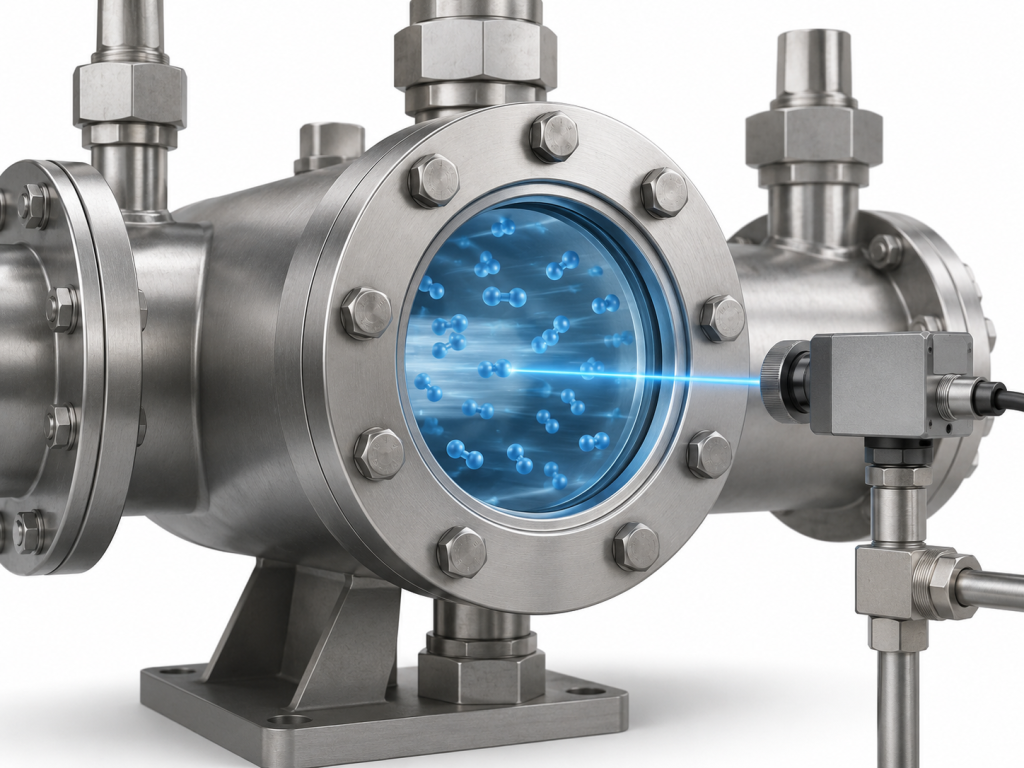
Why Hydrogen and High-Pressure Gas Systems Need Optical Windows
In high-pressure gas systems, optical windows are commonly used for:
- Visual inspection of the internal chamber
- Laser absorption spectroscopy
- Raman spectroscopy
- Combustion and reaction monitoring
- High-pressure gas research
- Fuel cell and hydrogen test equipment
- Gas sensor protection
- Plasma or catalytic reaction observation
- High-pressure reactor viewports
- Leak detection and process monitoring
For hydrogen systems, optical access is especially useful because hydrogen is colorless and difficult to observe directly. Engineers may need optical methods to monitor flame behavior, gas mixing, catalytic reactions, chamber contamination, thermal gradients, or process stability. A sapphire window allows optical access while maintaining separation between the pressurized hydrogen environment and the outside atmosphere.
Key Material Benefits of Sapphire Windows
1. High Mechanical Strength for Pressure Environments
High-pressure windows must resist stress caused by differential pressure. The larger the unsupported aperture, the higher the bending stress on the window. Sapphire has much higher hardness, stiffness, and mechanical strength than many common optical glasses, which is why it is frequently selected for pressure windows and viewports.
Technical pressure window references list sapphire with high Young’s modulus, high hardness, strong compressive strength, and higher mechanical performance than common fused silica or optical glass options. They also emphasize that clamped or unclamped mounting conditions, pressure load, window geometry, and safety factor must be considered during pressure window design.
This does not mean a sapphire window can be made thin without calculation. It means sapphire gives engineers a stronger material foundation when the window must work under pressure, vibration, thermal load, or repeated handling.
2. Excellent Optical Transparency from UV to Infrared
Sapphire windows are useful because they provide both strength and optical function. Single-crystal sapphire offers high transmittance across a wide wavelength range from ultraviolet to infrared, making it suitable for observation windows and sensing windows.
This is important in hydrogen and gas systems because different monitoring methods use different wavelengths. For example, UV, visible, near-infrared, and laser-based systems may all require window materials with stable optical transmission. If higher transmission is required at a specific wavelength, anti-reflective coating may be considered, because sapphire has a relatively high refractive index and surface reflection can reduce total transmission.
3. Chemical Resistance in Harsh Gas and Process Environments
Hydrogen itself is not the only concern. Many hydrogen-related systems also involve moisture, oxygen traces, catalytic materials, cleaning agents, high temperature, plasma, or corrosive by-products. Sapphire’s chemical resistance and wear resistance make it useful in environments where the window surface must remain clean, stable, and transparent over time.
Sapphire is used as observation windows and sensing windows partly because it resists corrosion and wear while maintaining optical transparency. For high-pressure gas systems, this helps reduce surface degradation, scratching, and contamination-related optical loss.
4. High Temperature Resistance
High-pressure gas systems may involve elevated temperature, rapid temperature change, or localized heating. Hydrogen combustion studies, high-temperature reactors, catalytic chambers, and process monitoring equipment may all require a window material that can tolerate thermal stress better than ordinary glass.
Sapphire viewports are widely used in demanding high-vacuum and high-temperature environments because sapphire provides strong thermomechanical properties, high optical transmission, and long-service scratch resistance.
5. Suitable for Hermetic or Vacuum-Related Assemblies
A sapphire window is often not used as a loose disc. In many high-pressure or vacuum-related systems, it must be assembled into a metal housing, flange, or sealed viewport. Sapphire can be metallized and brazed to other materials for high-airtightness assemblies, which is important for vacuum devices and sealed optical packages.
This is especially relevant for hydrogen systems, where leakage control is critical. A good window material alone is not enough. The seal between sapphire and metal, the gasket, the flange, and the housing design must all work together.
Where Sapphire Windows Can Be Used in Hydrogen Systems
Hydrogen Fuel Cell Test Chambers
Fuel cell testing may require optical monitoring of humidification, gas flow, thermal distribution, or reaction behavior. A sapphire window can provide visual or optical access while resisting moisture, pressure, and temperature changes.
High-Pressure Hydrogen Research Cells
Research systems may use sapphire windows for spectroscopy, laser diagnostics, or high-pressure gas observation. A published sapphire optical viewport design was operated from 20°C to 450°C and up to 330 bar in a noble gas environment, showing how sapphire viewports can be engineered for demanding high-pressure and high-temperature optical access.
Although noble gas testing is not the same as hydrogen service, this example shows the importance of the full viewport structure, including bonding, flange design, and stress control.
Hydrogen Compressors and Storage-Related Monitoring
Hydrogen compression and storage systems may require sensors, visual confirmation points, or protected optical components. Sapphire windows can protect optical sensors from mechanical wear, gas pressure, and environmental exposure.
High-Pressure Gas Reactors
Hydrogen is often used in chemical reactions, catalytic studies, material treatment, and laboratory-scale reactors. Sapphire windows can allow observation of reaction zones, catalysts, flame behavior, or phase changes under pressure.
Leak Detection and Optical Gas Sensing
Optical gas sensing may require a window that separates the sensor from the pressurized gas path. Sapphire can be used as a protective optical barrier when the sensor needs stable transmission and strong mechanical protection.
Major Design Risks Buyers Should Understand
1. Pressure Failure from Incorrect Thickness or Aperture Design
The first risk is mechanical failure under pressure. Window thickness cannot be selected only by experience. It depends on:
- Pressure difference
- Unsupported diameter or clear aperture
- Window shape
- Edge support condition
- Safety factor
- Material strength
- Surface defects
- Pressure cycling
- Temperature
- Mounting method
A small sapphire window may safely handle much higher pressure than a large window of the same thickness. The unsupported diameter is especially important. A larger aperture greatly increases bending stress, so increasing window diameter often requires a significant increase in thickness.
For safety-critical hydrogen systems, the sapphire window should be treated as part of the pressure boundary, not just as an optical component.
2. Edge Chipping and Microcracks
Sapphire is very hard, but it is still a brittle crystal. Edge chips, scratches, subsurface damage, and microcracks can become failure points under pressure. This is especially important when the window is exposed to pressure cycling.
To reduce this risk, buyers should specify:
- Proper chamfer or bevel
- Polished or fine-ground edges
- Controlled surface quality
- No visible chips in the clear aperture
- Inspection under magnification
- Protective packaging
- Safe installation procedure
A poorly handled sapphire window may look acceptable at first but fail earlier under pressure because small edge defects concentrate stress.
3. Mounting Stress from Over-Clamping
A sapphire window must be held firmly enough to seal, but not so aggressively that the housing creates harmful local stress. Over-clamping, uneven compression, metal burrs, misalignment, or point contact can cause cracking.
Good mounting design should consider:
- Flat and clean support surfaces
- Uniform gasket compression
- No metal-to-sapphire hard point contact
- Proper retainer geometry
- Controlled torque
- Avoiding sharp internal corners
- Thermal expansion differences between metal and sapphire
For high-pressure gas systems, the window should be supported in a way that distributes load evenly.
4. Hydrogen Compatibility of the Whole Assembly
The sapphire disc may be chemically stable, but the complete assembly includes metal parts, welds, brazed joints, elastomer seals, gaskets, adhesives, and coatings. These surrounding materials may be more vulnerable than the sapphire itself.
Hydrogen can degrade metals by embrittlement, reducing ductility, tensile strength, fracture toughness, and fatigue resistance. Sandia also notes that hydrogen can interact with metals used in valves, fuel tanks, and storage vessels, introducing damage and potential long-term degradation.
Therefore, a sapphire window for hydrogen service should not be evaluated as “sapphire only.” The full assembly must be reviewed for hydrogen compatibility.
5. Seal Leakage and Permeation
Hydrogen is difficult to seal because it has a very small molecular size and high diffusivity. Elastomer seals, polymer gaskets, and some adhesive systems may allow permeation or suffer long-term degradation. In high-pressure hydrogen systems, sealing materials may also face rapid gas decompression damage during pressure release.
This is why metal seals, brazed assemblies, or carefully selected hydrogen-compatible elastomers may be required depending on pressure level, leak rate requirement, and safety classification.
6. Thermal Expansion Mismatch
Sapphire and metal housings expand at different rates when temperature changes. If the window is brazed, clamped, or sealed into a metal component, temperature cycling can create stress at the interface.
This risk becomes more serious in:
- High-temperature hydrogen reactors
- Cryogenic hydrogen systems
- Rapid heating and cooling cycles
- Laser-heated chambers
- Systems with frequent start-stop operation
A successful design may require compliant metal layers, optimized seal geometry, controlled brazing process, or finite element analysis.
7. Optical Distortion Under Pressure
A pressure window can slightly deform under load. Even when it does not break, deformation may affect optical performance. For simple visual observation, this may not be a problem. For laser diagnostics, spectroscopy, imaging, or sensor calibration, pressure-induced distortion can affect measurement accuracy.
Buyers should consider:
- Flatness
- Parallelism
- Wedge angle
- Transmitted wavefront error
- Birefringence
- Coating performance under pressure and temperature
- Beam deviation
For precision optical systems, the window should be specified as both a pressure component and an optical component.
Recommended Specifications for Sapphire Windows in Hydrogen and High-Pressure Gas Systems
| Specification | Why It Matters |
|---|---|
| Material | Optical-grade single-crystal sapphire, Al₂O₃ |
| Diameter / length / width | Determines fit and unsupported aperture |
| Thickness | Critical for pressure resistance |
| Clear aperture | Defines usable optical area |
| Surface quality | Reduces scattering and crack initiation risk |
| Flatness | Important for sealing and optical accuracy |
| Parallelism | Reduces beam deviation and image distortion |
| Edge chamfer | Reduces chipping and stress concentration |
| Crystal orientation | Important for birefringence-sensitive systems |
| Coating | Improves transmission at target wavelength |
| Mounting type | Clamped, bonded, brazed, or sealed |
| Seal material | Must be compatible with hydrogen pressure and temperature |
| Pressure rating | Should include safety factor and test conditions |
| Temperature range | Important for thermal stress and seal selection |
| Leak rate | Critical for hydrogen and vacuum-related systems |
| Inspection report | Supports traceability and quality control |
Buyer Checklist Before Ordering
Before requesting a quotation, buyers should prepare the following information:
- Gas type: pure hydrogen, mixed gas, inert gas, oxygen-containing gas, or corrosive gas.
- Maximum working pressure and test pressure.
- Pressure cycling frequency.
- Operating temperature and thermal cycling condition.
- Window size and unsupported aperture.
- Required optical wavelength range.
- Whether the window is for visual observation, laser, camera, or spectroscopy.
- Required leak rate.
- Seal type: O-ring, metal gasket, brazed joint, welded housing, or custom assembly.
- Housing material and flange design.
- Required safety factor or applicable standard.
- Quantity for prototype and production.
The more complete the technical information, the easier it is for the supplier to recommend a realistic sapphire window design.
Common Mistakes to Avoid
Mistake 1: Selecting Thickness Only by Catalog Size
Catalog windows are not always rated for hydrogen or high-pressure service. The same sapphire window may be safe in one mounting design but unsafe in another. Thickness should be reviewed together with aperture, pressure, support type, and safety factor.
Mistake 2: Ignoring the Seal
Many failures occur at the seal rather than the sapphire itself. Hydrogen leakage, polymer permeation, gasket compression loss, or metal embrittlement can compromise the system even if the sapphire remains intact.
Mistake 3: Using Sharp Edges
Sharp sapphire edges increase the risk of chips and cracks. A controlled chamfer or bevel should be included in the drawing.
Mistake 4: Treating Hydrogen Like Ordinary Compressed Air
Hydrogen service has unique safety and compatibility challenges. The full assembly should be reviewed under the expected hydrogen pressure, temperature, cycling, and leak rate requirements.
Mistake 5: Overlooking Optical Performance Under Load
For optical sensing, deformation and stress may affect the measurement. The window should be designed for both mechanical strength and optical accuracy.
Conclusion
Sapphire windows can be an excellent choice for hydrogen and high-pressure gas systems because they combine optical transparency, high hardness, wear resistance, chemical stability, and strong mechanical properties. They are especially useful when engineers need optical access into pressure vessels, hydrogen test chambers, gas reactors, fuel cell systems, or spectroscopy cells.
However, the design risk should not be underestimated. In hydrogen systems, the sapphire window is only one part of the pressure boundary. The housing, gasket, metal flange, brazing layer, surface quality, edge design, pressure rating, thermal expansion, and hydrogen compatibility of all surrounding materials must be considered.
For buyers, the best approach is to provide complete working conditions rather than only a size drawing. Pressure, temperature, gas composition, optical wavelength, leak rate, mounting method, and safety requirements should all be discussed before production. A well-designed sapphire window assembly can provide long-term optical access in demanding hydrogen and high-pressure gas environments, but it must be engineered as a complete system.
FAQ
1. Can sapphire windows be used directly in hydrogen systems?
Yes, sapphire can be used in hydrogen-related systems, but the full assembly must be reviewed. The sapphire disc, metal housing, seal, coating, brazing layer, and mounting design all need to be compatible with hydrogen pressure, temperature, and cycling conditions.
2. Is sapphire stronger than ordinary glass for pressure windows?
Yes. Sapphire generally provides much higher hardness, stiffness, and mechanical strength than common optical glasses. However, final pressure resistance still depends on window thickness, unsupported aperture, edge support, surface quality, and safety factor.
3. What is the biggest risk when using sapphire windows in high-pressure hydrogen?
The biggest risk is usually not the sapphire material alone, but the complete pressure boundary. Seal leakage, metal hydrogen embrittlement, gasket permeation, mounting stress, edge chips, and pressure cycling must all be controlled.
4. Do sapphire windows need anti-reflective coating?
Not always. Uncoated sapphire can be used for many observation applications. AR coating is recommended when higher transmission is required at a specific wavelength, such as laser diagnostics, spectroscopy, imaging, or optical gas sensing.
5. What information should I provide for a custom sapphire window inquiry?
You should provide gas type, maximum pressure, test pressure, temperature range, window size, unsupported aperture, thickness requirement, optical wavelength, leak rate, mounting method, seal type, coating requirement, and application environment.