
Optical windows are essential components in infrared and laser systems. Their primary function is not only to transmit light but also to provide environmental sealing, mechanical protection, and isolation from harsh operating conditions. In modern applications—including thermal imaging, aerospace systems, laser processing, semiconductor equipment, and defense optics—the choice of window material increasingly depends on a combination of optical, thermal, and mechanical properties rather than transmission alone.
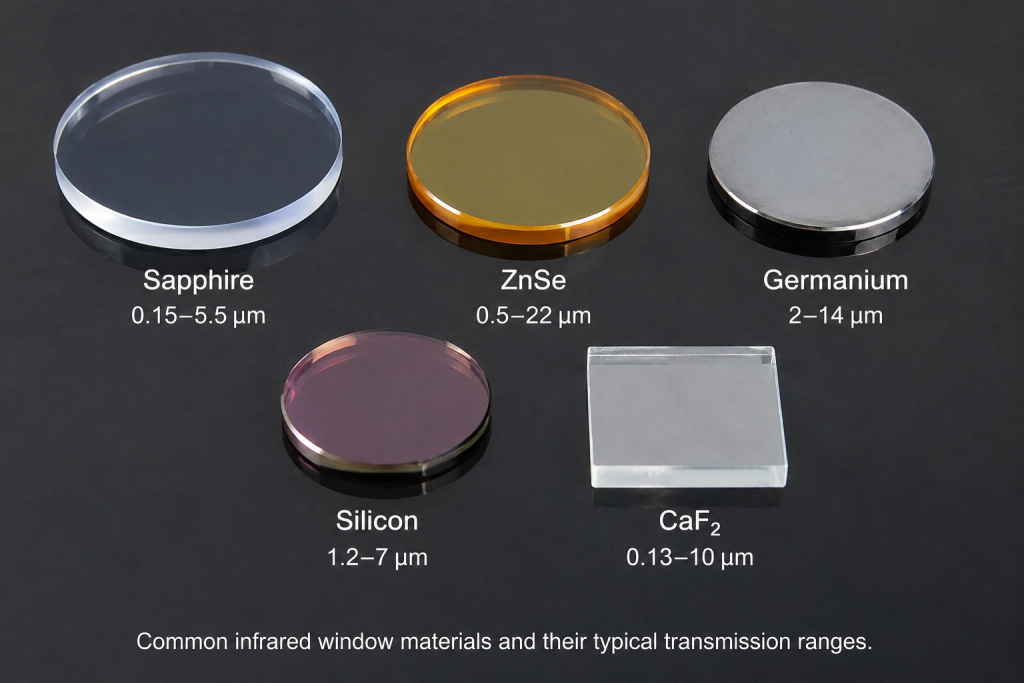
Among the most widely used infrared optical window materials are sapphire (Al₂O₃), zinc selenide (ZnSe), germanium (Ge), silicon (Si), and calcium fluoride (CaF₂). Each material exhibits unique characteristics and performance limitations. Understanding their differences is critical for selecting the optimal material for a specific engineering environment.
Material Background: Why Sapphire Is Unique
Sapphire is a single-crystal form of aluminum oxide (Al₂O₃) with a hexagonal crystal structure. Unlike conventional infrared materials, sapphire is known primarily for its exceptional mechanical and thermal properties.
Key characteristics include:
- Mohs hardness: 9 (second only to diamond)
- Melting point: approximately 2050°C
- High compressive and flexural strength
- Excellent wear resistance
- Superior chemical stability
- High pressure resistance
- Broad optical transmission range
Sapphire windows are widely used in applications where mechanical durability is as important as optical performance.
Typical applications include:
- Aerospace optical systems
- High-pressure viewports
- Harsh industrial environments
- Semiconductor process equipment
- Military and defense optics
- Protective laser windows
Comparative Analysis of Major Infrared Window Materials
The selection of infrared optical windows often involves balancing transmission performance against environmental durability.
| Material | Transmission Range | Hardness (Mohs) | Key Advantages | Major Limitations |
|---|---|---|---|---|
| Sapphire | 0.15–5.5 μm | 9 | Extreme hardness, wear resistance, high strength | Limited transmission beyond mid-IR |
| ZnSe | 0.5–22 μm | 5 | Excellent CO₂ laser transmission | Relatively soft and scratch-sensitive |
| Germanium | 2–14 μm | 6 | High refractive index and thermal imaging performance | Heavy; transmission decreases at high temperatures |
| Silicon | 1–7 μm | 7 | Cost-effective and mechanically robust | Limited long-wave infrared transmission |
| CaF₂ | 0.13–10 μm | 4 | Broad UV–IR transmission | Lower mechanical strength |
Sapphire vs ZnSe: Durability vs Infrared Performance
ZnSe is among the most commonly used materials for CO₂ laser systems because of its excellent transmission around 10.6 μm. It demonstrates low absorption and minimal optical losses in the infrared range.
However, compared with sapphire, ZnSe presents several engineering limitations:
- Lower hardness and poorer wear resistance
- More susceptible to surface scratches
- Reduced mechanical robustness
- Greater handling sensitivity
Sapphire, although unable to efficiently transmit 10.6 μm radiation, provides substantially better structural integrity. Therefore:
ZnSe is generally selected for optical performance, while sapphire is selected for environmental durability.
Sapphire vs Germanium: Mechanical Strength vs Thermal Imaging Capability
Germanium is a dominant material in long-wave infrared (LWIR) thermal imaging systems due to its high refractive index and excellent transmission in the 8–12 μm atmospheric window.
Nevertheless, germanium has limitations:
- High density (~5.33 g/cm³) increases system weight
- Transmission decreases as temperature rises
- Thermal lensing effects may occur under high heat loads
In aerospace or mobile systems where weight and environmental resistance matter, sapphire can provide advantages despite a narrower infrared transmission range.
Sapphire vs Silicon: Cost and Mechanical Balance
Silicon optical windows are frequently used in medium-wave infrared systems because they offer:
- Relatively low material cost
- Good thermal conductivity
- Moderate hardness and strength
However, silicon does not transmit effectively in long-wave infrared regions and therefore cannot replace ZnSe or Ge in many thermal imaging applications.
Sapphire generally outperforms silicon in:
- Surface durability
- Scratch resistance
- Extreme environment reliability
Engineering Selection Considerations
Material selection should be driven by operational requirements rather than a single property such as transmission.
For example:
Choose sapphire when:
- High pressure resistance is required
- Mechanical impact resistance is critical
- Severe wear environments exist
- Long-term durability is a priority
Choose ZnSe when:
- CO₂ laser transmission at 10.6 μm is essential
- Low optical absorption is required
Choose germanium when:
- Thermal imaging systems operate in the 8–12 μm band
Choose silicon when:
- Cost-sensitive infrared systems are being designed
Future Trends in Infrared Window Materials
As optical systems continue moving toward higher power, harsher environments, and greater integration, no single material can satisfy every requirement. Emerging trends increasingly focus on:
- Multilayer coatings
- Composite optical structures
- Advanced ceramic windows
- Customized material solutions
Sapphire remains one of the most attractive engineering materials due to its exceptional mechanical reliability, while ZnSe, Ge, and Si continue to dominate specialized infrared applications.
The future of infrared optical design is likely to rely less on material substitution and more on optimized combinations of optical and structural performance.