
Optical windows are essential components in high-precision optical systems, protecting sensitive equipment while allowing electromagnetic radiation to pass with minimal distortion. Among the most widely used materials are sapphire (single-crystal Al₂O₃) and fused quartz (amorphous SiO₂). Both materials exhibit excellent transparency and chemical stability, making them suitable for applications in semiconductor processing, aerospace optics, laser systems, and scientific instrumentation. However, significant differences exist in their optical and thermal properties. This article provides a comparative analysis of sapphire and quartz optical windows with a focus on refractive index, spectral transmission, thermal conductivity, thermal expansion, and high-temperature stability, providing guidance for material selection in demanding optical environments.
1. Introduction
Optical windows serve as protective barriers in optical systems while maintaining high transmission across specific spectral ranges. The choice of window material significantly affects system performance, particularly in high-power laser systems, vacuum chambers, high-temperature reactors, and semiconductor manufacturing tools.
Two of the most widely used materials are sapphire and fused quartz. Sapphire is a crystalline form of aluminum oxide (α-Al₂O₃) with exceptional mechanical strength and thermal conductivity, while fused quartz is an amorphous silica glass known for its low thermal expansion and excellent ultraviolet transparency. Both materials are chemically inert and optically transparent over broad wavelength ranges, yet their physical structures lead to different optical and thermal behavior.
2. Optical Properties Comparison
2.1 Refractive Index and Reflection Loss
One of the key parameters influencing optical window performance is the refractive index (n). Sapphire has a significantly higher refractive index than quartz.
| 材質 | Refractive Index (visible) |
|---|---|
| Sapphire | ~1.76 |
| Fused Quartz | ~1.46 |
Sapphire’s higher refractive index leads to greater Fresnel reflection losses at air-material interfaces. Experimental studies show that internal surface reflections in sapphire optical chambers can be more than twice those in quartz due to this refractive index difference.
As a result, sapphire windows often require anti-reflection coatings when used in precision optical systems. Quartz, with its lower refractive index, naturally exhibits lower reflection losses and may provide slightly higher transmission in uncoated optical assemblies.
2.2 Spectral Transmission Range
Both materials exhibit broad transparency across ultraviolet (UV), visible, and infrared (IR) wavelengths, but their spectral windows differ.
| 材質 | 傳輸範圍 |
|---|---|
| Sapphire | ~150 nm – 4–5 μm |
| Fused Quartz | ~195 nm – 2.1 μm |
Sapphire transmits radiation from deep ultraviolet to mid-infrared regions and can maintain transmission above 85% between approximately 0.3 and 4.0 μm.
Fused quartz is especially valued for ultraviolet optics due to its extremely high purity and transmission exceeding 90% across the visible and near-infrared spectrum.
Consequently:
- Quartz windows are widely used in UV spectroscopy and excimer laser systems.
- Sapphire windows are preferred in IR optics, high-power lasers, and high-temperature viewing ports.
2.3 Optical Anisotropy
Sapphire is a birefringent crystal, meaning its refractive index varies depending on light polarization and crystal orientation. The ordinary and extraordinary refractive indices differ slightly (nₒ ≈ 1.768, nₑ ≈ 1.760).
Fused quartz, being amorphous, is optically isotropic, which eliminates polarization-dependent effects. This isotropy simplifies optical design and alignment in interferometry or imaging systems.
3. Thermal Properties Comparison
3.1 Thermal Conductivity
Thermal conductivity determines how efficiently heat dissipates through the optical window.
| 材質 | Thermal Conductivity (W/m·K) |
|---|---|
| Sapphire | ~30–40 |
| Fused Quartz | ~1.3–1.4 |
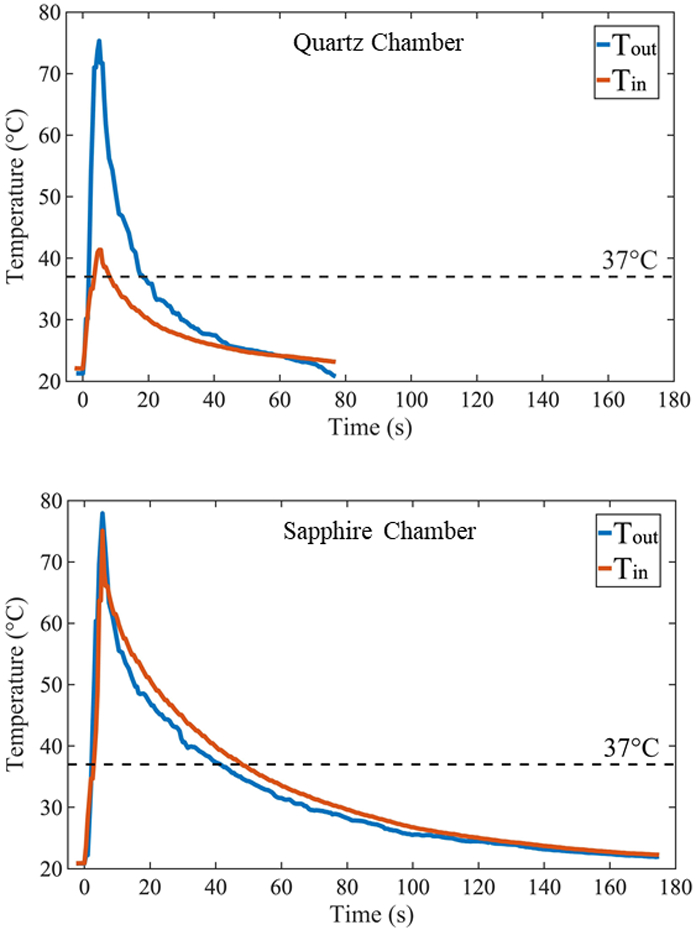
Sapphire’s thermal conductivity is more than an order of magnitude higher than that of quartz.
This property provides several advantages:
- Rapid heat dissipation in high-power laser systems
- Reduced thermal gradients
- Improved resistance to localized overheating
Quartz, by contrast, acts as a thermal insulator and may accumulate heat under intense irradiation.
3.2 Thermal Expansion
Thermal expansion affects optical stability when temperature changes.
| 材質 | Coefficient of Thermal Expansion (×10⁻⁶/K) |
|---|---|
| Sapphire | ~5–7 |
| Fused Quartz | ~0.5 |
Quartz exhibits an extremely low coefficient of thermal expansion, making it highly resistant to thermal shock and optical distortion.
Sapphire expands more significantly with temperature but compensates with high thermal conductivity, which reduces temperature gradients within the material.
3.3 High-Temperature Stability
Sapphire possesses a very high melting point (~2050 °C) and retains useful mechanical properties up to approximately 1800 °C.
Quartz softens at around 1687 °C and may experience deformation or micro-cracking under rapid temperature changes in extreme environments.
Therefore:
- Sapphire windows are commonly used in high-temperature furnaces, combustion diagnostics, and aerospace sensors.
- Quartz windows are more common in moderate-temperature optical instruments and UV systems.
4. Mechanical and Chemical Durability
Another key difference lies in mechanical hardness and durability.
| Property | Sapphire | Quartz |
|---|---|---|
| 莫氏硬度 | 9 | ~7 |
| Structure | Single crystal | Amorphous |
| Scratch Resistance | Excellent | Moderate |
Sapphire’s hardness (second only to diamond among common optical materials) allows it to withstand abrasion and mechanical wear.
Both materials exhibit excellent chemical resistance. Sapphire is stable against most acids and solvents at room temperature, while quartz is resistant to most chemicals except hydrofluoric acid.
5. Application-Driven Material Selection
The selection between sapphire and quartz windows ultimately depends on the operating environment and optical requirements.
Sapphire Windows – Typical Applications
- High-temperature furnace viewing ports
- Aerospace optical sensors
- High-power laser optics
- Infrared imaging systems
- Semiconductor plasma chambers
Quartz Windows – Typical Applications
- UV spectroscopy and photolithography
- Optical instruments requiring low thermal expansion
- Laboratory optical chambers
- Excimer laser systems
- Precision interferometry
6. Conclusion
Sapphire and fused quartz are both indispensable materials in advanced optical systems, yet their differing physical structures lead to distinct optical and thermal performance characteristics. Sapphire provides exceptional thermal conductivity, mechanical durability, and high-temperature stability, making it ideal for harsh industrial and aerospace environments. In contrast, quartz offers superior UV transmission, low refractive index, and extremely low thermal expansion, which are advantageous for precision optical instrumentation.
For engineers and optical designers, the choice between these materials should be guided by the specific operational conditions of the system, including wavelength range, thermal load, mechanical stress, and environmental exposure. In many advanced systems, the optimal solution may involve combining both materials in complementary roles.