Sapphire (single-crystal Al₂O₃) is widely used in optical systems, aerospace instruments, high-pressure viewports, and laser equipment due to its exceptional combination of mechanical strength and optical transparency. One of its most important properties is its ability to transmit a broad range of electromagnetic radiation.
This article provides a scientifically grounded explanation of which types of radiation can pass through sapphire windows, along with the physical mechanisms, limitations, and real-world engineering considerations.
1. Material Basis: Why Sapphire is Optically Transparent

Sapphire is a crystalline form of aluminum oxide (Al₂O₃) with a wide electronic bandgap (~9 eV). This is the key reason it is transparent across a wide spectral range.
In simple terms:
- Photons with energy below the bandgap are not absorbed by electrons
- This allows light (UV–visible–IR) to pass through with low loss
However, transparency is not unlimited—it depends on wavelength, lattice vibrations, and crystal interactions.
2. Electromagnetic Radiation Transmission Range
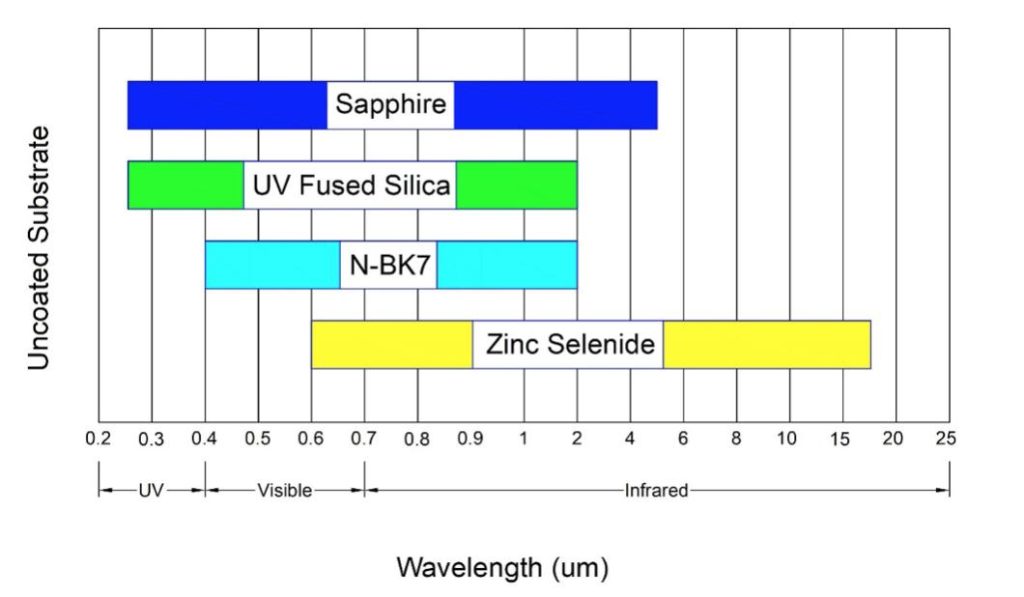
Sapphire windows are known for broadband optical transmission, typically covering:
2.1 Ultraviolet (UV) Radiation
- Transmission range: ~150 nm – 400 nm
- Performance: Good in near-UV, moderate in deep UV
Engineering significance:
- UV optical systems
- Plasma observation windows
- Semiconductor inspection systems
⚠ Note: Deep UV transmission decreases due to increased electronic absorption near the band edge.
2.2 Visible Light
- Transmission range: ~400 nm – 700 nm
- Performance: Excellent (>85–90% with polished surfaces)
Applications:
- Optical imaging systems
- Industrial inspection windows
- High-pressure visual observation
Sapphire is widely used in demanding environments where both clarity and durability are required.
2.3 Near-Infrared (NIR)
- Transmission range: ~700 nm – 3 µm
- Performance: Very high transmission
Applications:
- Laser optics (e.g., 1064 nm Nd:YAG systems)
- Fiber laser systems
- IR sensing and detection
This range is one of sapphire’s strongest optical advantages.
2.4 Mid-Infrared (MIR)
- Transmission range: ~3 µm – 5–5.5 µm
- Performance: Moderate to good, gradually decreasing
Applications:
- Gas sensing
- Thermal diagnostics
- Combustion monitoring systems
Beyond ~5.5 µm, absorption increases significantly due to lattice vibrational (phonon) effects.
3. Radiation That Does NOT Pass Efficiently
3.1 Long-Wave Infrared (>5.5 µm)
- Strong absorption due to phonon resonance
- Not suitable for thermal imaging in long-wave IR bands
For LWIR applications, materials like ZnSe or germanium are preferred.
3.2 X-rays
- Sapphire is not designed as an X-ray optical window
- Thin sapphire may allow partial transmission, but:
- attenuation is high
- imaging quality is poor
3.3 Gamma rays and high-energy radiation
- Can physically pass through due to high penetration power
- However, sapphire is not used as a radiation shielding or optical medium in this range
4. Physical Mechanisms Behind Transmission Limits
Sapphire’s optical behavior is governed by:
4.1 Electronic absorption (UV limit)
- UV photons excite electrons across the bandgap
- Defines the short-wavelength cutoff (~150 nm practical limit)
4.2 Phonon absorption (IR limit)
- Infrared light interacts with lattice vibrations
- Causes strong absorption beyond ~5.5 µm
4.3 Impurity and defect scattering
- Oxygen vacancies, inclusions, or polishing damage reduce transmission
- Surface quality strongly affects UV performance
5. Real-World Engineering Considerations
In practical optical systems, transmission is not determined only by material physics.
5.1 Surface quality
- Sub-nanometer polishing improves UV transmission
- Scratches cause scattering losses
5.2 Coating effects
- Anti-reflective (AR) coatings can increase transmission to >95%
- Coatings are wavelength-specific
5.3 Temperature effects
- High temperature can slightly shift absorption edges
- Thermal stress can induce birefringence
5.4 Crystal orientation
- C-axis orientation affects optical uniformity and birefringence
6. Engineering Summary Table
| Radiation Type | Transmission through Sapphire | Notes |
|---|---|---|
| Deep UV (150–200 nm) | Partial | Reduced efficiency |
| Near UV | 良好 | Widely used |
| Visible light | 極佳 | >85–90% |
| Near IR (0.7–3 µm) | Very good | Laser applications |
| Mid IR (3–5.5 µm) | 中度 | Decreases with wavelength |
| Long-wave IR (>5.5 µm) | 貧窮 | Strong absorption |
| X-rays | 有限責任 | Not practical optics |
| Gamma rays | Pass through | Not optically useful |
7.總結
藍寶石玻璃窗 are among the most versatile optical materials available, capable of transmitting radiation from the deep ultraviolet through the mid-infrared spectrum. Their unique combination of wide bandgap, mechanical strength, and thermal stability makes them essential in demanding optical environments.
However, their performance is fundamentally limited by:
- electronic absorption in the UV range
- phonon absorption in the IR range
In engineering applications, sapphire is best suited for:
- UV–visible–NIR optical systems
- High-pressure and high-temperature optical windows
- Laser and aerospace optical components
8. Key Takeaway
Sapphire windows provide broad-spectrum optical transparency (150 nm – ~5.5 µm), making them a premium material for extreme optical and environmental conditions, but not a universal solution for all radiation types.