
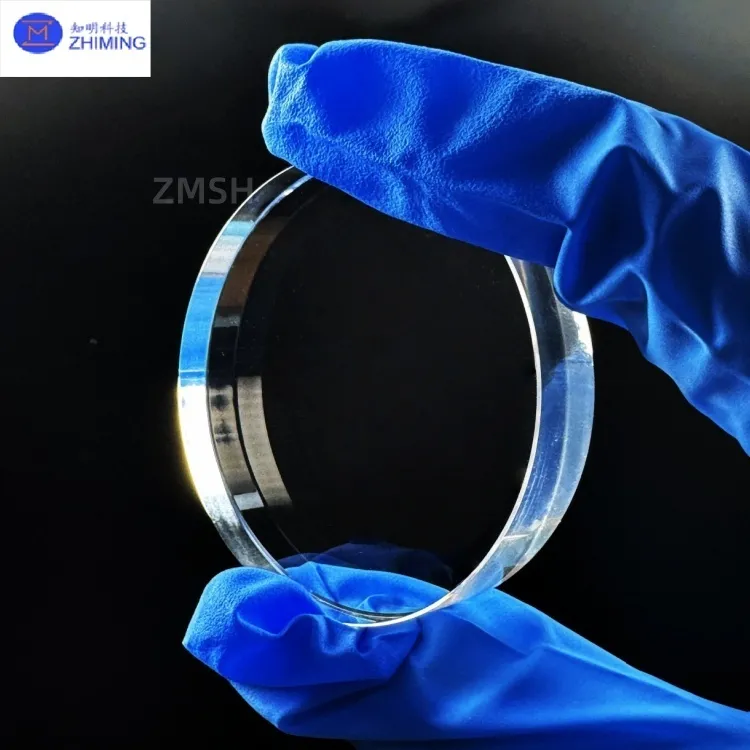
Sapphire windows, made from single-crystal aluminum oxide (Al₂O₃), are widely recognized for their exceptional hardness, chemical stability, and wide optical transmission range. These properties make sapphire windows indispensable in both scientific experiments and industrial testing environments where transparency, durability, and precision are required. This article explores the critical role of sapphire windows, their unique characteristics, and why they remain a preferred material for high-performance optical applications.
1. Exceptional Optical Properties
One of the primary advantages of sapphire windows is their broad optical transmission range, spanning ultraviolet (UV), visible, and infrared (IR) wavelengths (approximately 200–5500 nm). This makes 藍寶石窗 highly suitable for applications that require accurate light transmission and minimal distortion, such as:
- Spectroscopy and optical sensors: Maintaining signal fidelity over a wide wavelength range.
- Laser experiments: Providing minimal absorption and scattering, even under high-power irradiation.
- Photometric measurements: Ensuring precise and repeatable readings in laboratory settings.
Additionally, sapphire windows exhibit low birefringence, particularly when cut along the C-plane, which is crucial for polarization-sensitive experiments and high-precision optical instrumentation.
2.機械強度和耐用性
Sapphire is the second hardest material after diamond, which allows it to withstand high-pressure environments, mechanical impacts, and abrasion. This mechanical robustness is particularly important in industrial testing and scientific setups that involve:
- 高壓反應器: Sapphire windows can serve as observation ports in autoclaves and chemical reaction vessels.
- Extreme temperature experiments: Maintaining structural integrity in environments exceeding 1000°C.
- Wear-resistant optical windows: Withstanding repeated cleaning or exposure to particulate matter in industrial testing.
The combination of hardness and chemical inertness ensures long-term reliability and minimal maintenance in demanding environments.
3. Chemical and Thermal Stability
Sapphire is chemically inert to most acids, bases, and organic solvents, which makes it ideal for experiments involving aggressive chemical environments. In addition, its high thermal conductivity and stability allow sapphire windows to handle rapid temperature changes without cracking or deforming.
This property is critical in applications such as:
- High-temperature furnaces for materials research
- Laser heating experiments
- Industrial thermal sensors and monitoring systems
By resisting thermal shock and chemical corrosion, sapphire windows ensure experimental integrity and reproducibility.
4. Role in Industrial Testing
Beyond the laboratory, sapphire windows are widely used in industrial testing and process monitoring. Their transparency and robustness make them ideal for:
- Observation ports in vacuum and high-pressure chambers
- Optical access for laser-based measurement systems
- Real-time monitoring of manufacturing processes, including chemical, metallurgical, and semiconductor operations
By providing clear, reliable observation without interfering with the system’s conditions, sapphire windows improve process accuracy, safety, and operational efficiency.
5. Customization and Orientation Considerations
Sapphire windows can be customized in terms of size, thickness, surface finish, and crystallographic orientation (C-plane, A-plane, M-plane). These factors influence:
- Optical clarity and uniformity
- Birefringence and polarization behavior
- Mechanical stress tolerance and thermal expansion
Choosing the appropriate orientation and specification ensures that sapphire windows meet the stringent requirements of both scientific experiments and industrial testing scenarios.
6. Conclusion
Sapphire windows play a critical role in modern scientific and industrial applications, offering a unique combination of optical clarity, mechanical strength, chemical resistance, and thermal stability. From high-precision laboratory experiments to demanding industrial testing, sapphire windows enable accurate observation, reliable measurements, and long-term durability. By carefully selecting the appropriate specifications and orientation, engineers and researchers can maximize the performance and reliability of their optical systems, making sapphire an indispensable material in advanced experimental and industrial settings.