
Sapphire windows are widely used in demanding industrial and scientific environments where both optical transparency and extreme mechanical strength are required. Typical applications include vacuum chambers, high-pressure reactors, furnace observation ports, and laser systems.
Compared with conventional optical materials, sapphire (single-crystal Al₂O₃) offers exceptional hardness, high compressive strength, and broad spectral transmission, making it one of the most reliable materials for pressure-resistant optical windows.
This article focuses on how to properly design sapphire windows for high-pressure and high-temperature conditions, with practical engineering insights.
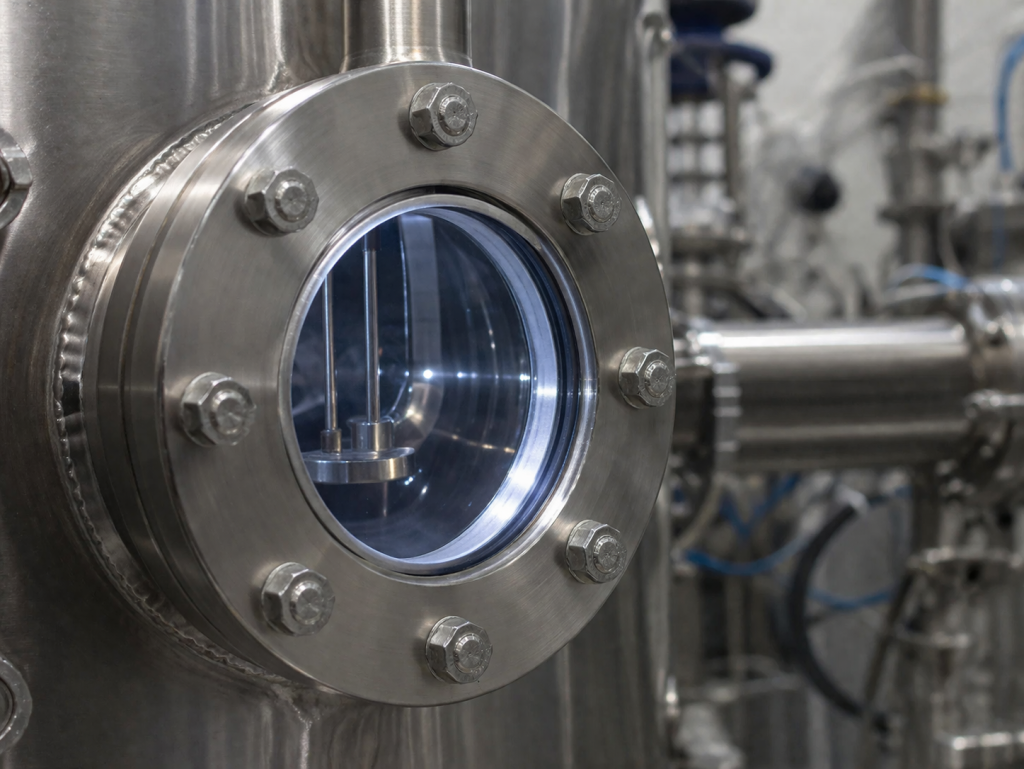
Why Choose Sapphire for Pressure Windows
Sapphire is often the first choice for critical environments due to its unique combination of properties:
Những ưu điểm nổi bật
- Ultra-high mechanical strength
Sapphire exhibits flexural strength up to ~900 MPa, far exceeding standard optical glass. - Outstanding hardness (Mohs 9)
Highly resistant to scratches and abrasive particles. - Wide optical transmission
Effective from UV (~150 nm) to mid-infrared (~5.5 μm). - Độ ổn định nhiệt tuyệt vời
Maintains structural integrity in high-temperature environments (>1000°C in some cases). - Khả năng chịu hóa chất
Performs well in corrosive atmospheres, including acids and alkalis.
Mechanical Properties of Sapphire Windows
Understanding the mechanical behavior of sapphire is essential for pressure design:
| Bất động sản | Giá trị điển hình |
|---|---|
| Độ bền uốn | ~700–900 MPa |
| Young’s Modulus | ~400 GPa |
| Cường độ nén | ~2.0 GPa |
| Độ bền kéo | ~300–400 MPa |
| Độ bền gãy | ~2.0 MPa·m½ |
| Poisson’s Ratio | 0.29 |
| Mật độ | 3.97 g/cm³ |
Engineering Insight
Although sapphire has extremely high compressive strength, failure in real applications is usually driven by tensile stress and surface defects. Therefore, design must prioritize stress control and surface quality.
Mounting Design: A Critical Factor
The mounting method significantly affects the pressure resistance of a sapphire window.
1. Clamped Design (Recommended)
- Window is fixed between flanges or holders
- Provides uniform stress distribution
- Allows higher pressure resistance with thinner thickness
👉 Phù hợp nhất cho:
- High-pressure vessels
- Hệ thống chân không
- Industrial reactors
2. Unclamped (Supported) Design
- Window rests on a seat (similar to a cover plate)
- Higher bending stress
- Requires thicker sapphire
👉 Used in:
- Low to moderate pressure applications
Shape Selection: Why Circular Windows Are Preferred
- Circular cửa sổ bằng ngọc bích
- Even stress distribution
- Best for high-pressure conditions
- Rectangular windows
- Stress concentration at corners
- Higher failure risk
👉 Engineering recommendation:
Always prioritize circular designs for pressure applications
Pressure Resistance and Thickness Design
The pressure capacity of a sapphire window depends on:
- Window diameter
- Độ dày
- Mounting condition
- Hệ số an toàn
General Rule
Larger diameter = higher stress = thicker window required
Ví dụ:
- Small sapphire windows (≤25 mm) can withstand extremely high pressures (tens of thousands of psi)
- Larger windows require significantly increased thickness or reinforced mounting
Safety Factor in Sapphire Window Design
Due to the brittle nature of sapphire, safety factors are essential.
Recommended Safety Factor Levels
| Application | Hệ số an toàn |
|---|---|
| Controlled lab environment | 2–3 |
| Industrial systems | ≥4 |
| High-risk / critical systems | 6–7 |
Tại sao điều này lại quan trọng
Even minor defects can reduce strength:
- Vết xước bề mặt
- Hư hỏng bên dưới bề mặt
- Thermal stress
- Improper sealing
👉 A safety factor of at least 4 is strongly recommended for most industrial applications.
High-Temperature and Sealing Considerations
In high-temperature environments, additional factors must be considered:
Thermal Effects
- Thermal expansion mismatch between sapphire and metal housing
- Risk of stress buildup during heating/cooling cycles
Sealing Options
- Metal sealing (e.g., Kovar brazing)
- High-temperature gaskets
- Vacuum-compatible sealing systems
👉 Proper sealing design is critical for:
- Buồng chân không
- Furnaces
- Aerospace systems
Typical Applications of Sapphire Windows
Sapphire windows are widely used in:
- High-pressure viewports (e.g., >10,000 psi systems)
- Vacuum chambers and semiconductor equipment
- High-temperature furnaces
- Laser and optical systems
- Underwater and subsea observation devices
Practical Design Recommendations
Based on real engineering experience:
- Use circular sapphire windows whenever possible
- Choose clamped mounting structures
- Apply ≥4 safety factor
- Ensure high-quality surface finishing (avoid micro-cracks)
- Match material and thickness to actual pressure conditions
Kết luận
Sapphire windows offer unmatched performance in extreme environments, combining mechanical strength, optical clarity, and thermal stability. However, achieving reliable performance requires careful consideration of:
- Material properties
- Mounting configuration
- Pressure and temperature conditions
- Safety margins
A properly designed sapphire window system ensures long-term durability, operational safety, and optimal optical performance.