
Sapphire windows are used in optical, industrial, medical, semiconductor, laser, vacuum and high-pressure systems because they combine high hardness, good optical transmission, chemical resistance and strong mechanical stability. When engineers design a custom sapphire window, thickness is one of the most important specifications. It affects not only mechanical strength, but also optical performance, weight, machining difficulty and final cost.
Choosing the right thickness is not simply a matter of making the window as thick as possible. A thicker sapphire window may improve strength and reduce deformation, but it can also increase material cost, processing time, reflection loss and optical path length. A thinner window may reduce cost and improve compactness, but it may not provide enough safety margin under pressure, impact or assembly stress.
For buyers and engineers, the best choice is a balanced thickness based on application conditions, window size, mounting structure and optical requirements.
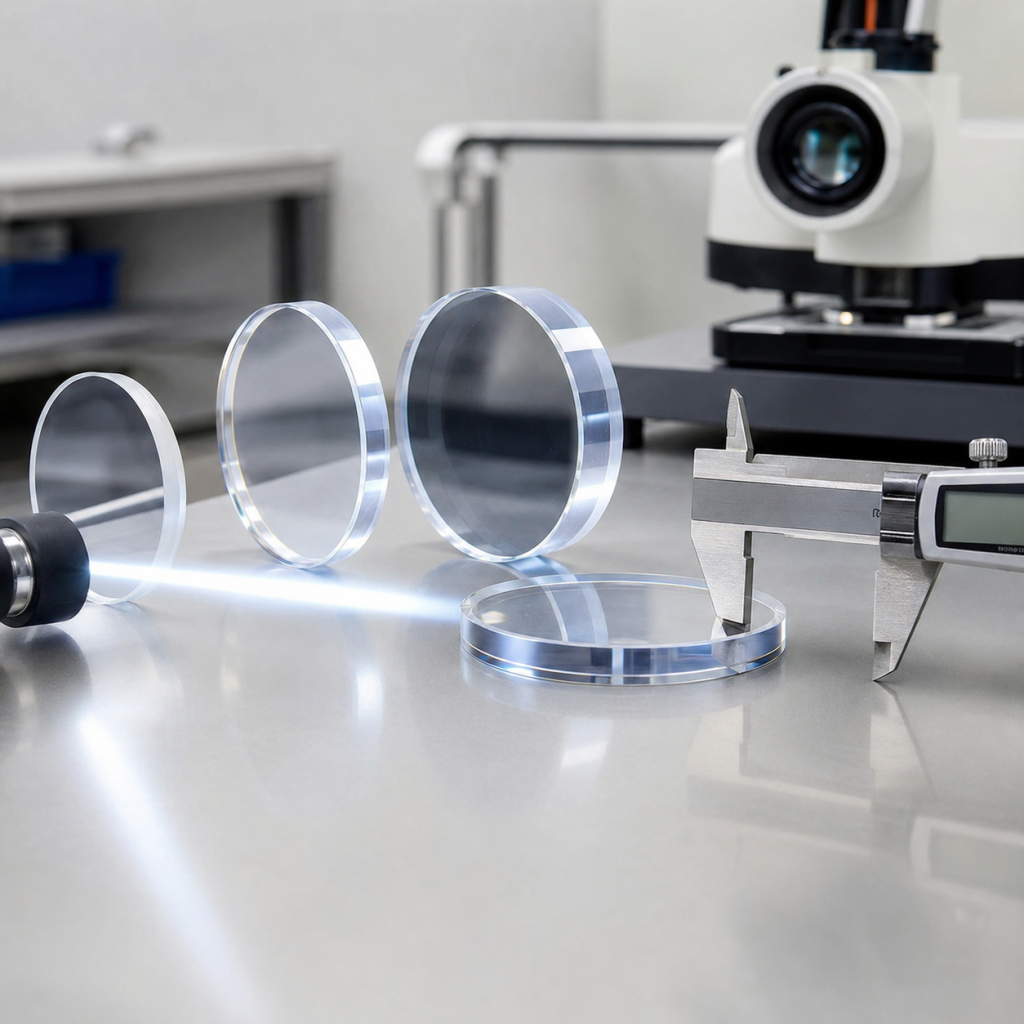
Why Thickness Matters
Sapphire is much stronger and harder than ordinary glass, but it is still a brittle crystalline material. If the window is too thin for the application, it may bend, crack or fail under pressure difference, clamping force, thermal stress or mechanical impact.
Thickness influences several key performance areas:
- Strength and pressure resistance
- Deflection under load
- Edge chipping risk
- Optik yol uzunluğu
- Transmission and reflection
- Ağırlık
- Machining difficulty
- Material utilization
- Cost and lead time
Because these factors are connected, thickness should be selected together with diameter, shape, support condition and surface quality.
Thickness and Mechanical Strength
In many applications, sapphire windows are used as protective covers, observation windows or sealed optical interfaces. They may need to resist pressure difference, impact, vibration or mechanical contact.
A thicker sapphire window generally provides:
- Higher load capacity
- Lower bending deformation
- Better resistance to pressure difference
- More safety margin during assembly
- Lower risk of cracking under uneven stress
However, strength does not depend on thickness alone. The final performance also depends on the window diameter, edge support, mounting method and surface defects. A large thin window is much more sensitive to pressure than a small thin window. A well-supported window may perform better than a thicker window with poor clamping design.
For vacuum, pressure or safety-related systems, engineers should not choose thickness only by experience. Pressure calculation, mechanical design review or simulation may be required.
Thickness and Window Size
The relationship between thickness and size is critical. As the window diameter or clear aperture increases, the required thickness usually increases. Large sapphire windows are more difficult to manufacture and more sensitive to stress.
For example, a small round sapphire window used as a sensor cover may only require a thin design. A large sapphire viewport for a chamber may require greater thickness to reduce bending and improve safety. A rectangular window may also need different thickness evaluation compared with a round window because stress distribution is different.
When requesting a quote, customers should provide:
- Dış çap veya uzunluk ve genişlik
- Net açıklık
- Thickness target
- Mounting support area
- Pressure or load condition
- Application environment
This allows the supplier to check whether the requested thickness is practical and whether the window may need design adjustment.
Thickness and Optical Transmission
Sapphire has good optical transmission in visible and infrared ranges, but thickness still affects optical performance. As thickness increases, the optical path through the material becomes longer. This may slightly influence absorption, internal reflection and image performance depending on wavelength and system sensitivity.
For many common visible-light applications, the effect may be acceptable. But for precision optical systems, laser systems, imaging devices or infrared applications, thickness should be considered carefully.
Important optical factors include:
- Working wavelength
- Transmission requirement
- Yüzey yansıması
- Internal absorption
- Paralellik
- Kama açısı
- Birefringence
- Kaplama şartı
If the window is very thick, anti-reflective coating may become more important to improve transmission and reduce glare. For imaging applications, parallelism and flatness should also be controlled to avoid image shift or distortion.
Reflection and Coating Considerations
Every uncoated optical surface reflects some light. A sapphire window has two surfaces, so reflection loss may reduce total transmission. Thickness itself is not the only cause of reflection, but thicker windows are often used in more demanding systems where optical loss becomes more noticeable.
Anti-reflective coating can help improve transmission at specific wavelengths or over a broadband range. For example, a sapphire window used for laser transmission may need coating matched to the laser wavelength. A machine vision window may need broadband visible AR coating. An infrared sensor window may need coating designed for the infrared band.
When specifying coating, customers should provide:
- Working wavelength or wavelength range
- Geliş açısı
- Transmission target
- Çalışma sıcaklığı
- Cleaning method
- Environmental exposure
Coating should be selected based on real use conditions, not only on catalog data.
Thickness and Cost
Thickness has a direct effect on sapphire window cost. Thicker sapphire parts require more raw material, longer grinding and polishing time, and may have lower production yield.
Cost can increase because of:
- More sapphire material consumption
- Longer cutting and grinding time
- Longer polishing process
- Higher difficulty controlling flatness
- Higher risk of breakage during machining
- More strict inspection requirements
- Heavier packaging and handling
Large and thick sapphire windows are especially expensive because both material cost and processing risk increase. If the design does not truly need extra thickness, over-specification can make the part much more costly without improving practical performance.
On the other hand, choosing a window that is too thin may create hidden costs later, such as cracking during assembly, failed pressure tests or frequent replacement.
Thickness and Lead Time
Lead time can also be affected by thickness. Standard thicknesses or commonly used dimensions may be easier to source and process. Non-standard thick parts, large sizes or tight tolerances usually require longer production time.
Lead time may increase when the part requires:
- Thick sapphire material
- Large diameter
- Tight thickness tolerance
- High flatness
- High parallelism
- Çift taraflı parlatma
- Special coating
- Custom edge finishing
- Strict inspection documentation
For urgent projects, it is useful to ask whether a slightly adjusted thickness can shorten production time or reduce cost.
Avoiding Over-Specification
Many buyers request very tight tolerances or thick designs because they want a safer part. However, over-specification can increase cost and delay delivery.
Before confirming thickness, consider these questions:
- What pressure or load will the window actually experience?
- Is the window used for protection, sealing or precision optics?
- What is the clear aperture?
- How is the window supported?
- Is optical distortion critical?
- Is weight important?
- Does the system require coating?
- Is there a target cost or lead time?
A practical design should meet performance requirements without adding unnecessary machining difficulty.
Common Application Examples
Protective Camera Windows
For industrial cameras and machine vision systems, thickness depends on impact risk, housing design and optical requirements. A moderate thickness is often preferred to balance strength, clarity and cost.
Vacuum Viewports
For vacuum viewport applications, thickness must be selected based on pressure difference, window diameter and mounting support. Safety factor is important because failure can damage equipment or create safety risk.
Lazer Pencereler
For laser systems, thickness affects optical path, thermal behavior and mechanical stability. Coating and surface quality may be more important than simply increasing thickness.
Sensor Covers
For compact sensors, thinner sapphire windows may be preferred to reduce size and cost. However, the window must still survive assembly and environmental exposure.
High-Pressure Systems
For high-pressure observation or protection, thickness must be carefully calculated. Edge design and sealing structure are also critical.
RFQ Checklist for Thickness Selection
To help suppliers recommend a suitable sapphire window thickness, provide the following information:
- Şekil ve boyut
- Net açıklık
- Required thickness or thickness range
- Başvuru
- Pressure difference or load condition
- Montaj yöntemi
- Support area
- Working wavelength
- Transmission requirement
- Yüzey kalitesi
- Flatness and parallelism
- Kenar işleme
- Kaplama şartı
- Sıcaklık aralığı
- Miktar
- Drawing or sample
- Denetim raporu gereklilikleri
If the exact thickness is uncertain, provide the application conditions and ask the supplier to suggest a practical range.
Sonuç
Sapphire window thickness affects strength, optical transmission, cost, weight and manufacturing difficulty. A thicker window can improve mechanical reliability, but it may also increase cost and affect optical design. A thinner window may be more economical and compact, but it must still meet pressure, impact and assembly requirements.
The right thickness should be selected based on window size, clear aperture, mounting design, pressure condition, wavelength and inspection requirements. For custom sapphire windows, the best approach is to provide complete application information during the RFQ stage. This helps the supplier recommend a balanced design that meets performance requirements without unnecessary cost.