
Sapphire windows, made from single-crystal aluminum oxide (Al₂O₃), are widely recognized for their exceptional hardness, high optical clarity, and thermal and chemical stability. These properties make them indispensable in various high-precision and high-performance applications, including aerospace, laser systems, industrial sensors, and scientific instrumentation. In recent years, technological advancements and increasing demand have driven significant developments in large-size and precision sapphire windows, pushing the boundaries of optical engineering and material science.
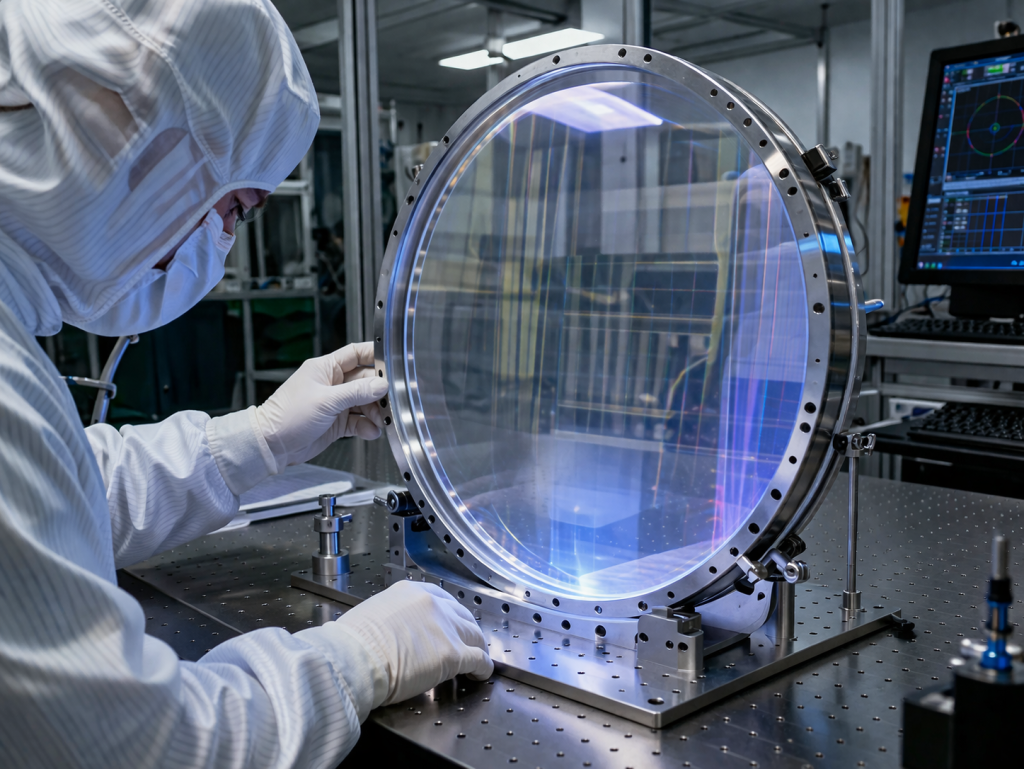
1. Introduction to Large-Size Sapphire Windows
Traditionally, sapphire windows were produced in relatively small diameters, typically below 100 mm, due to challenges in crystal growth and defect control. With the growth of high-power laser systems, semiconductor inspection, and aerospace pressure windows, there is a growing need for larger diameter sapphire windows without compromising optical quality or mechanical integrity.
Key advantages of large-size sapphire windows include:
- Enhanced field-of-view for optical sensors and instruments
- Improved thermal handling in high-power laser applications
- Reduced assembly complexity by minimizing the number of segments in large optical systems
Table 1: Typical Specifications for Large-Size Sapphire Windows
| พารามิเตอร์ | Typical Range / Value | หมายเหตุ |
|---|---|---|
| เส้นผ่านศูนย์กลาง | 100 mm – 300 mm | Some experimental growth exceeds 300 mm |
| ความหนา | 2 mm – 50 mm | Depending on mechanical load |
| การส่งผ่านด้วยแสง | 180 nm – 5500 nm | UV to mid-IR range |
| Surface Flatness | λ/10 – λ/4 @ 632.8 nm | High precision optics |
| ความหยาบผิว (Ra) | < 5 nm | Atomic-scale smoothness for laser applications |
| ความแข็งโมห์ส | 9 | Second only to diamond |
| ความหนาแน่น | 3.98 กรัม/ลูกบาศก์เซนติเมตร | Single-crystal sapphire |
2. Advances in Crystal Growth for Large Windows
Producing large-diameter sapphire windows requires advanced crystal growth techniques. Common methods include:
- วิธีไคโรโพลอส: Suitable for producing high-quality large crystals with low internal stress
- วิธีโซคราลสกี: Often used for smaller but highly uniform crystals
- Heat exchanger method (HEM): Cost-effective for medium to large crystals
Recent advancements focus on reducing dislocation density, minimizing inclusions, and controlling internal stress, which are critical for both mechanical performance and optical uniformity.
3. Precision Surface Processing
Even with a perfect crystal, the optical performance depends heavily on surface finishing. Precision sapphire windows undergo:
- Grinding and lapping – to achieve near-net flatness and remove surface damage
- Chemical-mechanical polishing (CMP) – to reach atomic-level smoothness
- Optical coating deposition – for anti-reflective or laser-enhancing coatings
Table 2: Surface Tolerances for High-Precision Sapphire Windows
| Surface Property | Typical Specification |
|---|---|
| ความเรียบ | λ/10 – λ/4 @ 632.8 nm |
| ความสมมาตร | < 5 arc seconds |
| ความหยาบผิว (Ra) | 1 – 5 nm |
| Edge Chamfer | 0.1 – 0.5 mm |
These parameters ensure minimal optical distortion, high laser damage threshold, and consistent performance in demanding industrial or scientific applications.
4. Applications Driving the Trend
Large-size and precision sapphire windows are increasingly applied in:
- Aerospace and defense: High-pressure windows, optical domes, and sensor protection
- Laser and photonics: High-power laser windows, beam steering, and UV/IR optics
- Semiconductor and electronics inspection: Wafer inspection, lithography, and precision metrology
- Industrial sensing: Harsh environments requiring high-temperature and chemical resistance
The demand for larger diameters and tighter tolerances is largely driven by laser systems and aerospace platforms, where even minor defects or misalignment can severely affect system performance.
5. Emerging Trends
- Scaling to 300 mm and beyond: Efforts are underway to produce even larger single-crystal sapphire windows while maintaining defect-free quality.
- Integrated multi-functional coatings: Anti-reflective, hydrophobic, and high-damage-threshold coatings are being applied during processing.
- Automated quality inspection: Laser interferometry, ellipsometry, and high-resolution optical scanning are now standard for precision assessment.
- Hybrid structures: Combining sapphire windows with other optical elements or substrates to achieve larger effective apertures or reduce weight.
- Faster production cycles: Innovations in crystal growth, slicing, and polishing are reducing lead times and costs for large-size sapphire windows.
6. Conclusion
Large-size and precision sapphire windows are a cornerstone of modern optical and industrial technologies. Advances in crystal growth, surface processing, and precision metrology allow production of windows with larger diameters, higher optical quality, and superior mechanical performance.
As applications in aerospace, high-power lasers, and industrial sensors expand, emerging trends such as ultra-large windows, functional coatings, and hybrid structures will continue to drive innovation. For engineers, researchers, and designers, understanding these trends is essential for leveraging sapphire windows in next-generation optical systems.