
The optical window of a surgical laser serves as the interface between the laser source and the patient, directly influencing laser performance, operational safety, and device longevity. High-power surgical lasers (HPSLs) have become indispensable tools in modern medicine, with applications ranging from ophthalmology and otolaryngology to plastic surgery and minimally invasive oncology. While fused quartz has traditionally been a standard material for optical windows, sapphire (Al₂O₃) has increasingly become the preferred choice for high-power surgical laser systems. This article examines the scientific reasons behind this preference, focusing on optical, thermal, mechanical, and chemical properties.
Optical Transmission and Laser Energy Handling
Fused quartz exhibits a wide spectral transmission range, approximately 180–2500 nm, making it suitable for low-power laser applications. However, high-power surgical lasers—such as CO₂ lasers (λ ≈ 10.6 μm), Nd:YAG lasers (λ ≈ 1064 nm), and ultrafast femtosecond lasers—often operate at tens to hundreds of watts. Under such conditions, the optical window material must withstand intense laser energy without degradation or failure.
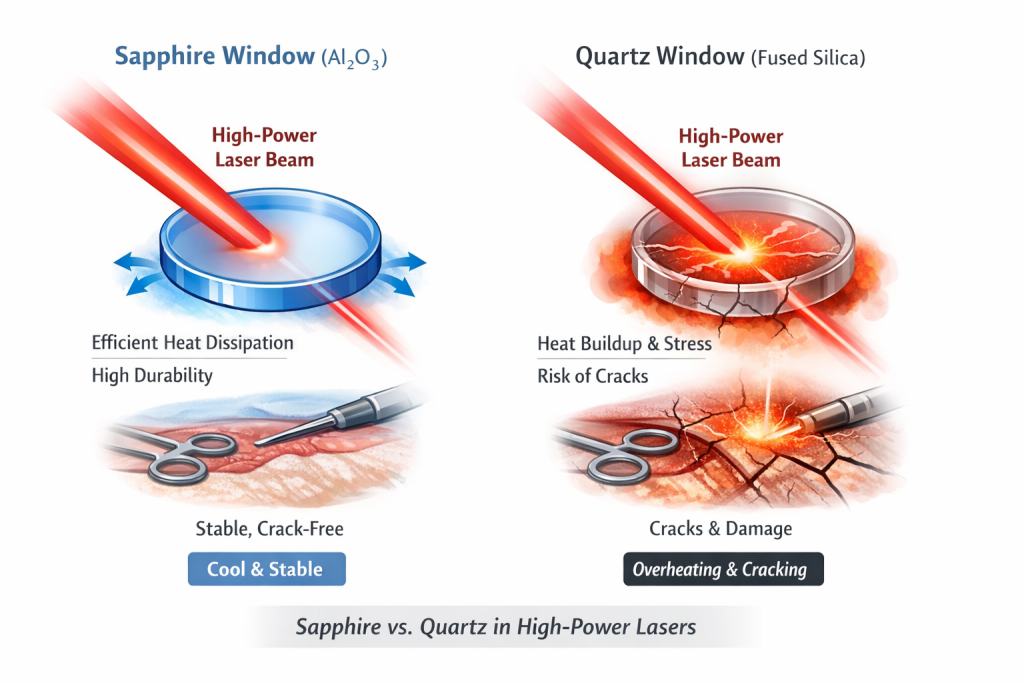
Sapphire offers excellent transmission in the visible and near-infrared spectrum (200–5000 nm), typically exceeding 80–90%. More importantly, sapphire’s thermal properties allow it to handle high laser intensities more effectively than quartz. While fused quartz has a melting point of approximately 1710°C, sapphire’s melting point reaches 2030°C. Its thermal conductivity along the c-axis (~35 W/m·K) is significantly higher than quartz (~1.4 W/m·K). These properties enable sapphire windows to dissipate heat more efficiently, minimizing the risk of localized overheating, thermal fracture, or stress-induced failure.
Mechanical Strength and Impact Resistance
Surgical environments impose strict requirements on the mechanical reliability of optical windows. Sapphire has a Vickers hardness of roughly 2000 HV, significantly exceeding quartz’s 600 HV. This hardness ensures superior scratch resistance, wear tolerance, and impact resilience.
During surgery, laser windows may be exposed to accidental tool contact, pressurized surgical gases, or splashing biological fluids. Quartz is prone to microcracks or catastrophic breakage under such conditions due to stress concentration, whereas sapphire’s crystalline structure and high fracture toughness (K_IC ≈ 3–4 MPa·m¹ᐟ²) provide robust mechanical performance, enhancing device safety and operational lifespan.
Thermal Expansion and Stress Management
High-power laser irradiation induces thermal expansion in optical windows. The material’s thermal expansion coefficient and anisotropy directly affect optical stability and stress distribution.
- Fused quartz has a low thermal expansion coefficient (~0.55 × 10⁻⁶ /K), but its limited thermal conductivity can cause localized hotspots, leading to microfractures.
- Sapphire exhibits thermal expansion coefficients of ~5 × 10⁻⁶ /K along the c-axis and ~7.5 × 10⁻⁶ /K along the a-axis. Its high thermal conductivity allows rapid heat dissipation, reducing thermal gradients and stress concentration.
Furthermore, sapphire windows can be precisely polished and oriented crystallographically to minimize thermally induced birefringence, ensuring stable beam quality and accurate laser focusing—a critical factor in precision surgical procedures.
Chemical Stability and Maintenance
Surgical laser windows must endure repeated cleaning and sterilization, often in contact with physiological fluids. Quartz is generally chemically resistant, but prolonged exposure to strong acids, bases, or disinfectants may cause surface etching or contamination over time. Sapphire, by contrast, is chemically inert and can withstand most acids, bases, and sterilization protocols without degradation. This stability simplifies maintenance and prolongs window service life in clinical settings.
Comprehensive Advantages in Surgical Applications
Considering optical, thermal, mechanical, and chemical properties, sapphire clearly outperforms quartz in high-power surgical laser applications:
- High laser energy tolerance: Minimizes the risk of thermal cracking under intense irradiation.
- Superior mechanical strength: Resistant to scratching, impact, and accidental mechanical stress.
- Stable thermal performance: High thermal conductivity mitigates heat-induced stress, preserving beam quality.
- Excellent chemical stability: Compatible with disinfectants and surgical fluids, reducing maintenance needs.
Consequently, sapphire windows are now standard in femtosecond eye surgery, high-power Nd:YAG lasers for tumor ablation, and various precision surgical laser systems, while quartz is generally limited to low-power or non-critical window applications.
Slutsats
High-power surgical lasers impose stringent requirements on optical window materials. A suitable window must not only transmit light efficiently but also withstand thermal stress, mechanical impact, and chemical exposure. Scientific evidence demonstrates that sapphire’s combination of high thermal conductivity, mechanical hardness, chemical inertness, and excellent optical properties makes it superior to quartz for high-power surgical laser windows. As surgical laser technology continues to advance toward higher power and precision, the role of sapphire in ensuring safety, performance, and reliability will only grow.