
Sapphire windows, made from single-crystal aluminum oxide (Al₂O₃), are widely recognized in industrial and scientific applications for their exceptional mechanical, optical, and thermal properties. While standard circular sapphire windows are common in optical systems, the increasing demand for large and square sapphire windows has emerged, particularly for industrial equipment requiring precise optical access under extreme conditions. This article explores the properties, advantages, and applications of large and square sapphire windows, along with the technical considerations involved in their fabrication and customization.
1. Material Properties of Sapphire
Sapphire is a crystalline form of aluminum oxide, renowned for its outstanding hardness, chemical stability, and optical clarity. It ranks 9 on the Mohs hardness scale, making it second only to diamond, which provides remarkable scratch resistance and durability in harsh environments. Its high thermal conductivity (25–35 W/m·K) and low thermal expansion coefficient (5–8 × 10⁻⁶/K) ensure dimensional stability under rapid temperature fluctuations. Additionally, sapphire exhibits excellent optical transparency across a wide spectral range (from ultraviolet at 150 nm to infrared at 5 μm), making it ideal for optical and laser applications.
Compared to traditional optical glass such as fused silica or BK7, sapphire’s superior mechanical strength and thermal resistance allow it to perform reliably in industrial equipment subjected to high pressures, extreme temperatures, and corrosive atmospheres.
2. Advantages of Large and Square Sapphire Windows
2.1 Maximized Optical Access
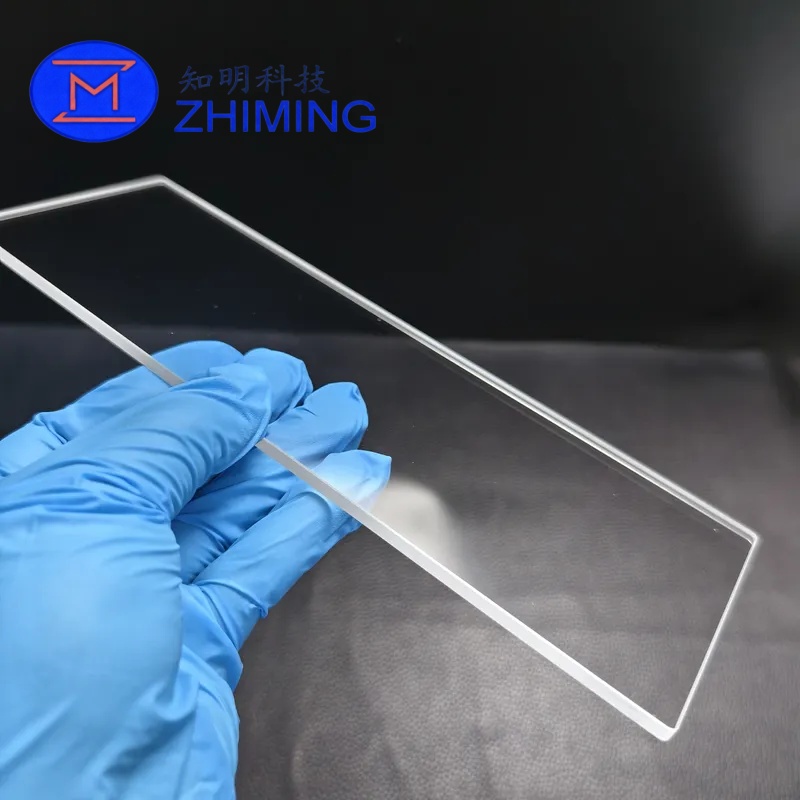
Circular windows are limited in coverage area for industrial instruments, particularly in applications such as high-pressure vessels, laser chambers, and furnace observation ports. Large sapphire windows, particularly in square or rectangular shapes, provide expanded optical access, enabling full-field observation and uniform illumination without requiring multiple windows or additional optical components.
2.2 Structural Integrity Under Stress
Sapphire’s high Young’s modulus (~345 GPa) and fracture toughness (~4 MPa·m^0.5) allow large windows to withstand substantial mechanical loads. For square windows, careful edge chamfering and stress-relieving treatments are critical to minimize stress concentrations that can lead to cracking under thermal or mechanical stress.
2.3 Customization for Industrial Equipment
Industrial equipment often requires windows that conform to specific dimensions and mounting configurations. Large sapphire windows can be custom-cut and polished to meet these requirements, including precise thickness, flatness, and surface roughness (Ra ≤ 0.1 μm). Additionally, integration with holders, gaskets, or Kovar frames ensures compatibility with high-temperature furnaces or high-pressure vessels.
3. Fabrication Challenges and Techniques
Producing large and square sapphire windows involves several technical challenges due to the material’s hardness and brittleness. Traditional cutting and polishing methods used for circular wafers are not directly applicable. Key fabrication techniques include:
3.1 Precision Cutting
Sapphire is typically cut using diamond wire saws or laser cutting, allowing precise shaping while minimizing micro-cracks. Square geometries require exact corner cutting and edge finishing to reduce stress points.
3.2 Surface Polishing
High-quality optical surfaces are achieved using chemical-mechanical polishing (CMP). Maintaining flatness and parallelism is critical for laser and imaging applications. Large surfaces may require staged polishing with progressively finer abrasives.
3.3 Coating and Surface Treatments
For certain applications, sapphire windows can be coated with anti-reflective (AR) coatings, such as magnesium fluoride (MgF₂), to maximize transmission. Protective layers like ALD Al₂O₃ may be applied to enhance resistance against high-power lasers or corrosive chemicals.
4. Industrial Applications
4.1 High-Temperature Furnaces
Large square sapphire windows are often used in furnace observation ports, allowing engineers to monitor processes such as crystal growth or chemical vapor deposition without opening the furnace. Sapphire’s thermal stability ensures clarity even at temperatures exceeding 1500°C.
4.2 High-Pressure Chambers
In high-pressure experimental setups, square sapphire windows provide large viewing areas while maintaining structural integrity. Applications include hydraulic testing, reaction chambers, and deep-sea equipment.
4.3 Laser and Optical Systems
Square sapphire windows are favored in high-power laser systems, photolithography, and UV/IR optics due to their wide spectral transmission and high damage threshold. Custom shapes allow optimal alignment and uniform illumination across large optical paths.
4.4 Aerospace and Defense
The mechanical toughness and scratch resistance of sapphire make it suitable for sensor windows and protective covers in aerospace instrumentation. Square geometries maximize field of view for imaging and sensing equipment while maintaining durability in harsh conditions.
5. Customization Considerations
When ordering large or square sapphire windows, several parameters must be considered:
| Parameter | Typical Range / Notes |
|---|---|
| Mått och dimensioner | Up to 200 mm × 200 mm or larger |
| Tjocklek | 0.5 mm – 20 mm depending on mechanical requirements |
| Surface Flatness | λ/10 – λ/4 (at 632.8 nm) |
| Ytjämnhet | Ra ≤ 0.1 μm |
| Kantfinish | Chamfered or beveled to reduce stress |
| Ytbeläggningar | Anti-reflective, protective ALD layers as required |
| Mounting | Direct bonding, Kovar frames, or mechanical holders |
Selecting the proper combination ensures performance, durability, and ease of integration with industrial systems.
6. Conclusion
Large and square sapphire windows represent a critical advancement in industrial optical access, combining the unique mechanical, thermal, and optical properties of sapphire with the flexibility of custom geometries. Their applications range from high-temperature furnaces and high-pressure chambers to laser optics and aerospace sensors, demonstrating the versatility of sapphire in extreme industrial environments.
Advances in precision cutting, polishing, and coating techniques now allow manufacturers to produce these windows in large sizes and complex shapes without compromising optical clarity or structural integrity. For engineers and designers, custom sapphire windows provide a reliable solution to meet the growing demands of modern industrial equipment, combining durability, transparency, and precise performance in a single optical component.