
Why Material Selection Matters in Extreme Environments
In high-pressure and high-temperature systems—such as pressure vessels, reactors, downhole tools, aerospace sensors, and industrial observation ports—the optical window is often the weakest yet most critical component.
A failure at the window interface can lead not only to measurement errors, but also to catastrophic safety risks.
Sapphire optical windows are frequently selected for such environments, often described as a “default premium solution.” However, in engineering practice, material selection must be justified by physics and application constraints, not reputation.
This article provides an experience-driven, engineering-focused guide to choosing sapphire optical windows for extreme pressure and temperature conditions, helping designers and procurement teams make defensible, specification-level decisions.
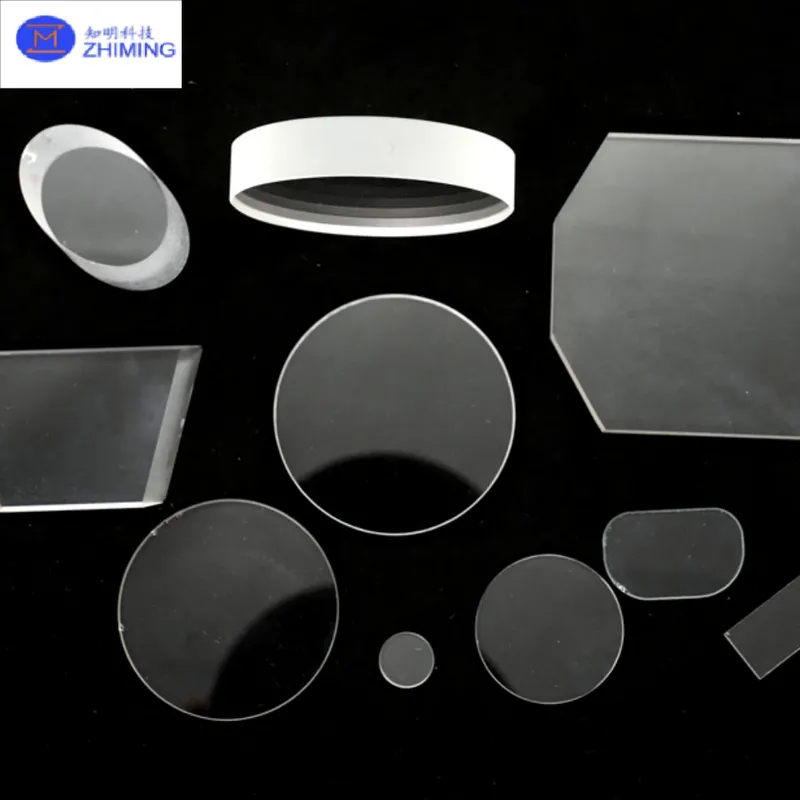
1. Defining the Operating Conditions
A reliable sapphire window design always starts with clear boundary conditions, в том числе:
- Maximum and minimum operating pressure
- Continuous and peak operating temperature
- Pressure cycling vs. static load
- Heating and cooling rates
- Chemical or plasma exposure
- Optical wavelength and measurement method
Without this data, even the best material choice becomes unreliable.
Engineering reality: Most sapphire window failures are not caused by insufficient strength, but by incorrect assumptions about thermal gradients or mounting stress.
2. Why Sapphire Performs Well Under High Pressure
2.1 Mechanical strength in compression
Sapphire (single-crystal Al₂O₃) exhibits exceptional compressive strength and stiffness:
- Young’s modulus ≈ 435 GPa
- Very high elastic limit under compressive stress
- Minimal long-term deformation
These properties make sapphire particularly suitable for static high-pressure optical windows, where compressive loads dominate.
Compared with fused silica or borosilicate glass, sapphire can:
- Withstand significantly higher pressures at the same thickness
- Achieve the same pressure rating with reduced window thickness
- Maintain optical alignment under load
This is why sapphire is widely used in pressure viewports, autoclave windows, and subsea optical systems.
3. High-Temperature Performance: Strength with Constraints
3.1 Thermal stability
Sapphire remains mechanically stable at temperatures far beyond conventional glass:
- Melting point ≈ 2050 °C
- No softening or creep in typical industrial temperature ranges
- Stable optical transmission at elevated temperatures
In steady-state high-temperature environments, sapphire outperforms quartz and fused silica.
3.2 Thermal shock considerations
However, sapphire is not immune to thermal shock. Its high stiffness and moderate thermal conductivity mean that:
- Rapid temperature changes can induce internal stress
- Localized heating (e.g., flame exposure, plasma edges) may cause cracking
- Mounting design plays a critical role in survival
For applications involving frequent or rapid thermal cycling, sapphire must be carefully evaluated against alternatives with higher thermal shock resistance.
4. Chemical and Environmental Resistance
Sapphire offers excellent resistance to:
- Strong acids and alkalis
- High-purity process gases
- Vacuum and high-radiation environments
- Many plasma processes
Unlike glass, sapphire does not devitrify, leach ions, or haze over time, making it suitable for long-life industrial and scientific systems.
That said, no material is chemically invulnerable. Certain high-temperature alkali vapors and fluorine-rich plasmas can still degrade sapphire surfaces over extended exposure.
5. Optical Characteristics Engineers Must Consider
While sapphire provides broad spectral transmission (UV–Visible–NIR–Mid-IR), it is not optically neutral:
- Refractive index (~1.77) is higher than fused silica
- Higher Fresnel reflection losses without coatings
- Intrinsic birefringence due to crystal anisotropy
For polarization-sensitive or interferometric systems, crystal orientation (C-plane, A-plane, R-plane) and surface quality specifications are essential.
6. Sapphire vs. Alternative Window Materials
| Материал | Strengths | Ограничения |
|---|---|---|
| Сапфир | High pressure & temperature balance | Thermal shock sensitivity, cost |
| Fused silica | Excellent thermal shock resistance | Low pressure capability |
| Кварц | Optical purity | Softening at high temperature |
| Spinel | Isotropic optics | Низкая механическая прочность |
| SiC | Extreme strength & temperature | Opaque (not suitable for optical windows) |
There is no universally “best” material—only the best-fit material for a defined application.
7. Practical Selection Guidelines
Sapphire optical windows are typically the right choice when:
- Pressure is high and predominantly static
- Temperature is elevated but relatively stable
- Chemical resistance and long service life are required
- Mechanical thickness must be minimized
They may be less suitable when:
- Rapid heating or cooling is unavoidable
- Cost sensitivity outweighs performance margins
- Optical polarization effects cannot be tolerated
Conclusion: Engineering Judgment Over Material Mythology
Choosing sapphire optical windows for high-pressure and high-temperature use is not about selecting the hardest or most expensive material—it is about matching material physics to real operating conditions.
Sapphire is not unbeatable in every scenario. But when pressure, temperature, chemical stability, and optical access must coexist in a single component, sapphire remains one of the most technically justified and field-proven solutions available.
In engineering terms, sapphire’s value lies not in marketing claims, but in predictable performance when the design assumptions are correct.