
Synthetic szafirowe okna have become one of the most reliable optical materials for demanding industrial, aerospace, and scientific environments. Thanks to their exceptional hardness, thermal stability, and chemical resistance, sapphire optical components are widely used where conventional glass fails.
Beyond material performance, shape customization plays a critical role in real-world applications. Different optical systems require different geometries to achieve optimal performance, sealing, and mechanical integration.
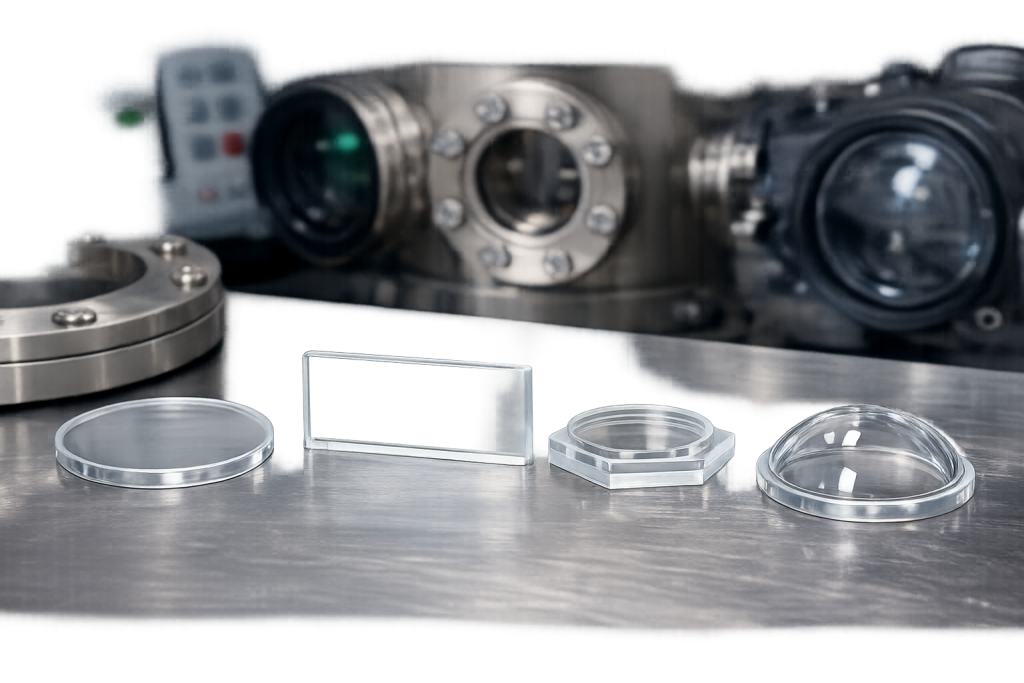
This article explores the most common custom sapphire window shapes—round, rectangular, stepped, and domed designs—and their typical engineering applications.
Why Sapphire Windows Are Used in Advanced Applications
Before looking at shapes, it’s important to understand why sapphire is chosen in the first place.
Synthetic sapphire (single-crystal Al₂O₃) offers:
- Wyjątkowo wysoka twardość (9 w skali Mohsa)
- Excellent scratch and abrasion resistance
- High transmission from UV to mid-IR ranges
- Strong resistance to high temperature and pressure
- Excellent chemical stability in corrosive environments
Because of these properties, sapphire windows are widely used in optical, semiconductor, defense, and high-pressure systems.
1. Round Sapphire Windows
Round sapphire windows are the most common and versatile form.
Key Characteristics:
- Symmetrical stress distribution
- Easy integration into standard flanges and housings
- Suitable for high-pressure sealing systems
- Cost-effective for mass production
Typical Applications:
- Optical sensors and laser systems
- High-pressure observation ports
- Aerospace instrumentation
- Przemysłowe okna inspekcyjne
Round designs are often preferred when mechanical stress needs to be evenly distributed across the surface, improving long-term durability.
2. Rectangular Sapphire Windows
Rectangular sapphire windows are widely used in imaging and scanning systems where a wider field of view is required.
Key Characteristics:
- Larger usable viewing area
- Ideal for linear optical systems
- Easier integration with flat mounting structures
- Can be customized with chamfered or polished edges
Typical Applications:
- Systemy wizyjne
- Semiconductor inspection equipment
- Scientific imaging devices
- Protective windows for display sensors
Rectangular sapphire windows are often chosen when spatial design constraints require flat interfaces or when imaging systems scan in linear paths.
3. Stepped Sapphire Windows
Stepped sapphire windows include a machined “step” or shoulder around the edge, allowing precise mechanical positioning.
Key Characteristics:
- Enhanced alignment accuracy in assemblies
- Improved sealing capability
- Better resistance to vibration and mechanical shift
- Suitable for precision housings
Typical Applications:
- Komory próżniowe
- High-precision optical instruments
- Urządzenia do obróbki półprzewodników
- Hermetically sealed sensor systems
Stepped designs are especially important in environments requiring high positional accuracy and leak-tight sealing under extreme conditions.
4. Domed Sapphire Windows
Domed sapphire windows are engineered for applications requiring pressure resistance and wide-angle optical performance.
Key Characteristics:
- High structural strength under external/internal pressure
- Reduced optical distortion at wide viewing angles
- Aerodynamic shape for high-speed environments
- Excellent impact resistance
Typical Applications:
- Underwater optical systems
- Aerospace sensor protection (drones, missiles, aircraft)
- High-pressure and deep-sea observation equipment
- Military-grade camera housings
Domed sapphire windows are often selected when both mechanical protection and optical clarity under extreme conditions are required.
Comparison of Sapphire Window Shapes
| Kształt | Strength | Optical Field | Best Use Case |
|---|---|---|---|
| Okrągły | Wysoki | Średni | General industrial and optical systems |
| Prostokątny | Średni | Szeroki | Imaging and scanning systems |
| Stepped | Bardzo wysoka | Średni | Precision sealing assemblies |
| Domed | Extremely High | Wide-angle | Aerospace, underwater, high-pressure environments |
Customization Options for Sapphire Windows
In real industrial applications, shape is only one part of customization. Sapphire windows can also be engineered with:
- Powłoki antyrefleksyjne (AR)
- Custom thickness and diameter
- Double-side polishing (DSP)
- Edge chamfering or beveling
- Optical-grade surface flatness (λ/10 level)
These modifications allow sapphire components to be optimized for specific wavelengths, pressure conditions, and mechanical assemblies.
Wnioski
Custom sapphire window shapes are not just design variations—they are engineering solutions tailored to different optical and mechanical challenges.
- Round windows offer balanced strength and versatility
- Rectangular windows support wide-field imaging systems
- Okna schodkowe ensure precision alignment and sealing
- Domed windows deliver maximum durability under extreme conditions
Choosing the right geometry can significantly improve system reliability, optical performance, and long-term durability in harsh environments.
FAQ: Custom Sapphire Windows
What are sapphire windows used for?
Sapphire windows are used as high-performance optical components in demanding environments such as aerospace, semiconductor equipment, underwater systems, and industrial inspection devices. They provide a transparent viewing interface while protecting internal systems from heat, pressure, and corrosion.
Why choose sapphire instead of glass or quartz?
Sapphire offers significantly higher hardness, scratch resistance, and thermal stability compared to glass or quartz. It also performs better in extreme environments where mechanical stress, high pressure, or corrosive chemicals are present, making it more suitable for long-term industrial use.
Can sapphire windows be customized in shape and size?
es. Sapphire windows can be customized into various shapes such as round, rectangular, stepped, and domed designs. They can also be tailored in thickness, surface finish, and coatings (such as anti-reflective coatings) to meet specific optical and mechanical requirements.