
Saffier ramen are widely used in semiconductor equipment, high-pressure sensors, vacuum systems, laser instruments, aerospace optics and harsh-environment imaging devices. While the optical performance of sapphire is well understood, the reliability of the final assembly often depends on another critical process—the method used to bond the sapphire window into its metal housing.
Unlike conventional glass, sapphire possesses extremely high hardness but relatively low fracture toughness. It can withstand tremendous compressive loads but is sensitive to localized tensile stress, point loading and improper mounting. A poorly designed bonding process may lead to edge chipping, optical distortion, coating damage or even catastrophic cracking after thermal cycling.
This article explains the engineering principles behind sapphire-to-metal bonding, common assembly methods, material selection, thermal stress management and best practices for achieving reliable optical assemblies.
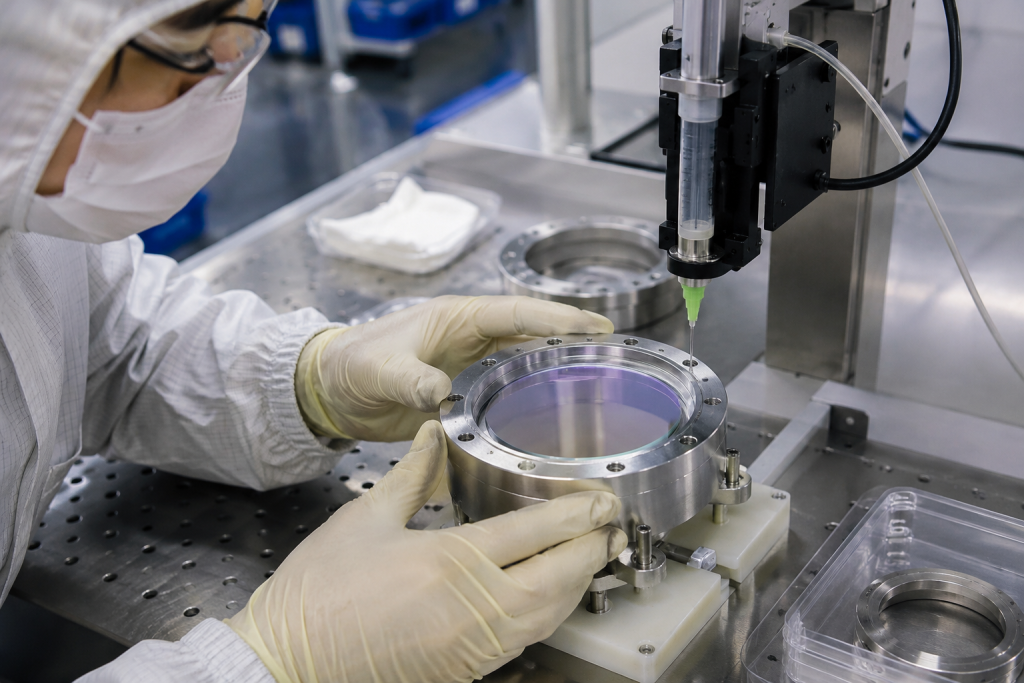
Why Bonding Sapphire to Metal Is Challenging
Although sapphire and stainless steel may appear to be simple mechanical components, they behave very differently under changing temperatures and mechanical loads.
Several factors complicate the assembly process:
- Different coefficients of thermal expansion (CTE)
- Extremely high elastic modulus of sapphire
- Brittleness under tensile stress
- Tight optical alignment requirements
- Vacuum or pressure sealing requirements
- Long-term environmental reliability
During assembly, both the sapphire window and the metal housing expand and contract at different rates. If the bonding material cannot absorb these movements, significant stress may be transferred directly into the sapphire.
Understanding Thermal Expansion Mismatch
One of the most important considerations is the difference in thermal expansion between sapphire and common engineering metals.
Approximate room-temperature coefficients of thermal expansion include:
| Materiaal | CTE (×10⁻⁶/K) |
|---|---|
| Sapphire (C-axis) | 5–6 |
| Kovar Alloy | 5–6 |
| Titanium Alloy | 8–9 |
| Stainless Steel 304 | 17 |
| Aluminum Alloy | 23 |
Kovar is often selected because its thermal expansion closely matches sapphire, minimizing thermal stress during heating and cooling.
Stainless steel and aluminum are commonly used due to their strength and machinability, but additional design measures are usually required to accommodate expansion differences.
Common Bonding Methods
Several joining techniques are used depending on operating temperature, pressure, optical accuracy and production volume.
1. Adhesive Bonding
Optical-grade adhesives are among the most common methods for assembling sapphire windows.
Typical adhesive families include:
- Epoxy adhesives
- UV-curable adhesives
- Silicone adhesives
- Hybrid structural adhesives
Voordelen zijn onder meer:
- Low assembly stress
- Relatively simple manufacturing
- Good dimensional tolerance
- Cost-effective production
- Suitable for many optical instruments
However, adhesive selection depends heavily on environmental conditions.
Bijvoorbeeld:
- High-temperature applications may exceed epoxy limits.
- UV exposure may degrade certain polymers.
- Vacuum systems require extremely low outgassing.
- Chemical environments require compatible adhesive chemistry.
2. Brazing
For aerospace, vacuum or hermetic packages, brazing may provide superior long-term sealing.
In brazed assemblies, a metallized sapphire surface is joined to a metal component using a brazing alloy at elevated temperature.
Voordelen zijn onder meer:
- Hermetische afdichting
- Excellent mechanical strength
- High-temperature capability
- Lange levensduur
Challenges include:
- Complex manufacturing
- High process temperatures
- Residual thermal stress
- Higher production cost
Brazing is typically reserved for demanding industrial or scientific applications.
3. Mechanical Retention
Some sapphire windows are not bonded directly.
Instead, they are retained using:
- Threaded retaining rings
- Precision bezels
- Compression flanges
- Clamp assemblies
This approach allows easier replacement and avoids permanent bonding.
However, compression force must be carefully controlled to prevent edge damage.
4. Elastomer Sealing
Many vacuum and pressure systems use elastomer seals between sapphire and metal.
Common sealing materials include:
- Silicone
- Fluoroelastomers (FKM)
- EPDM
- Perfluoroelastomers (FFKM)
These materials provide:
- Stress isolation
- Pressure sealing
- Thermal expansion compensation
- Reduced assembly stress
The elastomer often serves both as a seal and as a compliant support for the sapphire window.
Why Adhesive Thickness Matters
A common misconception is that thinner adhesive layers always produce stronger joints.
In reality, an adhesive layer that is too thin may become excessively rigid and transfer thermal stress directly to the sapphire.
Conversely, an excessively thick adhesive layer may reduce positional accuracy or mechanical stability.
The optimum bond-line thickness depends on:
- Adhesive modulus
- Thermische uitzetting
- Window diameter
- Housing material
- Bedrijfstemperatuur
- Required alignment accuracy
Engineers typically optimize bond thickness through finite element analysis (FEA) and environmental testing.
Avoiding Stress Concentration
Most sapphire failures originate near the edges rather than the center.
Stress concentration can result from:
- Sharp housing corners
- Burrs
- Poor chamfers
- Uneven adhesive distribution
- Localized clamping force
- Machining defects
For this reason, housing designs usually incorporate:
- Rounded corners
- Precision chamfers
- Uniform support surfaces
- Controlled adhesive gaps
- Smooth seating surfaces
These features help distribute mechanical loads more evenly.
Protecting Optical Coatings During Assembly
Many sapphire windows receive anti-reflection (AR), high-reflectivity or specialized functional coatings.
Bonding must avoid damaging these coatings.
Recommended practices include:
- Handling with non-abrasive gloves
- Avoiding adhesive contamination
- Controlling dispensing volume
- Preventing solvent attack
- Protecting coated surfaces during curing
Some adhesives may outgas during curing and contaminate nearby optical surfaces, making low-outgassing materials essential for precision optical systems.
Bonding for Vacuum Applications
Vacuum systems place additional demands on the assembly.
Important considerations include:
- Low outgassing adhesives
- Vacuum-compatible seal materials
- Helium leak testing
- Clean assembly procedures
- Particle contamination control
In semiconductor equipment, even microscopic contamination can affect process yield, so bonding operations are often performed in cleanroom environments.
Bonding for High-Pressure Windows
Pressure-resistant sapphire windows require careful load management.
The housing should:
- Support the entire perimeter
- Avoid point contact
- Maintain even compression
- Minimize bending stress
Finite element analysis is frequently used to predict stress distribution under internal or external pressure.
Thermal Cycling Reliability
Many optical assemblies experience repeated temperature changes throughout their service life.
Voorbeelden zijn:
- Outdoor imaging equipment
- Aerospace systems
- Semiconductor process tools
- Laserapparatuur
- Industriële inspectiesystemen
Repeated thermal expansion can gradually fatigue adhesives or introduce stress into the sapphire.
Manufacturers typically perform environmental testing such as:
- Thermische cycli
- High-temperature storage
- Humidity exposure
- Mechanische schok
- Trillingstests
These evaluations help verify long-term assembly reliability.
Cleanliness During Bonding
Optical bonding requires extremely clean surfaces.
Before assembly, sapphire and metal components are typically cleaned to remove:
- Stofdeeltjes
- Vingerafdrukken
- Machining oil
- Polishing residues
- Moisture
- Organic contaminants
Poor cleanliness can weaken adhesion, create optical defects or introduce contamination into sensitive equipment.
Inspection After Bonding
After assembly, manufacturers generally inspect several characteristics, including:
- Optical alignment
- Bond-line uniformity
- Adhesive coverage
- Bubble inspection
- Randvoorwaarde
- Oppervlakteverontreiniging
- Parallellisme
- Overall dimensional accuracy
Depending on the application, additional testing may include pressure testing, vacuum leak testing or optical transmission measurements.
Choosing the Right Bonding Method
There is no universal bonding solution for every sapphire window.
Selection depends on factors such as:
| Toepassing | Preferred Bonding Method |
| Industrial sensors | Optical adhesive |
| Lasersystemen | Precision adhesive or mechanical retention |
| Vacuümkamers | Brazing or vacuum-compatible adhesive |
| Hogedruk kijkvensters | Mechanical retention with sealing gasket |
| Optica voor de lucht- en ruimtevaart | Brazing or specialized structural bonding |
| Halfgeleiderapparatuur | Low-outgassing adhesive or precision sealing |
The best design balances optical performance, mechanical reliability, manufacturing cost and long-term durability.
Conclusie
Bonding a sapphire window into a metal housing involves far more than simply applying adhesive. Engineers must carefully manage thermal expansion, mechanical stress, optical alignment, environmental compatibility and long-term reliability.
Whether using optical adhesives, brazing, mechanical retention or elastomer sealing, the primary objective is the same: distribute loads evenly while protecting the sapphire from localized stress.
By selecting compatible materials, optimizing bond-line geometry, controlling assembly cleanliness and validating performance through environmental testing, manufacturers can produce sapphire window assemblies capable of operating reliably in semiconductor equipment, aerospace systems, laser instruments, vacuum chambers and other demanding applications.
A well-engineered bonding process not only protects the sapphire itself but also preserves optical accuracy, mechanical integrity and system performance throughout the product’s service life.