
Synthetisch saffieren ramen zijn uitgegroeid tot een van de meest betrouwbare optische materialen voor veeleisende industriële, luchtvaart- en wetenschappelijke omgevingen. Dankzij hun uitzonderlijke hardheid, thermische stabiliteit en chemische weerstand worden optische componenten van saffier veel gebruikt op plaatsen waar conventioneel glas faalt.
Naast materiaalprestaties speelt vormaanpassing een cruciale rol in echte toepassingen. Verschillende optische systemen vereisen verschillende geometrieën voor optimale prestaties, afdichting en mechanische integratie.
In dit artikel worden de meest voorkomende saffierraamvormen op maat-ronde, rechthoekige, getrapte en koepelvormige ontwerpen en hun typische technische toepassingen.
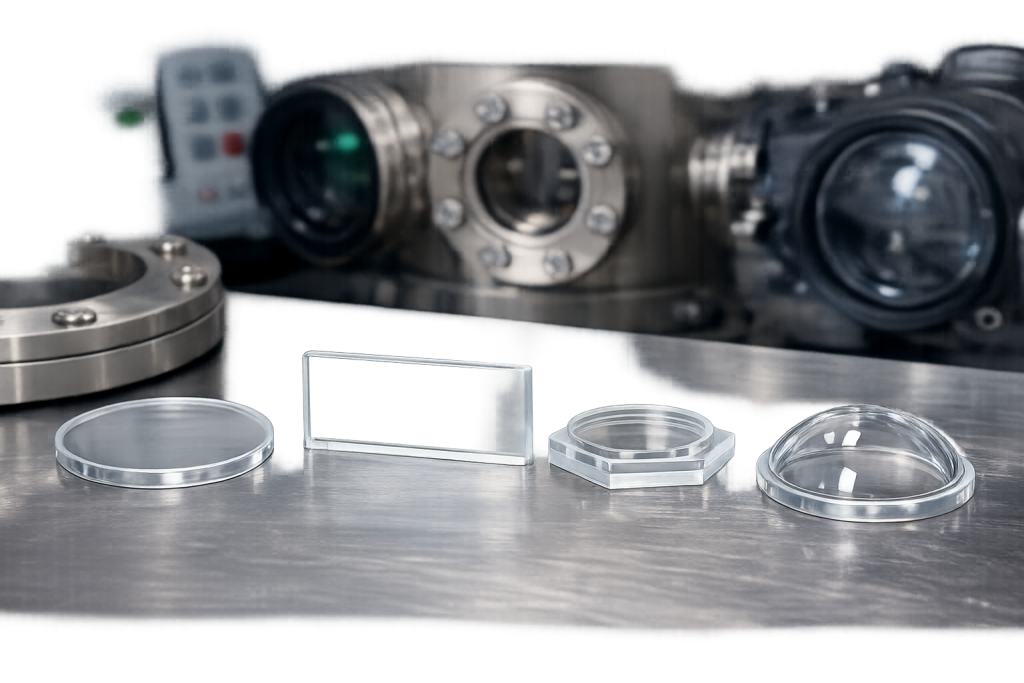
Waarom Sapphire Windows worden gebruikt in geavanceerde toepassingen
Voordat we naar de vormen kijken, is het belangrijk om te begrijpen waarom er in de eerste plaats voor saffier wordt gekozen.
Synthetische saffier (eenkristal Al₂O₃) biedt:
- Extreem hoge hardheid (Mohs 9)
- Uitstekende weerstand tegen krassen en schuren
- Hoge transmissie van UV- tot midden-IR-bereiken
- Sterke weerstand tegen hoge temperatuur en druk
- Uitstekende chemische stabiliteit in corrosieve omgevingen
Vanwege deze eigenschappen worden saffierramen veel gebruikt in optische, halfgeleider-, defensie- en hogedruksystemen.
1. Ronde saffierramen
Ronde saffierramen zijn de meest voorkomende en veelzijdige vorm.
Belangrijkste kenmerken:
- Symmetrische spanningsverdeling
- Eenvoudige integratie in standaard flenzen en behuizingen
- Geschikt voor hogedrukafdichtingssystemen
- Rendabel voor massaproductie
Typische toepassingen:
- Optische sensoren en lasersystemen
- Hogedruk observatiepoorten
- Instrumentatie voor de ruimtevaart
- Industriële inspectieramen
Ronde ontwerpen hebben vaak de voorkeur als de mechanische spanning gelijkmatig over het oppervlak moet worden verdeeld, wat de duurzaamheid op lange termijn verbetert.
2. Rechthoekige saffierruiten
Rechthoekige saffiervensters worden veel gebruikt in beeldvormings- en scansystemen waar een breder gezichtsveld nodig is.
Belangrijkste kenmerken:
- Groter bruikbaar kijkgebied
- Ideaal voor lineaire optische systemen
- Eenvoudigere integratie met vlakke montagestructuren
- Kan worden aangepast met afgeschuinde of gepolijste randen
Typische toepassingen:
- Machinevisiesystemen
- Semiconductor inspection equipment
- Scientific imaging devices
- Protective windows for display sensors
Rectangular sapphire windows are often chosen when spatial design constraints require flat interfaces or when imaging systems scan in linear paths.
3. Stepped Sapphire Windows
Stepped sapphire windows include a machined “step” or shoulder around the edge, allowing precise mechanical positioning.
Belangrijkste kenmerken:
- Enhanced alignment accuracy in assemblies
- Improved sealing capability
- Better resistance to vibration and mechanical shift
- Suitable for precision housings
Typische toepassingen:
- Vacuümkamers
- High-precision optical instruments
- Apparatuur voor de halfgeleiderproductie
- Hermetically sealed sensor systems
Stepped designs are especially important in environments requiring high positional accuracy and leak-tight sealing under extreme conditions.
4. Domed Sapphire Windows
Domed sapphire windows are engineered for applications requiring pressure resistance and wide-angle optical performance.
Belangrijkste kenmerken:
- High structural strength under external/internal pressure
- Reduced optical distortion at wide viewing angles
- Aerodynamic shape for high-speed environments
- Excellent impact resistance
Typische toepassingen:
- Underwater optical systems
- Aerospace sensor protection (drones, missiles, aircraft)
- High-pressure and deep-sea observation equipment
- Military-grade camera housings
Domed sapphire windows are often selected when both mechanical protection and optical clarity under extreme conditions are required.
Comparison of Sapphire Window Shapes
| Vorm | Strength | Optical Field | Best Use Case |
|---|---|---|---|
| Rond | Hoog | Medium | General industrial and optical systems |
| Rechthoekig | Medium | Breed | Imaging and scanning systems |
| Stepped | Zeer hoog | Medium | Precision sealing assemblies |
| Domed | Extremely High | Wide-angle | Aerospace, underwater, high-pressure environments |
Customization Options for Sapphire Windows
In real industrial applications, shape is only one part of customization. Sapphire windows can also be engineered with:
- Antireflecterende (AR) coatings
- Custom thickness and diameter
- Double-side polishing (DSP)
- Edge chamfering or beveling
- Optical-grade surface flatness (λ/10 level)
These modifications allow sapphire components to be optimized for specific wavelengths, pressure conditions, and mechanical assemblies.
Conclusie
Custom sapphire window shapes are not just design variations—they are engineering solutions tailored to different optical and mechanical challenges.
- Round windows offer balanced strength and versatility
- Rectangular windows support wide-field imaging systems
- Trapvormige ramen ensure precision alignment and sealing
- Domed windows deliver maximum durability under extreme conditions
Choosing the right geometry can significantly improve system reliability, optical performance, and long-term durability in harsh environments.
FAQ: Custom Sapphire Windows
What are sapphire windows used for?
Sapphire windows are used as high-performance optical components in demanding environments such as aerospace, semiconductor equipment, underwater systems, and industrial inspection devices. They provide a transparent viewing interface while protecting internal systems from heat, pressure, and corrosion.
Why choose sapphire instead of glass or quartz?
Sapphire offers significantly higher hardness, scratch resistance, and thermal stability compared to glass or quartz. It also performs better in extreme environments where mechanical stress, high pressure, or corrosive chemicals are present, making it more suitable for long-term industrial use.
Can sapphire windows be customized in shape and size?
es. Sapphire windows can be customized into various shapes such as round, rectangular, stepped, and domed designs. They can also be tailored in thickness, surface finish, and coatings (such as anti-reflective coatings) to meet specific optical and mechanical requirements.