
Sapphire windows are widely used in optical systems that must operate under high temperature, vacuum, pressure, abrasion and chemically aggressive environments. Applications range from semiconductor processing chambers and industrial furnaces to aerospace sensors, combustion monitoring systems and high-temperature observation equipment.
One of sapphire’s major advantages is its ability to maintain mechanical and optical performance in environments where ordinary glass materials may soften, scratch, deform or chemically degrade.
However, maximum operating temperature alone does not determine the reliability of a sapphire window.
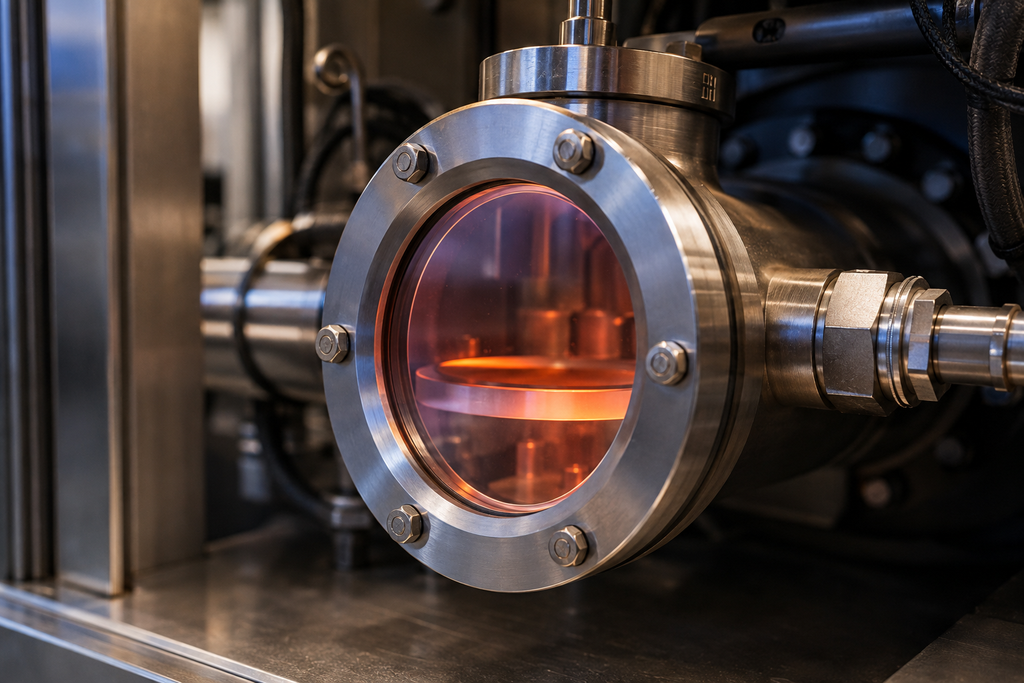
In many real systems, the window is repeatedly heated and cooled during equipment startup, shutdown, process cycling or environmental exposure. These repeated temperature changes can generate thermal gradients, internal stress, mounting stress and microscopic crack growth.
A sapphire window may survive a single exposure to a high temperature but still experience reliability problems after hundreds or thousands of thermal cycles.
For this reason, engineers should evaluate not only maximum temperature, but also thermal stress, heating and cooling rate, crystal orientation, window geometry, edge quality, mounting conditions and expected service cycles.
This guide explains the major factors that influence sapphire window performance under repeated thermal cycling.
1. What Is Thermal Cycling?
Thermal cycling refers to repeatedly changing the temperature of a component between two or more operating conditions.
A simplified cycle might be:
25°C → 300°C → 25°C
또는:
25°C → 600°C → 25°C
The sapphire window may experience this sequence dozens, hundreds or thousands of times during its service life.
Typical causes of thermal cycling include:
- equipment startup and shutdown;
- semiconductor process cycles;
- furnace loading and unloading;
- plasma chamber operation;
- laser heating;
- combustion systems;
- engine operation;
- vacuum chamber bakeout;
- high-temperature cleaning;
- aerospace day/night temperature variation;
- rapid process-gas temperature changes.
The severity of thermal cycling depends not only on the maximum temperature, but also on how quickly and uniformly the temperature changes.
A sapphire window slowly heated to 500°C may experience less thermal stress than the same window rapidly heated from room temperature to 300°C.
Therefore, specifying only an operating temperature such as “500°C maximum” does not provide enough information to evaluate thermal-cycle reliability.
2. Thermal Shock vs. Thermal Cycling
Thermal shock and thermal cycling are related but different.
Thermal Shock
Thermal shock generally refers to a rapid temperature change that creates a large temperature gradient within the material.
예를 들면 다음과 같습니다:
- inserting a cold window into a hot environment;
- exposing a hot sapphire surface to cold gas;
- rapid laser heating;
- sudden furnace withdrawal.
Severe thermal shock can cause immediate fracture.
Thermal Cycling
Thermal cycling describes repeated heating and cooling over time.
Individual cycles may not be severe enough to cause immediate failure, but repeated stress can expose manufacturing defects, edge damage or weaknesses in the mounting structure.
Research on sapphire thermal shock shows that fracture behavior depends strongly on thermal loading, sample dimensions, crystal orientation and anisotropic material properties.
For long-life optical systems, both single-event thermal shock resistance and repeated thermal-cycle durability should be considered.
3. Why Temperature Gradients Produce Thermal Stress
If an entire sapphire window heats uniformly and is free to expand, relatively little thermal stress may develop.
Real systems rarely heat so perfectly.
예를 들어
- the center of the window may face a hot plasma;
- the edge may remain cooled by a metal flange;
- one surface may face a hot chamber;
- the opposite surface may remain near ambient temperature;
- cooling gas may strike only part of the window.
These temperature differences cause different regions of the sapphire to expand or contract by different amounts.
A simplified relationship is:
Thermal Stress ∝ Elastic Modulus × Thermal Expansion × Temperature Difference
Sapphire has a high elastic modulus of approximately 335 GPa and a relatively low but non-zero coefficient of thermal expansion. Published optical-material data list thermal expansion values around 5.0–5.6 × 10⁻⁶ K⁻¹ depending on crystal direction, which reflects sapphire’s anisotropic nature.
Because sapphire is stiff, significant mechanical stress can develop when thermal expansion is constrained.
The larger the internal temperature difference, the greater the potential thermal stress.
4. Sapphire Is an Anisotropic Crystal
Sapphire is single-crystal aluminum oxide, Al₂O₃.
Unlike isotropic glasses, sapphire does not have identical properties in every direction.
Its:
- thermal expansion;
- elastic modulus;
- fracture toughness;
- cleavage behavior;
- optical properties
depend on crystallographic orientation.
This means C-plane, A-plane, R-plane and other sapphire orientations may respond differently under the same thermal load.
Experimental studies have shown that sapphire thermal-shock resistance changes with crystal orientation and that fracture morphology is influenced by the crystallographic plane.
For ordinary protective windows this may not always be critical.
For severe thermal-cycle applications, however, crystal orientation should be included in the engineering specification.
5. Heating and Cooling Do Not Produce the Same Stress
A common assumption is that the most dangerous condition occurs at the maximum temperature.
This is not necessarily true.
During heating, the surface exposed to the heat source may expand first.
During cooling, that same surface may contract before the interior of the window.
This reverses the thermal stress distribution.
Because brittle materials are particularly sensitive to tensile stress, the cooling stage can sometimes be more dangerous than heating.
Finite-element research on sapphire wafers subjected to thermal shock found that maximum tensile stress can occur at the wafer edge during cooling, creating a high probability of fracture at those locations.
For engineering applications, this means that:
cooling rate can be just as important as maximum operating temperature.
6. Why Sapphire Window Cracks Often Start at the Edge
A polished optical surface may look perfect, but thermal failure often begins outside the clear aperture.
The edge of a sapphire window may contain:
- grinding marks;
- microchips;
- chamfer damage;
- subsurface microcracks;
- machining defects;
- mounting contact points.
These features act as stress concentrators.
When thermal stress becomes tensile, a microscopic flaw can become the starting point for crack propagation.
Research on thermally shocked sapphire wafers found that fracture probability is strongly related to edge location and anisotropic cleavage behavior.
Therefore, edge quality is not just a cosmetic requirement.
For thermally cycled windows, specifications should consider:
- edge polish;
- chamfer dimensions;
- chip limits;
- corner radius;
- grinding damage;
- surface-to-edge transition.
A high-quality edge can significantly reduce the number of potential crack-initiation sites.
7. Surface Quality Also Affects Thermal Reliability
Sapphire is extremely hard, but it is still a brittle crystal.
Manufacturing operations such as:
- slicing;
- grinding;
- lapping;
- polishing;
- drilling;
- edge machining
can introduce microscopic surface or subsurface damage.
These defects may include:
- scratches;
- pits;
- microcracks;
- residual stress;
- subsurface fracture.
Under normal room-temperature service, these defects may remain stable.
Repeated thermal stress can make them more important.
For demanding applications, polishing quality should therefore be evaluated not only for optical performance, but also for mechanical reliability.
This is particularly important when the same sapphire window must withstand both:
thermal cycling + pressure or vacuum loading.
8. Window Thickness Is a Tradeoff
Window thickness is one of the most important design parameters.
Increasing thickness usually improves resistance to:
- pressure differential;
- bending;
- mechanical impact;
- mounting loads.
However, thicker sapphire can also develop larger temperature differences between its two surfaces during rapid heating or cooling.
Consider a window with one side exposed to a high-temperature chamber while the other side is cooled.
A thicker window may maintain a larger through-thickness temperature gradient.
This can increase thermal stress.
Therefore:
Thicker does not automatically mean better thermal-cycle reliability.
The optimum thickness must balance:
- pressure resistance;
- mechanical stiffness;
- thermal response;
- optical requirements;
- diameter;
- mounting method.
For critical applications, finite-element thermal and structural analysis is often preferable to simply increasing the thickness.
9. Large Sapphire Windows Require More Care
As window diameter increases, thermal management becomes more difficult.
A large sapphire window can develop substantial radial temperature gradients between:
the hot center and the cooled perimeter.
Larger windows may also experience:
- greater pressure-induced deflection;
- higher edge stress;
- more differential expansion relative to the mount;
- greater sensitivity to nonuniform heating.
A design that works successfully for a 25 mm window should therefore not automatically be scaled to 150 mm or 200 mm.
Large sapphire windows may require:
- greater thickness;
- optimized crystal orientation;
- slower temperature ramps;
- more uniform cooling;
- carefully controlled mounting;
- thermal simulation.
Geometry should be treated as part of the thermal design rather than simply a dimensional requirement.
10. Mounting Design Is Critical
A sapphire window rarely operates as a free-standing component.
It is usually installed inside a metal housing or flange.
Typical housing materials may include:
- stainless steel;
- Kovar;
- titanium;
- nickel alloys;
- aluminum.
These materials have different coefficients of thermal expansion from sapphire.
When temperature changes, the sapphire and metal housing attempt to expand by different amounts.
If the sapphire is rigidly constrained, the mount can generate additional mechanical stress.
Potential results include:
- radial compression;
- edge tension;
- seal damage;
- localized contact stress;
- sapphire cracking;
- permanent mount deformation.
The window therefore cannot be evaluated independently from its housing.
A reliable mounting design should allow sufficient thermal movement while maintaining:
- mechanical support;
- pressure sealing;
- vacuum sealing;
- optical alignment.
Depending on the operating temperature, mounting methods may include:
- mechanical retaining rings;
- compliant metal seals;
- brazed assemblies;
- metallized sapphire;
- high-temperature sealing structures.
11. Rapid Cooling Can Be Especially Dangerous
Consider a sapphire window operating at 500°C.
If cold gas suddenly contacts one surface, the surface temperature decreases rapidly while the interior remains hot.
The surface attempts to contract.
The hotter interior prevents it from contracting freely.
This creates tensile stress.
If a microscopic surface or edge defect is present, a crack may initiate.
Possible strategies for reducing this risk include:
- slower cooling ramps;
- preheated purge gases;
- avoiding direct cold-gas impingement;
- symmetrical cooling;
- controlled furnace cooling;
- gradual reduction of process temperature.
In many systems, controlling cooldown may be more effective than simply increasing sapphire thickness.
12. Repeated Thermal Cycling Can Reveal Hidden Defects
One successful thermal cycle does not guarantee long-term reliability.
A small crack or defect may remain stable during the first cycle and become more critical after repeated loading.
Possible long-term mechanisms include:
Crack Initiation
Microscopic defects may become active under repeated tensile stress.
Crack Propagation
Existing cracks may slowly extend.
Stress Redistribution
The window and mount experience different stress states during every heating and cooling stage.
Seal Degradation
The sapphire may remain intact while the surrounding seal or braze deteriorates.
Coating Degradation
If an optical coating is applied, differences in thermal expansion between the coating layers and sapphire substrate may contribute to coating stress.
Mounting Changes
Repeated expansion and contraction may gradually alter clamping conditions.
Service-life testing should therefore consider the complete assembly, not only a loose sapphire disk.
13. Optical Distortion Can Occur Before the Window Breaks
Thermal cycling does not need to cause catastrophic fracture to affect system performance.
A temperature gradient changes the physical dimensions and refractive behavior of the window.
Possible optical effects include:
- transmitted wavefront distortion;
- focal shift;
- beam deviation;
- image distortion;
- changes in optical path length.
Crystran data, for example, list a measurable temperature coefficient of refractive index for sapphire, meaning optical behavior changes as temperature changes.
In precision systems, temporary thermal distortion may already exceed optical tolerances long before mechanical failure occurs.
Applications particularly sensitive to this include:
- laser systems;
- high-resolution imaging;
- infrared sensing;
- optical metrology;
- beam delivery systems.
Therefore, engineers should distinguish between:
mechanical survival
그리고
acceptable optical performance.
A window may survive the environment physically but still fail the optical requirement.
14. Temporary Distortion vs. Permanent Damage
Not every thermally induced change is permanent.
When the window returns to a uniform room temperature, elastic deformation may largely disappear.
However, permanent damage can occur if thermal cycling causes:
- crack growth;
- crystal twinning;
- permanent mount deformation;
- coating failure;
- seal displacement.
Research on sapphire thermal shock has shown that sapphire fracture behavior differs from conventional polycrystalline ceramics partly because of crystal anisotropy and deformation mechanisms such as twinning.
For high-precision components, post-cycle inspection should therefore evaluate more than visible fracture.
15. How to Inspect Sapphire Windows After Thermal Cycling
A thermal-cycle qualification program may include multiple inspection methods.
육안 검사
Look for:
- obvious cracks;
- edge chips;
- discoloration;
- coating damage.
Microscopic Inspection
Useful for detecting:
- small edge cracks;
- surface microcracks;
- crack growth around machining features.
광학 검사
Depending on the application:
- flatness;
- transmitted wavefront;
- surface quality;
- transmission;
- haze;
- coating performance.
치수 검사
Check whether the component or mount experienced permanent deformation.
Leak Testing
For pressure and vacuum assemblies:
- helium leak testing;
- pressure decay testing;
- vacuum retention testing.
A sapphire window may appear visually acceptable while its seal or optical performance has already degraded.
16. How Many Thermal Cycles Should Be Tested?
There is no universal number of thermal cycles suitable for every sapphire window.
Qualification should reflect the expected application.
Consider two systems:
System A: A scientific vacuum chamber opened only several times per year.
System B: Semiconductor equipment running multiple heat cycles every day.
Their lifetime requirements are completely different.
A useful thermal-cycle specification should include:
- minimum temperature;
- maximum temperature;
- heating rate;
- cooling rate;
- dwell time;
- number of cycles;
- surrounding atmosphere;
- applied pressure;
- mounting configuration.
For critical equipment, testing the actual mounted assembly is much more meaningful than testing an unmounted sapphire sample.
17. Important Parameters for Sapphire Window RFQs
When requesting sapphire windows for repeated thermal-cycle applications, customers should provide as much operating information as possible.
치수
- diameter or length × width;
- thickness;
- dimensional tolerance;
- clear aperture.
Sapphire Material
- crystal orientation;
- orientation tolerance;
- material grade;
- purity requirements.
광학 사양
- surface quality;
- flatness;
- parallelism;
- surface roughness;
- coating specification.
Thermal Environment
- minimum temperature;
- maximum temperature;
- normal operating temperature;
- heating rate;
- cooling rate;
- dwell time;
- number of expected cycles.
Mechanical Conditions
- pressure differential;
- vacuum level;
- mounting configuration;
- seal method;
- vibration conditions.
애플리케이션
예를 들면 다음과 같습니다:
- furnace observation;
- semiconductor plasma processing;
- vacuum viewport;
- aerospace sensor;
- laser system;
- high-temperature imaging;
- combustion monitoring.
The more complete the application information, the better the window design can be optimized.
18. Design Strategies for Improving Thermal-Cycle Reliability
Several engineering approaches can improve sapphire window lifetime.
Select High-Quality Single-Crystal Sapphire
Lower defect density reduces potential crack-initiation sites.
Control Edge Quality
Smooth edges, controlled chamfers and reduced machining damage improve reliability.
Avoid Excessive Clamping
The mount should not completely restrict sapphire’s thermal expansion.
Reduce Temperature Gradients
Uniform heating is often more important than maximum temperature alone.
Control Cooling Rate
Avoid unnecessary thermal shock during equipment shutdown.
Optimize Thickness
Balance mechanical strength with thermal response.
Consider Crystal Orientation
Sapphire’s anisotropic thermal and fracture properties can influence performance.
Validate the Complete Assembly
The actual metal holder, seal and sapphire window should be evaluated together.
19. Sapphire vs. Fused Silica for Thermal-Cycle Applications
Sapphire and fused silica are both widely used as high-performance optical window materials, but their thermal behavior is different.
| 속성 | 사파이어 | 용융 실리카 |
|---|---|---|
| 기계적 강도 | 높음 | 보통 |
| 경도 | 매우 높음 | Lower |
| Abrasion resistance | 우수 | 보통 |
| 열 전도성 | 더 높음 | Lower |
| 열팽창 | 더 높음 | Extremely low |
| Crystal anisotropy | Yes | No |
| 압력 저항 | 우수 | Application dependent |
| High-temperature durability | 우수 | 우수 |
Fused silica has an exceptionally low coefficient of thermal expansion, which gives it excellent thermal-shock resistance in many optical systems.
Sapphire offers important advantages where the window must also withstand:
- high mechanical loading;
- abrasion;
- particle erosion;
- pressure;
- harsh chemical exposure.
Material selection should therefore consider the entire operating environment rather than temperature alone.
20. Key Engineering Principle
The most important concept is simple:
The thermal reliability of a sapphire window is determined by temperature gradients and mechanical constraints—not just maximum temperature.
A properly mounted sapphire window can perform reliably under severe operating temperatures when heating and cooling are controlled.
Conversely, even a much lower temperature can cause cracking if:
- temperature changes too rapidly;
- the window is rigidly constrained;
- edge defects are present;
- cooling is highly nonuniform.
For repeated-cycle applications, engineers should treat the sapphire window, coating, seal and housing as one thermal-mechanical system.
결론
Sapphire is one of the most durable optical window materials available for demanding high-temperature, vacuum, pressure and abrasive environments.
However, repeated thermal cycling introduces design challenges that cannot be evaluated from maximum temperature alone.
Thermal gradients generate internal stress. Cooling can create dangerous tensile stress. Edge defects may become crack-initiation sites. Crystal orientation affects fracture behavior, while mounting structures can add additional stress through differential thermal expansion.
At the same time, a sapphire window may experience optical distortion before catastrophic mechanical failure occurs.
For reliable long-term operation, engineers should evaluate:
temperature range, heating rate, cooling rate, temperature uniformity, crystal orientation, diameter, thickness, edge quality, optical surface quality, mounting design and expected number of thermal cycles.
For demanding semiconductor, aerospace, furnace, vacuum and high-temperature optical systems, the best practice is to evaluate the complete sapphire window assembly under representative thermal-cycle conditions rather than considering the sapphire material in isolation.
A well-designed sapphire window can provide excellent long-term service, but successful performance begins with understanding how thermal, mechanical and optical requirements interact throughout the full operating cycle.