
Sapphire (Al₂O₃ single crystal) is one of the most important engineering crystal materials used in modern industry. Although commonly associated with gemstones, synthetic sapphire has become a critical material in optics, semiconductors, electronics, sensing technologies, and medical applications.
With a Mohs hardness of 9, second only to diamond among commonly used engineering materials, sapphire combines exceptional mechanical strength with excellent optical, thermal, electrical, and chemical properties. Its compressive strength is approximately ten times higher than its tensile strength, while its Young’s modulus is nearly twice that of conventional steel. In addition, sapphire exhibits remarkable chemical stability, corrosion resistance, thermal conductivity, electrical insulation, and broadband optical transparency.
These unique characteristics have enabled sapphire to become an indispensable material in numerous high-performance applications.
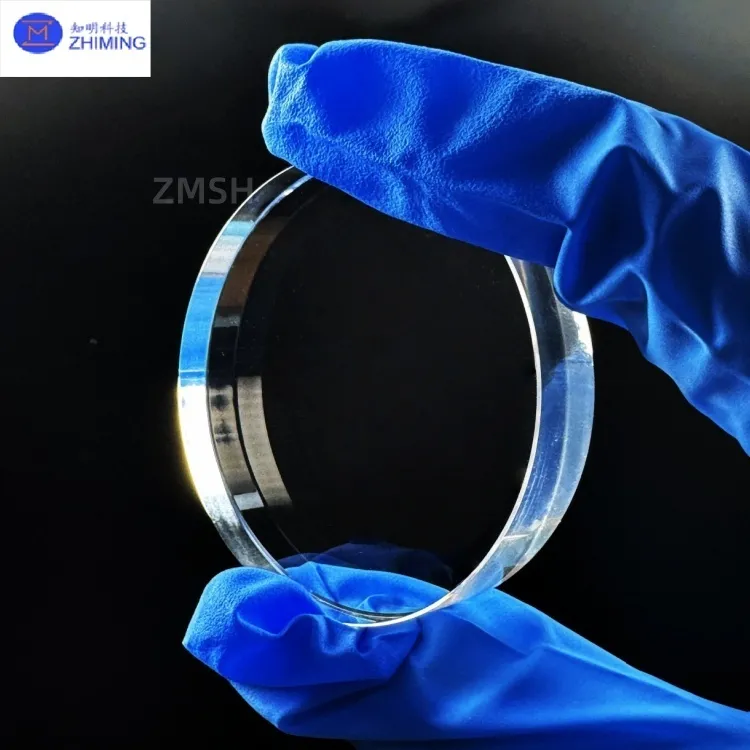
1. Gemstones and Luxury Applications
Natural and synthetic sapphire have long been valued as premium gemstones. Trace impurities such as titanium, iron, chromium, and nickel ions can produce a wide range of colors, including blue, yellow, pink, and green.
Among them, deep blue sapphire is considered the most valuable and has historically symbolized nobility, wisdom, loyalty, and truth. Today, sapphire remains a popular choice for high-end jewelry, luxury watches, and engagement rings.
While gemstone applications represent the historical origin of sapphire, industrial sapphire now accounts for a growing share of global production.
2. Consumer Electronics and Wearable Devices
The outstanding hardness and scratch resistance of sapphire make it an attractive material for consumer electronics.
Modern applications include:
- 스마트폰 카메라 렌즈 커버
- Fingerprint recognition windows
- Smartwatch display covers
- Smart glasses and wearable devices
- Optical sensor protection windows
Compared with conventional glass, sapphire provides significantly higher resistance to scratches and wear. Even after prolonged use, sapphire surfaces maintain excellent optical clarity and appearance.
As electronic devices continue to evolve toward greater durability and premium design, sapphire remains an important protective material for high-value components.
3. Semiconductor Industry: The Foundation of LED Manufacturing
One of the most significant industrial applications of sapphire is as a substrate material for gallium nitride (GaN)-based light-emitting diodes (LEDs).
Gallium nitride is a third-generation semiconductor material characterized by:
- Wide bandgap
- 높은 열 전도성
- Excellent radiation resistance
- 뛰어난 화학적 안정성
Sapphire substrates provide several advantages for LED manufacturing:
- Mature crystal growth technology
- Relatively low production cost
- Excellent chemical stability
- Suitable dielectric properties
- 높은 기계적 강도
Today, sapphire wafers remain the dominant substrate platform for LED production, supporting applications ranging from general lighting and automotive lighting to displays and consumer electronics.
4. Precision Optical Components
Sapphire possesses outstanding optical transparency from ultraviolet through visible wavelengths and into portions of the infrared spectrum.
As a result, sapphire is widely used to manufacture:
- 광학 렌즈
- 프리즘
- 거울
- Observation windows
- 센서 커버
- Scientific instrumentation components
Unlike many conventional optical materials, sapphire maintains excellent optical performance under harsh operating conditions involving:
- High temperatures
- High pressures
- Corrosive chemicals
- Abrasive environments
Its combination of optical transmission and mechanical durability makes sapphire an ideal material for demanding industrial and scientific applications.
5. High-Performance Optical Windows
Optical windows serve as transparent barriers that protect sensitive optical systems while allowing light transmission.
Sapphire optical windows offer several advantages:
- High hardness and scratch resistance
- 뛰어난 내식성
- Broad spectral transmission
- 높은 열 안정성
- 긴 서비스 수명
These characteristics make sapphire windows suitable for:
- 산업용 검사 시스템
- 레이저 장비
- 분광학 기기
- Environmental monitoring devices
- Scientific research equipment
Compared with conventional glass windows, sapphire windows provide significantly enhanced durability in challenging environments.
6. Advanced Laser Technologies
Sapphire also plays a critical role in laser technology.
Titanium-doped sapphire (Ti) crystals are among the most important tunable laser gain media available today. Ti lasers offer:
- Broad wavelength tuning range
- High output power
- Excellent beam quality
- Ultrafast pulse generation capability
These features have made Ti lasers essential tools in:
- Scientific research
- Spectroscopy
- Biomedical imaging
- Ultrafast optics
- 정밀 계측학
Many breakthroughs in modern photonics and laser science have relied on the unique properties of sapphire-based laser crystals.
7. Sapphire Fiber Sensors for Extreme Environments
Sapphire fibers represent a new generation of sensing materials capable of operating in environments beyond the limits of conventional silica fibers.
Key advantages include:
- Melting temperatures above 2000°C
- 뛰어난 기계적 강도
- High chemical stability
- Strong resistance to moisture and corrosion
- 넓은 광 전송 범위
Sapphire fiber sensors can accurately monitor temperatures from room temperature to approximately 1800°C.
애플리케이션에는 다음이 포함됩니다:
- High-temperature industrial processing
- Semiconductor manufacturing
- Plasma-assisted deposition systems
- Energy generation facilities
- Aerospace testing environments
Their ability to provide reliable measurements under extreme conditions has attracted growing interest in industrial sensing applications.
8. Medical and Biomedical Applications
Sapphire has gained increasing attention in medical technology due to its exceptional biocompatibility and chemical inertness.
Medical applications include:
Surgical Instruments
Sapphire scalpels provide:
- Extremely sharp cutting edges
- 뛰어난 내마모성
- 높은 치수 안정성
- Reduced tissue trauma
Medical Imaging and Laser Delivery Systems
Sapphire capillary tubes and optical components are used in:
- Laser therapy systems
- Photodynamic therapy
- Endoscopic instruments
- Precision optical diagnostics
Implantable Medical Devices
Because sapphire is non-toxic and highly biocompatible, it is increasingly utilized in:
- Biomedical implants
- Artificial joint components
- Cardiac assist devices
- Long-term implantable sensors
Its excellent resistance to biological degradation makes sapphire an attractive material for next-generation medical devices.
9. Scientific Research and Analytical Instruments
Modern scientific instruments often require materials capable of maintaining stability under demanding experimental conditions.
사파이어 부품은 주로 다음과 같은 분야에서 사용됩니다:
- High-pressure chambers
- 진공 시스템
- Spectroscopic instruments
- Synchrotron research facilities
- Analytical measurement equipment
The material’s unique combination of transparency, strength, and chemical resistance enables accurate measurements in environments where conventional materials would fail.
10. Emerging Photonics and Future Technologies
As photonics and semiconductor technologies continue to advance, sapphire is finding new opportunities in emerging fields such as:
- Micro-LED displays
- Optical communications
- Quantum technologies
- Advanced sensors
- Integrated photonic devices
The rapid growth of artificial intelligence, high-speed communications, and next-generation electronics is expected to further increase demand for high-performance sapphire materials.
결론
Sapphire has evolved far beyond its traditional role as a precious gemstone. Today, it serves as a critical enabling material across numerous advanced technology sectors, including semiconductors, optics, photonics, sensing, electronics, and medicine.
Its unique combination of exceptional hardness, optical transparency, thermal stability, electrical insulation, and chemical durability continues to drive innovation in modern industry. As emerging technologies demand increasingly robust and reliable materials, sapphire is expected to play an even greater role in the development of future scientific and engineering breakthroughs.