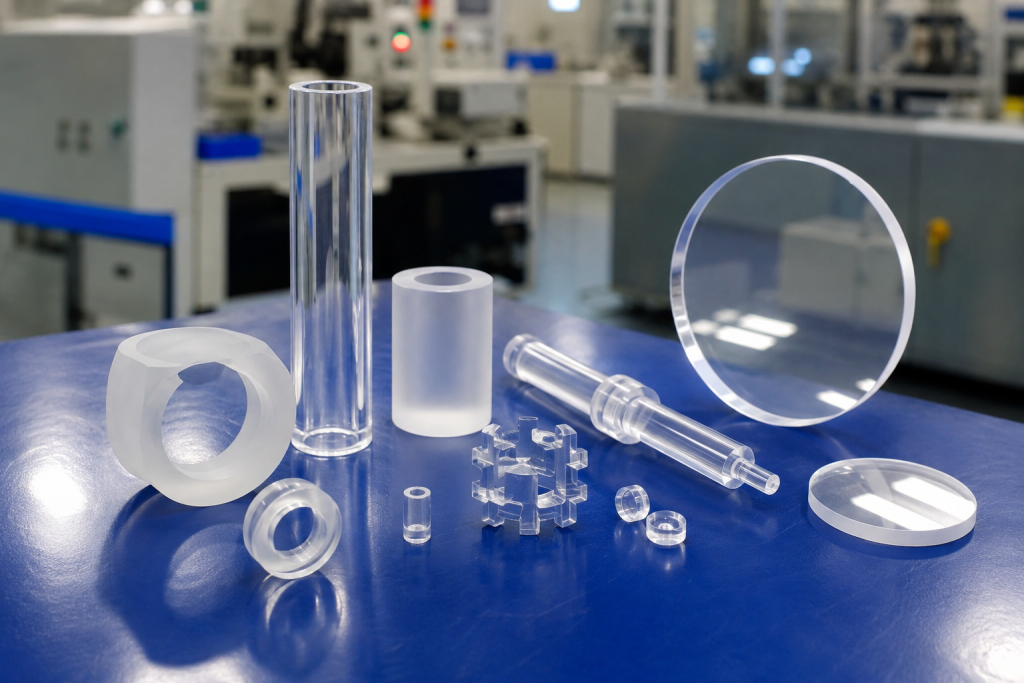
Synthetic sapphire (single-crystal aluminum oxide, Al₂O₃) has become one of the most important engineering materials in high-performance industries. Combining exceptional hardness, excellent optical transmission, chemical inertness, and thermal stability, sapphire is widely used in demanding environments where traditional glass, ceramics, or metals may fail.
Key material advantages include:
- ダイヤモンドに次ぐモース硬度9
- Excellent wear and scratch resistance
- High temperature resistance exceeding 2000°C
- Outstanding chemical stability against acids and alkalis
- Broad optical transmission from UV to infrared wavelengths
- High mechanical strength and dimensional stability
- Long service life in harsh operating environments
Thanks to these properties, sapphire is increasingly used for precision mechanical, optical, electronic, and scientific components.

1. Sapphire Rotor and Stator Components
Rotors and stators are critical parts in precision mechanical systems, pumps, flow meters, and rotating equipment. These components operate under continuous friction and require materials with exceptional wear resistance.
サファイアのオファー
- Extremely low wear rates
- High dimensional stability
- Long operating life
- メンテナンスの軽減
Because of its hardness and resistance to abrasion, sapphire is frequently selected for rotor and stator assemblies used in precision instrumentation and industrial equipment.
代表的なアプリケーション
- Precision flow meters
- Industrial pumps
- Analytical instruments
- Aerospace mechanisms
- High-speed rotating equipment
2. Sapphire Plunger Rods
Sapphire plunger rods are widely used in high-pressure and precision fluid delivery systems. Manufactured from single-crystal sapphire, these components provide outstanding durability under continuous operation.
メリット
- 優れた耐摩耗性
- Excellent corrosion resistance
- Low friction surface
- High chemical compatibility
- Stable performance under pressure
Common Applications
- HPLC (High Performance Liquid Chromatography) pumps
- Medical dosing pumps
- Laboratory analytical equipment
- Petrochemical pumps
- Precision metering systems
Compared with conventional ceramic or metal plungers, sapphire plungers often deliver significantly longer service life and improved pumping accuracy.
3. Sapphire Tubes and Cylindrical Components
Sapphire tubes are increasingly used in electronic, optical, and scientific equipment. Their combination of transparency, strength, and temperature resistance makes them suitable for harsh operating environments.
Key Benefits
- Optical transparency
- High-pressure resistance
- Excellent thermal shock performance
- 耐薬品性
- 電気絶縁
Typical Uses
- レーザーシステム
- High-temperature sensors
- 半導体製造装置
- Plasma processing systems
- 科学機器
- Vacuum systems
Manufacturing sapphire tubes requires advanced grinding, drilling, and polishing technologies to achieve the required dimensional accuracy and surface quality.
4. Sapphire Components in Electronic Devices
As electronic products become smaller and more sophisticated, sapphire components are finding applications in specialized areas where durability and chemical stability are essential.
Potential Uses
- Protective covers
- センサー・ウィンドウ
- Optical monitoring elements
- Wear-resistant surfaces
- Precision insulating components
The material’s resistance to scratching and environmental degradation helps improve product reliability and lifespan.
5. Sapphire Optical Windows
Optical windows represent one of the largest application areas for sapphire components.
Because sapphire transmits light across a broad wavelength range—from ultraviolet through visible and into infrared—it is widely used in demanding optical systems.
メリット
- 高い光学的透明度
- 優れた耐傷性
- Long-term environmental stability
- 高い耐圧性
- Suitable for extreme temperatures
代表的なアプリケーション
- Flame detectors
- 赤外線画像システム
- Laser equipment
- 工業用ビジョンシステム
- 航空宇宙用センサー
- Military optics
- 分光装置
Sapphire windows are often selected when conventional optical glass cannot survive the operating environment.
6. Sapphire Components for Semiconductor Manufacturing
The semiconductor industry relies on materials capable of maintaining stability under vacuum, plasma, and high-temperature conditions.
Sapphire components are commonly used in:
- Wafer processing equipment
- Inspection systems
- Optical monitoring devices
- 真空チャンバー
- プラズマ処理装置
- Precision positioning mechanisms
Their combination of purity, hardness, thermal stability, and chemical resistance makes sapphire an important engineering material throughout semiconductor manufacturing.
7. Sapphire Components for Medical and Scientific Equipment
Medical and laboratory equipment often requires materials that can withstand aggressive chemicals, repeated cleaning, and long-term operation.
Common Applications
- Medical analytical instruments
- Optical diagnostic devices
- Flow control systems
- Laboratory observation windows
- Precision pump components
- Research equipment
Sapphire’s biocompatibility and chemical inertness make it suitable for many specialized medical and scientific applications.
8. Underwater and Harsh Environment Protection Windows
For equipment operating under extreme pressure or corrosive conditions, sapphire offers unique advantages over traditional glass.
Applications Include
- Underwater cameras
- Marine sensors
- Deep-sea exploration equipment
- Offshore monitoring systems
- Industrial inspection cameras
The material’s high strength and scratch resistance help maintain optical performance even in abrasive environments.
Custom Sapphire Components
Modern sapphire manufacturing technology allows the production of highly customized components, including:
- サファイア・ウィンドウ
- Sapphire wafers
- Sapphire rods
- Sapphire tubes
- Sapphire discs
- Sapphire rings
- Sapphire bearings
- Sapphire nozzles
- Sapphire plungers
- Sapphire precision-machined parts
Additional processes may include:
- CNC machining
- Precision grinding
- Double-side polishing
- Optical polishing
- Laser drilling
- Metallization
- 光学コーティング
These capabilities enable sapphire components to meet the demanding requirements of advanced industrial and scientific applications.
結論
Sapphire has evolved far beyond its traditional association with gemstones. Today, it serves as a high-performance engineering material used across semiconductor manufacturing, industrial automation, optical systems, medical equipment, aerospace technologies, and scientific research.
Its unique combination of hardness, optical transparency, thermal stability, and chemical resistance continues to drive demand for sapphire components in applications where reliability and long service life are critical.
As manufacturing technologies advance and costs become more competitive, sapphire components are expected to play an increasingly important role in next-generation industrial and optical systems.