
Sapphire material is a synthetic single-crystal form of corundum (Al₂O₃) that has become one of the most important advanced engineering materials in high-end industrial applications. It is widely recognized for its exceptional hardness (Mohs hardness 9, second only to diamond), excellent wear resistance, high thermal conductivity, strong chemical inertness, and broad optical transmission range from ultraviolet to infrared wavelengths.
Because of this unique combination of properties, sapphire is no longer limited to optiset ikkunat or jewelry applications. It is increasingly used as a functional structural material in demanding mechanical, chemical, and electronic environments.
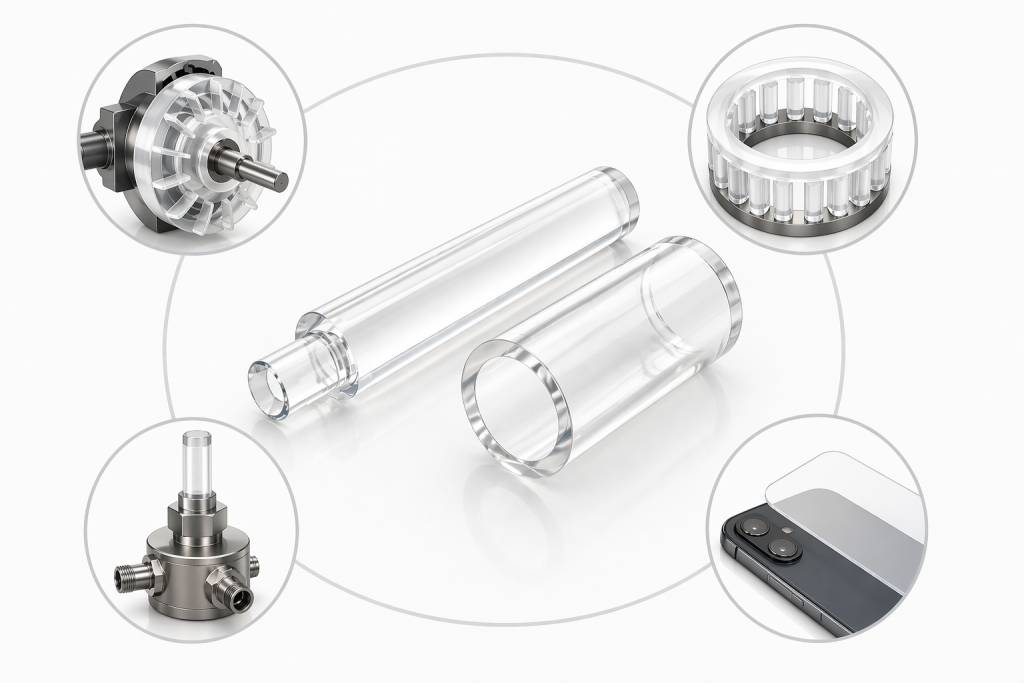
1. Rotor and Stator Wear-Resistant Components
In industrial mechanical systems, rotors and stators are key moving and stationary components that operate under continuous friction, high speed, and heavy mechanical load.
Traditional metal materials often suffer from wear, deformation, and performance degradation over time. Sapphire, however, provides extremely high hardness and excellent surface stability, significantly reducing friction-related damage.
As a result, sapphire is used in certain high-end pump systems and precision mechanical assemblies where long service life and stable operation are critical requirements. It helps improve reliability and reduce maintenance frequency in harsh operating environments.
2. Sapphire Plunger Rods for Precision Fluid Control
Sapphire plunger rods are widely used in high-precision fluid handling systems, including analytical instruments, high-pressure metering pumps, medical diagnostic equipment, and industrial liquid delivery systems.
These applications typically involve:
- High-pressure environments
- Continuous reciprocating motion
- Corrosive chemical exposure
- Extremely tight precision requirements
Sapphire offers several key advantages in these conditions:
- Excellent wear resistance, ensuring long-term dimensional stability
- Strong chemical inertness, resistant to acids and alkalis
- High thermal stability with minimal deformation
- Smooth and precise surface finish for improved sealing performance
These characteristics make sapphire an ideal material for high-reliability fluid control systems.
3. Sapphire Tubes for Structural and Electronic Applications
Cylindrical sapphire tubes are used in electronic components, precision instruments, optical systems, and structural support applications.
Due to its high mechanical strength and rigidity, sapphire maintains excellent structural stability even under high temperature, high pressure, or strong vibration conditions.
In addition, its optical transparency enables its use in certain optical and sensing systems where both mechanical strength and light transmission are required.
However, sapphire is a difficult material to machine. Manufacturing typically requires multiple precision processes, including:
- Rough grinding for shaping
- Fine grinding for dimensional accuracy
- Ultra-precision polishing for surface quality
Surface quality control is especially important, as it directly affects the performance and durability of the final component.
4. Applications in Consumer Electronics and Protective Components
In consumer electronics, sapphire is mainly used in high-end protective or functional components rather than large structural parts.
Common applications include:
- Scratch-resistant protective windows
- Sensor protection layers
- High-temperature or chemically stable barrier components
Its key advantages include:
- Extremely high scratch resistance
- Excellent thermal stability (melting point above 2000°C)
- Vahva kemiallinen inerttiys
- Long-term optical and structural durability
Although cost limits large-scale adoption, sapphire remains valuable in premium or mission-critical electronic devices.
5. Päätelmät
Sapphire is not a general-purpose replacement material but a specialized solution for extreme environments. Its value lies in its ability to perform under conditions involving high wear, strong corrosion, high temperature, and extreme precision requirements.
With continuous advances in precision machining and manufacturing technologies, the application scope of sapphire components is expected to expand further. From industrial machinery and analytical instruments to advanced electronic systems, sapphire is becoming an increasingly important material in modern high-performance engineering.