
Sapphire windows are often selected for optical systems that require a combination of transparency, mechanical strength, surface hardness and environmental resistance. But choosing sapphire as the substrate is only part of the optical design.
For many applications, an anti-reflection coating on the sapphire window is required to reduce surface reflection and increase useful transmission at the operating wavelength.
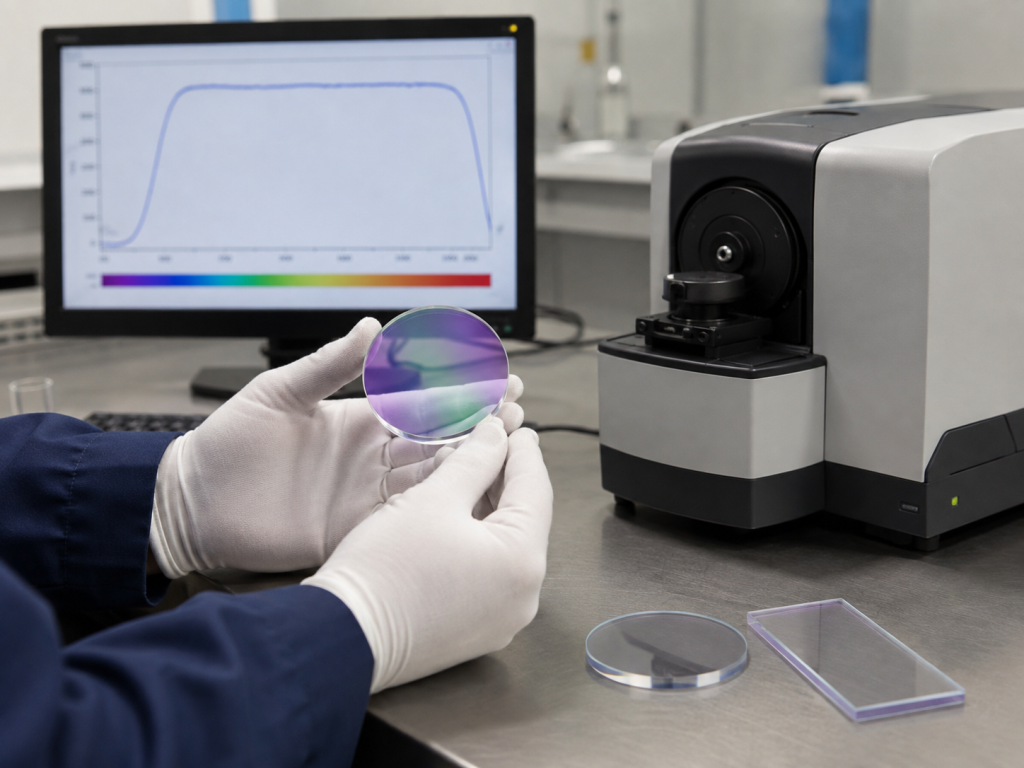
The coating specification should not simply say:
“AR coating required.”
A useful sapphire window coating specification should define the wavelength range, angle of incidence, transmission or reflectance target, polarization conditions, coated surfaces and environmental durability requirements.
This guide explains the main factors engineers and buyers should consider when specifying an AR-coated sapphire window for lasers, sensors, cameras, optical instruments and industrial systems.
1. Why Are Sapphire Windows AR Coated?
Uncoated sapphire already transmits over a wide spectral range from the ultraviolet into the mid-infrared. Commercial sapphire optics are commonly used across approximately the UV-to-mid-IR region, and manufacturers offer anti-reflection coating options spanning visible, NIR and IR wavelengths.
However, transmission through the sapphire material itself does not mean that all incident light reaches the detector or optical system.
Whenever light passes from air into a material with a different refractive index, part of the light is reflected at the interface.
Because a typical sapphire window has two optical surfaces:
Air → Sapphire
und
Sapphire → Air
reflection losses occur at both interfaces.
An AR coating is designed to reduce these surface reflections over a specified wavelength range.
Depending on the coating design, this can help:
- Increase optical transmission
- Improve detector signal
- Reduce unwanted reflections
- Reduce ghost images
- Improve laser system efficiency
- Reduce stray light
- Improve imaging contrast
The important point is that the correct coating depends on the actual optical system.
There is no single “best AR coating” for every sapphire window.
2. Uncoated vs AR-Coated Sapphire Windows
The first decision is whether the application actually requires a coating.
An uncoated sapphire window may be appropriate when:
- Maximum mechanical durability is more important than transmission
- Optical losses are acceptable
- The operating wavelength varies over a very broad range
- The application is primarily protective rather than optical
- Cost needs to be minimized
- The environment may be especially aggressive
- No specific spectral performance is required
An AR-coated sapphire window may be preferred when:
- Higher transmission is required
- The window is positioned directly in an optical path
- A laser operates at a defined wavelength
- Detector signal needs to be maximized
- Reflection or ghost imaging must be reduced
- Multiple optical windows are used in the system
- The application requires controlled optical performance
Commercial sapphire window products are available with AR coating options that cover different portions of the visible, near-infrared and infrared spectrum.
Therefore, instead of asking:
“Can you provide an AR-coated sapphire window?”
a better question is:
“Can you provide an AR-coated sapphire window optimized for our operating wavelength and angle of incidence?”
3. Start with the Operating Wavelength
The operating wavelength is one of the most important pieces of information when specifying an optical coating.
Beispiele hierfür sind:
- 355 nm
- 405 nm
- 532 nm
- 633 nm
- 808 nm
- 940 nm
- 1064 nm
- 1310 nm
- 1550 nm
Some systems operate at one narrow wavelength, while others require transmission across a broad spectral band.
Zum Beispiel:
Laser system: 1064 nm
Machine vision camera: 400-700 nm
NIR sensor: 900–1700 nm
Telecommunications optical system: around 1550 nm
These applications should not automatically use the same AR coating.
4. Narrowband AR Coating vs Broadband AR Coating
AR coatings can be designed around either a relatively narrow spectral region or a broader wavelength range.
Narrowband AR Coating
A narrowband coating is optimized around a particular wavelength or limited wavelength region.
Typical applications may include:
- Laserfenster
- Laser protection optics
- Optical measurement systems
- Rangefinders
- Laser machining equipment
- Single-wavelength sensors
Zum Beispiel:
Design wavelength: 1064 nm
A coating optimized specifically around 1064 nm may achieve better performance at that wavelength than a very broad coating designed to cover hundreds of nanometers.
Broadband AR Coating
A broadband coating is designed to reduce reflection across a wider wavelength interval.
Examples might include:
400-700 nm
650–1050 nm
1000–1600 nm
The exact wavelength range should be determined by the optical system rather than copied from a standard catalog coating.
Broadband coatings are useful for:
- Bildgebungssysteme
- Cameras
- Spectroscopy
- Multi-wavelength sensors
- Broadband illumination
- Optical instruments
The trade-off is that achieving extremely low reflection over a very broad wavelength range can require a more complex coating design.
5. Should You Specify Wavelength or Wavelength Range?
If the system uses a laser, specify the actual laser wavelength.
Zum Beispiel:
Operating wavelength: 1064 nm
If the system uses broadband illumination or a detector with a wide response range, specify the full required wavelength band.
Zum Beispiel:
Required transmission range: 400–700 nm
Avoid vague specifications such as:
Visible AR coating
oder:
IR coating
These descriptions may be insufficient for a custom optical coating.
“IR” can represent a very large spectral range, and coating performance that is suitable around 1064 nm may not be suitable for a system operating around 3–5 µm.
The more precisely the spectral requirement is defined, the easier it is to evaluate the appropriate coating.
6. Transmission and Reflectance Specifications
Once the wavelength range is established, buyers should define the required optical performance.
This is commonly expressed using:
- Getriebe
- Average transmission
- Reflectance
- Durchschnittlicher Reflexionsgrad
- Maximale Reflexion
A coating specification might look like:
Ravg ≤ 0.5% per surface from 1000–1100 nm
oder:
Tavg ≥ 95% over the specified wavelength range
These figures are only examples of specification formats.
Actual achievable values depend on:
- Wavelength
- Bandwidth
- Sapphire substrate
- Coating design
- Number of coated surfaces
- Einfallswinkel
- Polarisation
- Oberflächenqualität
- Messverfahren
Manufacturers of sapphire optics report that optimized AR coatings can substantially increase transmission compared with uncoated sapphire, but performance varies according to the selected coating system.
For procurement, it is therefore better to specify the required performance rather than assuming a particular coating structure.
7. One-Side vs Two-Side AR Coating
Another important RFQ item is which surface should be coated.
Options include:
AR coating on Side A only
oder:
AR coating on both sides
Two-side coating is common when light passes completely through the sapphire window and reflection losses at both air/sapphire interfaces need to be reduced.
Single-side coatings may be selected when:
- One surface is bonded to another optical component
- One side contacts an optical adhesive
- Only one air interface requires reflection reduction
- One surface needs a different functional coating
- The assembly structure makes a second coating unnecessary
When sending a drawing, clearly identify:
Surface A
und
Surface B
to avoid ambiguity.
8. Angle of Incidence Matters
The angle of incidence (AOI) is the angle between the incoming optical beam and the normal to the optical surface.
If light strikes the sapphire window perpendicular to the surface:
AOI = 0°
However, not every optical system operates at normal incidence.
Possible examples include:
- 5°
- 10°
- 30°
- 45°
Thin-film optical coatings can change their spectral behavior as the angle of incidence changes. Increasing AOI can shift spectral features toward shorter wavelengths, and polarization effects can also become more significant at non-normal incidence.
Therefore, a coating designed for:
1064 nm @ 0° AOI
should not automatically be assumed to provide identical performance at:
1064 nm @ 45° AOI
If your system uses an angled sapphire window, specify the actual AOI during the quotation stage.
9. Do Not Forget Polarization
At normal or near-normal incidence, polarization may not be a critical consideration for many ordinary window applications.
At larger angles of incidence, however, the optical response of thin-film coatings can differ between:
- S-polarized light
- P-polarized light
Optical coating suppliers note that increasing angle of incidence can create different spectral behavior for S and P polarization states.
For high-performance laser or optical systems, the RFQ should therefore specify whether the beam is:
- Unpolarized
- S-polarized
- P-polarized
- Circularly polarized
- Polarization-sensitive
For general protective windows, this may not be necessary.
For precision systems, it can be important.
10. AR Coating for 1064 nm Sapphire Windows
1064 nm is a common laser wavelength and an important custom sapphire window application.
A typical RFQ could state:
Substrate: Optical-grade sapphire
Wavelength: 1064 nm
AOI: 0°
Coating: AR both surfaces
Reflectance requirement: As specified by optical design
Lichtdurchlass: ≥90%
Quantity: 50 pcs
The coating should be designed around the laser wavelength and operating angle.
Other optical requirements may include:
- Oberflächenqualität
- Ebenheit
- Parallelität
- Übertragene Wellenfront
- Schwelle für Laserschäden
For laser applications, providing the laser type, wavelength, beam diameter and power or energy density can help the coating supplier evaluate the requirement.
11. AR Coating for 1550 nm Sapphire Windows
The 1550 nm wavelength region is widely used in optical sensing and telecommunications-related systems.
When requesting a 1550 nm sapphire window, define whether the requirement is:
Single wavelength around 1550 nm
or a wider range such as:
1500–1600 nm
This matters because a narrowband AR design and a broadband NIR coating may have different performance and cost characteristics.
The RFQ should also identify:
- AOI
- Polarisation
- Erforderliches Getriebe
- Beschichtete Oberflächen
- Environmental conditions
- Lichtdurchlass
Avoid simply specifying:
NIR AR coating
if your system requires controlled optical performance around a defined wavelength.
12. Visible-Light Sapphire Window Coatings
Sapphire windows are also commonly used in visible imaging systems.
Applications may include:
- Camera protection windows
- Industrielle Bildverarbeitungssysteme
- Outdoor cameras
- Optische Sensoren
- Barcode or scanning systems
- High-durability viewing windows
For visible applications, a broadband AR coating might be specified across approximately:
400-700 nm
depending on the camera, illumination source and detector response.
If the optical system does not use the entire visible spectrum, a narrower coating range may sometimes be more appropriate.
For example, a machine vision system illuminated only by a 660 nm source does not necessarily require the same coating as a full-color camera.
13. UV Sapphire Window Coatings
Sapphire’s useful transmission extends into the ultraviolet, which allows it to be considered for certain UV optical systems. Commercial sapphire windows are available with coating options beginning in the near-UV region, although exact limits depend on the sapphire material and coating system.
UV coating design can be more demanding than ordinary visible coatings.
For UV applications, provide:
- Betriebswellenlänge
- Erforderliches Getriebe
- UV exposure level
- Betriebstemperatur
- Environmental conditions
- Expected service life
Do not assume that an AR coating designed for visible or NIR use will perform correctly in the UV.
14. IR Sapphire Window Coatings
Sapphire is also useful into the infrared and is often selected where the optical window must tolerate difficult mechanical or environmental conditions.
Possible applications include:
- IR detectors
- Thermal sensing
- Industrial monitoring
- High-temperature observation
- Harsh-environment optical systems
However, “IR” is not a complete coating specification.
A system operating around:
1.5 µm
is very different from one operating around:
3–5 µm
The RFQ should therefore provide the actual transmission band rather than simply requesting an infrared coating.
15. Coating Durability Matters
Optical performance on the day of delivery is only one part of coating selection.
The coating may also need to survive the actual service environment.
Depending on the application, coating durability requirements can include resistance to:
- Luftfeuchtigkeit
- Temperature cycling
- Reinigung
- Abrasion
- Adhesion stress
- Salt fog
- Exposition im Freien
- Kontakt mit Chemikalien
Modern optical coating systems can be engineered for demanding environmental conditions, but durability should be explicitly included in the specification when it matters. For example, optical coating manufacturers perform environmental tests involving humidity, adhesion and salt-fog exposure for coatings intended for severe environments.
Do not assume that all AR coatings have identical durability simply because the substrate is sapphire.
The sapphire substrate can be extremely durable while the coating system has its own environmental limitations.
16. Sapphire Hardness Does Not Automatically Mean Coating Hardness
This distinction is particularly important.
Sapphire itself has exceptional surface hardness and resistance to scratching compared with ordinary optical glasses. This is one of the reasons sapphire is chosen for exposed optical windows.
However, after an optical coating is deposited, the exposed surface is no longer bare sapphire.
The practical durability of the finished optical surface depends on:
Sapphire substrate + coating materials + coating process + environment + cleaning method
Therefore, buyers using sapphire specifically because of abrasion resistance should discuss coating durability with the manufacturer.
For some extremely abrasive applications, the optical benefit of a coating must be balanced against the durability requirements of the exposed surface.
17. Cleaning Requirements Should Be Considered
Optical windows installed in industrial systems may require regular cleaning.
Typical contaminants can include:
- Dust
- Fingerabdrücke
- Oil
- Process residue
- Water spots
- Industrial particles
If the sapphire window will be cleaned frequently, tell the coating manufacturer.
Important information can include:
- Cleaning frequency
- Cleaning solution
- Wiping method
- Contact cleaning vs non-contact cleaning
- Expected lifetime
Aggressive or repeated cleaning can be more demanding on a coated surface than on bare sapphire.
18. Consider Operating Temperature
Temperature may influence both the mechanical design and optical coating performance.
If the sapphire window operates in a high-temperature or rapidly changing thermal environment, provide:
- Minimum operating temperature
- Maximale Betriebstemperatur
- Thermal cycling requirements
Thin-film optical systems can show wavelength-dependent changes with temperature, with the magnitude depending on the coating construction and substrate.
For ordinary room-temperature applications this effect may be negligible.
For narrowband or high-precision optical systems, it may need to be considered during coating design.
19. Coating Performance Should Be Defined Over the Clear Aperture
A sapphire window may have a physical diameter of 50 mm while the actual usable optical area is only 45 mm.
Zum Beispiel:
Outside diameter: Ø50 mm
Clear aperture: Ø45 mm
Optical coating specifications should clearly state whether transmission, reflectance and cosmetic requirements apply over:
- Die gesamte Oberfläche
- Die freie Öffnung
- A defined central region
This is particularly important when the outer edge is used for:
- Mechanical mounting
- Kleben
- Clamping
- Sealing
Defining the clear aperture prevents unnecessary confusion during coating and inspection.
20. Coating Uniformity for Large Sapphire Windows
As sapphire window size increases, coating uniformity can become more important.
A large coated sapphire window may require consistent spectral performance across the usable aperture.
For large optical components, buyers should discuss:
- Maximum component size
- Coating chamber capability
- Lichtdurchlass
- Spectral uniformity
- Kantenausschluss
- Measurement positions
This can be particularly important for:
- Large sensor windows
- Large viewing ports
- Luft- und Raumfahrtoptik
- Laser-Systeme
- Bildgebungssysteme
If the application has strict spatial uniformity requirements, define how the coating should be measured across the part.
21. Optical Coating Inspection
For production orders, specify what coating inspection documentation is required.
Possible requirements include:
- Übertragungskurve
- Reflectance curve
- Messung mit dem Spektralphotometer
- Coating appearance inspection
- Haftungsprüfung
- Prüfung der Umweltbeständigkeit
- Coating uniformity report
- Konformitätsbescheinigung
- Batch traceability
Not every order requires every test.
A general industrial protective window may need only basic inspection documentation.
A precision laser or aerospace optical component may require significantly more detailed verification.
Define these requirements before production.
22. Common Sapphire Window Coating RFQ Mistakes
Several mistakes repeatedly make optical quotations more difficult.
Mistake 1: Writing Only “AR Coating”
This does not define the wavelength or performance.
Better:
AR coating, 1064 nm, AOI 0°
Mistake 2: Writing Only “Visible Coating”
Define the actual wavelength range.
Better:
Broadband AR coating, 400–700 nm
Mistake 3: Forgetting Angle of Incidence
Coating spectral performance can change as AOI changes.
Better:
AOI: 0–5°
oder:
AOI: 45°
Mistake 4: Specifying Extreme Performance Without Need
A very demanding reflectance requirement can increase coating complexity and cost.
Specify what the optical system actually requires.
Mistake 5: Ignoring Environmental Conditions
A laboratory coating and a coating used outdoors, near salt water or in an industrial process chamber may require different durability considerations.
Mistake 6: Not Identifying the Coated Surface
Clearly specify:
Side A only
oder:
Beide Seiten
23. Example Sapphire Window Coating RFQ
A complete RFQ might look like this:
Product: Optisches Fenster aus Saphir
Material: Optical-grade synthetic sapphire
Shape: Rund
Durchmesser: Ø50.00 ±0.05 mm
Die Dicke: 2.00 ±0.05 mm
Orientation: C-Ebene
Surface Quality: 20-10 scratch-dig
Flatness: λ/4 @ 632.8 nm
Clear Aperture: ≥90%
Coating: AR coating both sides
Operating Wavelength: 1064 nm
AOI: 0° ±5°
Polarisierung: Unpolarized
Optical Performance: Please confirm achievable reflectance/transmission
Environment: Indoor industrial laser system
Quantity: 20 pcs prototype + 500 pcs/year
Documentation: Dimensional inspection report and coating spectral curve
This provides substantially more useful information than simply asking:
“Please quote a 50 mm AR-coated sapphire window.”
24. Sapphire Window Coating RFQ Checklist
Before requesting a quotation, confirm whether you have provided:
- Sapphire window dimensions
- Dicke
- Kristallorientierung
- Oberflächenqualität
- Ebenheit der Oberfläche
- Lichtdurchlass
- Betriebswellenlänge
- Wellenlängenbereich
- AR coating type
- One-side or two-side coating
- Übermittlungsanforderung
- Reflectance requirement
- Einfallswinkel
- Polarisation
- Betriebstemperatur
- Environmental conditions
- Cleaning requirements
- Durability requirements
- Inspection documents
- Prototype quantity
- Produktionsmenge
Not every application needs every parameter.
The objective is to provide enough information for the sapphire window and coating design to match the real optical system.
FAQ
Can sapphire windows be AR coated?
Yes. Sapphire windows can be supplied with anti-reflection coatings designed for visible, near-infrared, infrared and selected ultraviolet wavelength ranges. The coating should be selected according to the operating wavelength and optical system requirements.
What wavelength should I specify for an AR-coated sapphire window?
Specify the actual operating wavelength or wavelength range of the optical system. For a laser, this may be a single wavelength such as 532 nm, 1064 nm or 1550 nm. For cameras and broadband sensors, specify the complete required spectral range.
Is broadband AR coating better than narrowband AR coating?
Not necessarily. A narrowband coating may provide optimized performance around a specific laser wavelength, while a broadband coating is useful when the system must transmit a wider spectral range. The correct choice depends on the application.
Should both sides of a sapphire window be AR coated?
If light travels through both air-to-sapphire interfaces, coating both sides can reduce reflection at both surfaces. However, some designs require coating on only one surface. The assembly structure and optical requirements should determine the coating configuration.
Why is angle of incidence important for AR coating?
Thin-film optical coating performance changes with angle of incidence. Spectral features can shift as the optic is tilted, and S- and P-polarized light may respond differently at higher angles.
Can AR coating reduce sapphire window durability?
The finished surface durability depends on the coating materials and deposition process. Sapphire itself is extremely hard, but the exposed coating has its own abrasion, cleaning and environmental limits. Durability requirements should therefore be discussed when the window will operate in harsh environments.
What information should I send for a custom sapphire window coating quote?
Provide the sapphire dimensions, wavelength or wavelength range, AOI, polarization if relevant, required transmission or reflectance, coated surfaces, environmental requirements, quantity and drawing.
Request an AR-Coated Sapphire Window Quote
Selecting the correct sapphire window coating requires more than choosing between “coated” and “uncoated.”
The coating must be matched to the:
Operating wavelength + wavelength bandwidth + AOI + polarization + transmission target + environmental conditions.
If you need a custom AR-coated sapphire window, send us your drawing and optical requirements, including the operating wavelength, dimensions, sapphire orientation, coating surfaces, angle of incidence and required quantity.
For projects where the coating specification has not yet been finalized, provide the application and operating conditions. The sapphire window and coating requirements can then be evaluated together before prototype or production manufacturing.