
Abstract
Sapphire windows have become a critical component in modern optical and photonic systems where extreme environmental stability, high optical transmission, and long-term reliability are required. As a single-crystal form of aluminum oxide (Al₂O₃), sapphire combines exceptional mechanical strength with excellent optical transparency across a broad spectral range. This article provides a scientific yet application-oriented overview of sapphire windows for optical use, focusing on material properties, optical performance, manufacturing considerations, and key industrial applications. The goal is to help engineers, researchers, and procurement professionals better understand when and why sapphire windows represent the optimal solution in advanced optical systems.
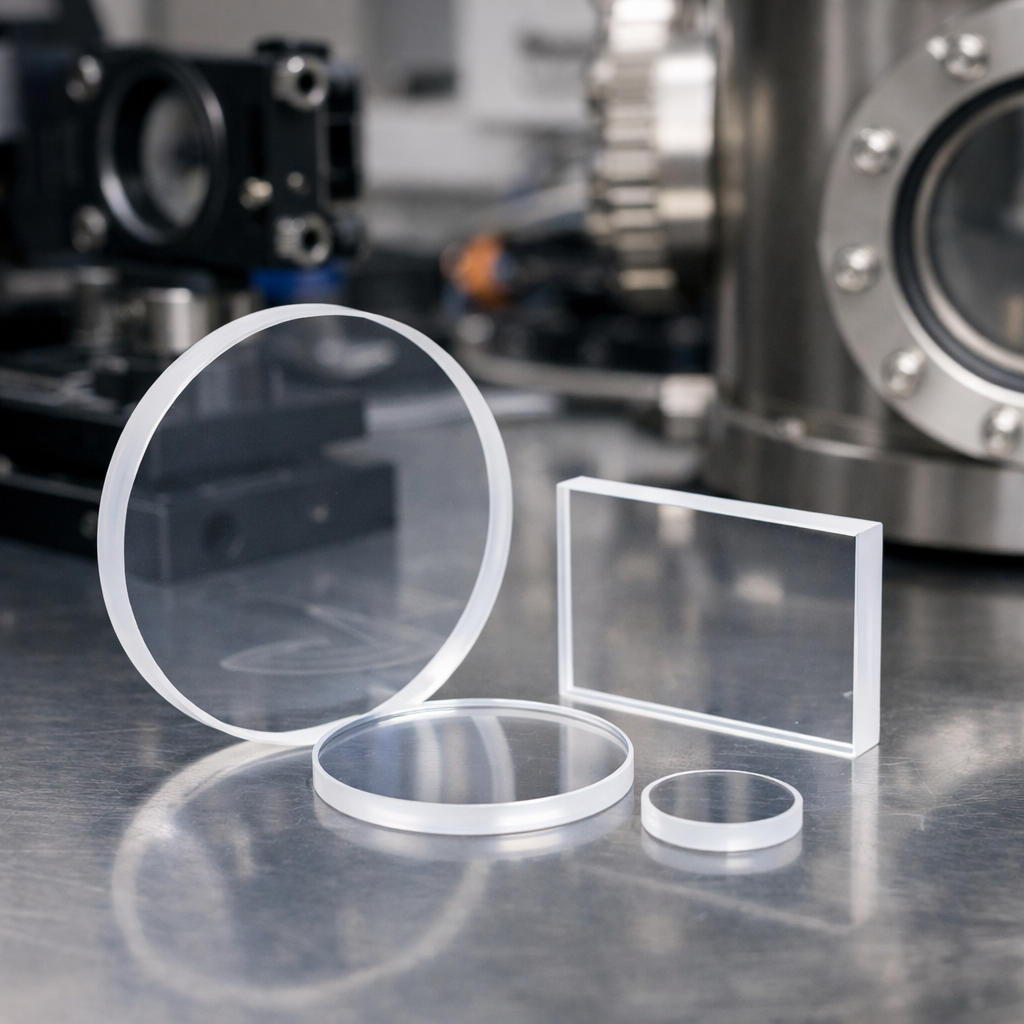
Introduction: The Role of Sapphire in Optical Window Design
Optical windows function as the critical interface between sensitive optical components and demanding external environments. In applications involving high temperature, high pressure, vacuum, corrosive media, or mechanical abrasion, conventional optical materials such as BK7 glass or fused silica often encounter performance limitations.
Sapphire windows address these challenges by offering a rare combination of optical clarity and extreme physical durability. With ongoing improvements in crystal growth and precision polishing technologies, sapphire optical windows are now available in a wide range of sizes, orientations, and surface qualities, enabling their integration into increasingly sophisticated optical systems.
Material Characteristics of Optical-Grade Sapphire
Optical sapphire is a synthetic single crystal of aluminum oxide (Al₂O₃), typically grown using Kyropoulos, Czochralski, or EFG methods. The absence of grain boundaries in single-crystal sapphire ensures uniform refractive behavior and outstanding mechanical integrity.
For optical window applications, sapphire generally achieves purity levels above 99.99% Al₂O₃, minimizing absorption losses and internal scattering. Its mechanical hardness, high elastic modulus, and resistance to thermal shock make sapphire particularly suitable for long-term optical use in harsh environments.
Optical Transmission and Polarization Behavior
Sapphire windows exhibit excellent optical transmission from the deep ultraviolet region (approximately 190 nm) through the visible spectrum and into the mid-infrared range (up to around 5 μm). This wide spectral transparency allows sapphire to serve as a universal window material across multiple optical platforms.
As an anisotropic crystal, sapphire displays birefringence, which may influence polarization-sensitive optical systems. By carefully controlling crystal orientation—commonly along the C-axis or A-axis—manufacturers can mitigate polarization effects and ensure consistent optical performance.
Manufacturing Precision and Surface Quality
The optical quality of sapphire windows depends strongly on crystal orientation accuracy, dimensional tolerances, and surface finish. Advanced cutting and orientation control techniques are employed to align the crystal lattice with application-specific optical requirements.
High-grade sapphire windows are typically polished on one or both sides to achieve nanometer-level surface roughness, reducing scattering and reflection losses. Depending on system demands, sapphire windows may also incorporate anti-reflective coatings optimized for ultraviolet, visible, or infrared wavelengths.
Optical and Industrial Applications
Sapphire windows are widely used in high-power laser systems, where thermal stability and laser damage resistance are critical. They also play a key role in optical sensing and detection equipment operating in extreme environments such as aerospace systems, combustion diagnostics, and oil and gas instrumentation.
In vacuum and high-pressure applications, sapphire windows provide a robust solution for optical viewports, enabling visual inspection and optical measurements while maintaining mechanical integrity and sealing reliability. Their broad spectral transmission further supports ultraviolet spectroscopy and infrared imaging systems, reducing the need for multiple window materials within a single optical assembly.
Comparison with Conventional Optical Window Materials
| Property | Sapphire | Fused Silica | BK7 Glass |
|---|---|---|---|
| Tvrdost | Extremely High | Medium | Low |
| Operating Temperature | Very High | High | Moderate |
| Spectral Transmission | UV–Mid-IR | UV–NIR | Visible |
| Chemická odolnost | Excellent | Good | Limited |
| Mechanical Strength | Excellent | Moderate | Low |
This comparison illustrates why sapphire windows are often selected for optical systems requiring long service life, mechanical reliability, and stable optical performance under demanding conditions.
Customization and Design Considerations
Modern sapphire window manufacturing supports extensive customization, including tailored dimensions, thicknesses, and geometries. Optical coatings can be applied to enhance transmission or reduce reflection at specific wavelengths, while tight flatness and parallelism tolerances support precision optical assemblies.
Such flexibility allows sapphire windows to be optimized not only for optical performance but also for mechanical integration and long-term system reliability.
Conclusion
Sapphire windows for optics represent a strategic material choice for applications where optical performance must be maintained under extreme physical and environmental conditions. Their unique combination of wide spectral transmission, mechanical strength, thermal stability, and chemical resistance positions sapphire as a long-term, high-value solution in advanced optical systems.
For engineers and decision-makers seeking reliability, precision, and durability, sapphire optical windows continue to set the benchmark for high-performance optical interfaces.