
As modern medical devices, MEMS sensors, and optical communication systems continue to evolve toward higher performance and greater reliability, packaging technologies have become increasingly important. While much attention is often given to chips, detectors, and optical components, the window material that protects these sensitive devices is equally critical.
Among the various optical materials available today, sapphire has emerged as one of the most reliable choices for high-performance optical windows. Its exceptional mechanical strength, optical transparency, thermal stability, and chemical resistance make it ideal for demanding environments where conventional glass may fail.
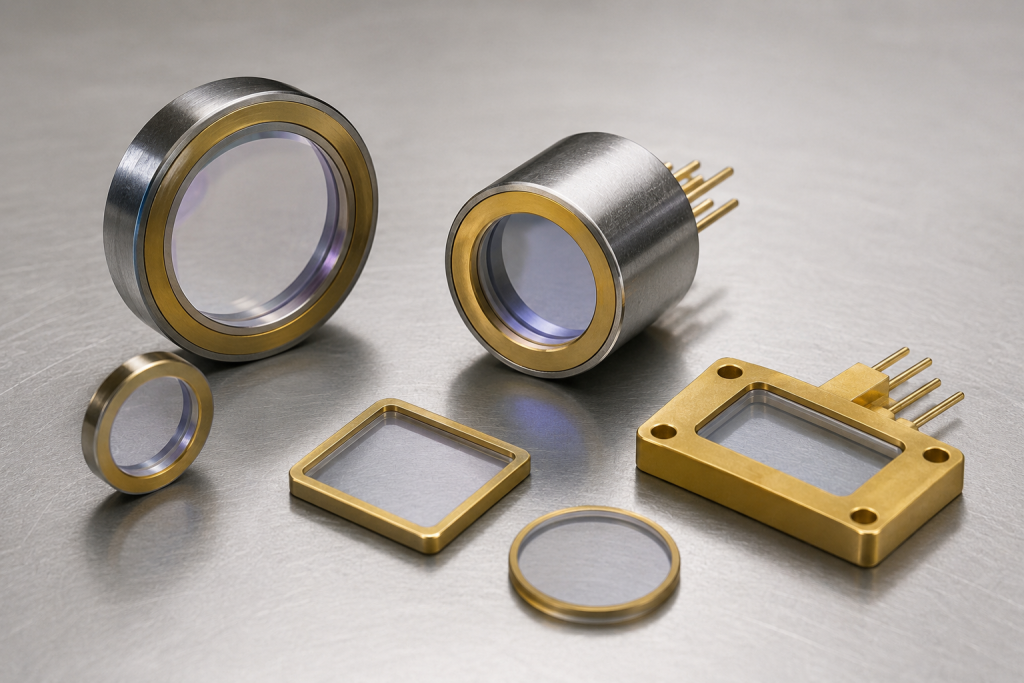
When combined with advanced metallization and optical coating technologies, safírová okna become key enabling components in hermetic packaging solutions for medical instruments, sensor systems, and photonic devices.
Why Sapphire Is an Ideal Window Material
Sapphire is a single-crystal form of aluminum oxide (Al₂O₃). Unlike ordinary glass, sapphire possesses a unique combination of optical and mechanical properties that allow it to perform reliably in harsh environments.
Some of its most important characteristics include:
- High optical transmission from ultraviolet (UV) to infrared (IR) wavelengths
- Exceptional hardness (Mohs hardness of 9)
- Excellent scratch and abrasion resistance
- Vysoká tepelná vodivost
- Superior thermal shock resistance
- Outstanding chemical stability
- Long-term reliability in corrosive environments
These properties make sapphire particularly suitable for applications requiring both optical transparency and structural integrity.
In many precision devices, the optical window must not only allow light transmission but also protect sensitive internal components from moisture, pressure, chemicals, and mechanical damage. Sapphire fulfills these requirements better than most conventional optical materials.
The Need for Sapphire Metallization
Although sapphire offers excellent optical and mechanical performance, it presents a challenge when integrated into electronic or optoelectronic packages.
As a ceramic and electrical insulator, sapphire cannot be directly soldered or brazed to metal housings. To create a reliable hermetic seal, the sapphire surface must first undergo metallization.
Metallization refers to the deposition of thin metallic layers onto the sapphire surface, creating a bondable interface between the crystal and surrounding package materials.
This process enables sapphire windows to be joined with:
- Kovar packages
- Stainless steel housings
- Titanium enclosures
- Ceramic packages
- Optical transceiver assemblies
The resulting package can achieve excellent mechanical strength and long-term hermeticity.
Common Metallization Structures
To achieve strong adhesion and reliable bonding, multiple metal layers are typically deposited onto the sapphire substrate.
Typical metallization stacks include:
Ti/Pt/Au
- Titanium (Ti) acts as an adhesion layer.
- Platinum (Pt) serves as a diffusion barrier.
- Gold (Au) provides corrosion resistance and solderability.
Cr/Ni/Au
- Chromium (Cr) enhances adhesion.
- Nickel (Ni) functions as a barrier layer.
- Gold (Au) ensures excellent weldability and oxidation resistance.
The specific layer structure depends on the intended joining process and environmental requirements.
Metallization Technologies
Several thin-film deposition techniques are used for sapphire metallization.
Magnetron Sputtering
Magnetron sputtering is one of the most widely used industrial processes.
Mezi výhody patří:
- Excellent film uniformity
- Strong adhesion
- Precise thickness control
- High repeatability
- Scalability for volume production
This method is commonly employed for medical and telecommunications applications requiring high reliability.
Electron Beam Evaporation
Electron beam evaporation offers:
- High-purity metal films
- Low contamination levels
- Reduced internal stress
It is often selected for specialized optical packaging applications.
Advanced Thin-Film Processes
For highly demanding applications, manufacturers may employ:
- Ion-assisted deposition
- Plasma-enhanced surface activation
- Hybrid sputtering systems
These technologies further improve adhesion and package reliability.
Optical Coatings: Enhancing Sapphire Performance
While sapphire naturally provides excellent optical transmission, its relatively high refractive index can generate unwanted surface reflections.
A bare sapphire surface typically reflects approximately 7% of incident light at each interface. In precision optical systems, these losses can significantly impact performance.
Optical coatings are therefore applied to optimize transmission and tailor spectral behavior.
Anti-Reflection (AR) Coatings
Anti-reflection coatings are among the most common optical treatments applied to sapphire windows.
Mezi výhody patří:
- Increased light transmission
- Reduced reflection losses
- Improved signal quality
- Enhanced detector sensitivity
AR coatings are widely used in:
- Medical imaging equipment
- Laserové systémy
- Fiber optic communication devices
- Optické senzory
By reducing reflection, AR coatings can increase total system efficiency and improve measurement accuracy.
Infračervené povlaky
Certain applications require optimized transmission within specific infrared wavelength ranges.
Infrared coatings are commonly used in:
- Systémy termovize
- Environmental monitoring equipment
- Industrial sensing devices
- Scientific instrumentation
These coatings help maximize signal transmission while minimizing unwanted optical losses.
Bandpass and Filter Coatings
Some optical packages require selective wavelength transmission.
Bandpass coatings allow only a specific wavelength range to pass through the sapphire window while blocking others.
Mezi aplikace patří:
- Optical communication modules
- Fluorescence detection systems
- Medical diagnostics
- Spectroscopic instruments
Such coatings enable precise wavelength control and improved signal-to-noise ratios.
Medical Device Applications
Medical technology represents one of the fastest-growing markets for metallized and coated sapphire windows.
Modern medical devices often operate in demanding environments involving:
- Sterilization cycles
- Biological fluids
- Vystavení chemickým látkám
- Continuous operation
Příklady zahrnují:
Implantable Sensors
Implantable monitoring devices require biocompatible and hermetically sealed packaging.
Sapphire windows provide:
- Long-term durability
- Chemical inertness
- Vysoká optická průhlednost
Endoscopic Systems
Advanced endoscopes rely on optical windows capable of resisting scratches and repeated cleaning procedures.
Sapphire significantly extends service life compared with conventional glass components.
Laser Medical Equipment
Laser surgery and therapeutic systems require high optical transmission and resistance to thermal loading.
AR-coated sapphire windows help maintain consistent optical performance under demanding operating conditions.
Sensor Packaging Applications
The rapid growth of MEMS and photonic sensing technologies has created increasing demand for reliable optical packaging.
Sensors often operate in environments characterized by:
- Temperature fluctuations
- Vystavení vlhkosti
- Mechanical vibration
- Chemical contamination
Metallized sapphire windows enable robust hermetic packaging while preserving optical functionality.
Mezi typické aplikace patří:
- Pressure sensors
- Gas sensors
- Environmental monitoring systems
- Aerospace instrumentation
- Industrial automation equipment
The combination of optical clarity and mechanical durability makes sapphire an ideal solution for these applications.
Optical Communication and Photonics Packaging
Optical communication systems require packaging solutions capable of maintaining precise optical alignment and long-term stability.
Sapphire windows are increasingly used in:
- Fiber optic transceivers
- Laser diode packages
- Photodetector modules
- Optical amplifiers
- Quantum photonics devices
The advantages include:
- Excellent dimensional stability
- Low optical loss
- High environmental resistance
- Reliable hermetic sealing
As data transmission rates continue to increase, packaging reliability becomes increasingly important. Sapphire-based optical windows help ensure consistent device performance throughout the product lifecycle.
Budoucí trendy
The demand for high-reliability optical packaging is expected to grow rapidly alongside developments in medical electronics, artificial intelligence infrastructure, advanced sensing technologies, and next-generation telecommunications.
Several trends are driving increased adoption of metallized and coated sapphire windows:
- Miniaturization of optical devices
- Growth of photonic integrated circuits
- Expansion of biomedical sensing technologies
- Higher requirements for package hermeticity
- Increasing deployment of harsh-environment sensors
As packaging technologies continue to advance, sapphire windows will play an increasingly important role in enabling reliable optical transmission, environmental protection, and long-term device stability.
Závěr
Sapphire windows have evolved far beyond their traditional role as protective optical covers. Through advanced metallization and optical coating technologies, they have become critical components in high-performance hermetic packaging systems.
Their combination of optical transparency, mechanical durability, chemical resistance, and compatibility with precision packaging processes makes them an ideal choice for medical devices, sensor modules, and optical communication equipment.
As the demand for high-reliability photonic and electronic systems continues to grow, metallized and coated sapphire windows are expected to remain a cornerstone of next-generation precision packaging solutions.