


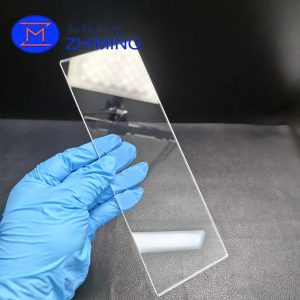
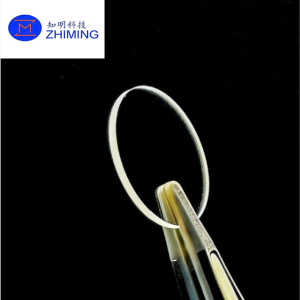
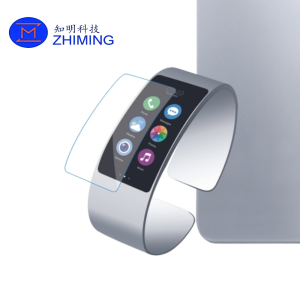
The Customized Ruby Optical Window is a high-performance optical component precision-engineered from synthetic ruby (Cr³⁺-doped α-Al₂O₃ single crystal). Designed for demanding optical applications, it combines the exceptional mechanical hardness, thermal stability, chemical resistance, and broad-spectrum transmittance of ruby with tailored geometries for specialized laser and high-temperature systems.
Unlike standard optical glass, ruby optical windows provide superior environmental durability, scratch resistance, and laser damage tolerance, ensuring reliable protection of internal optical components in high-power lasers, industrial furnaces, aerospace systems, and extreme environmental monitoring devices.


Technical Specifications
| Parameter | Specification |
|---|---|
| Material | Synthetic ruby (Cr³⁺-doped α-Al₂O₃ single crystal) |
| Crystal Structure | Hexagonal |
| Lattice Constants | a = 4.758 Å, c = 12.991 Å |
| Density | 3.98 g/cm³ |
| Melting Point | 2040°C |
| Mohs Hardness | 9 |
| Thermal Expansion Coefficient | 6.5–8.4 × 10⁻⁶ /°C |
| Thermal Conductivity | 52 W/m/K |
| Specific Heat | 0.42 J/g/K |
| Transmission Range | 400–1500 nm (visible to near-IR) |
| Vision Light Transmissivity | ≥85% |
| Surface Finish | Double-Side Polished (DSP), Ra <5 nm |
| Laser Damage Threshold | >10 kW/cm² |
| Emission Peak | 795 nm |
| Absorption Peak | 488 nm |
| Refractive Index | 1.76 at 800 nm |
| Thickness & Size | Customized, polished to optical tolerance |
| Packaging | Class 100 cleanroom |
| Certification | RoHS |
Key Features
-
Ultra-High Hardness & Wear Resistance
-
Mohs hardness 9, 20× more scratch-resistant than conventional optical glass.
-
Resists sand, dust, and mechanical abrasion for long-term optical clarity.
-
-
Broad Optical Transmission
-
85% transmittance in NIR (700–1500 nm) and >90% in visible light (400–700 nm).
-
Supports high-precision laser and sensing systems across UV–NIR spectra.
-
-
Superior Thermal Stability
-
Continuous operation up to 1200°C, short-term tolerance up to 1500°C.
-
Low thermal expansion ensures surface accuracy (<λ/8 @632.8 nm) under rapid heating and cooling.
-
-
Exceptional Chemical & Environmental Resistance
-
Stable in highly acidic (pH 1) to alkaline (pH 14) environments.
-
Ideal for corrosive, high-pressure, or high-humidity conditions.
-
-
Laser Damage Tolerance
-
Can withstand >10 kW/cm², suitable for CO₂, YAG, and ultrafast laser applications.
-
-
Precision Manufacturing
-
Produced via Kyropoulos (KY) or Czochralski (Cz) crystal growth methods.
-
Polished to DSP standards for minimal scattering, surface defects, and high optical uniformity.
-
Primary Applications
-
High-Power Laser Systems
-
Output windows and protective lenses for resonators.
-
Supports CO₂, YAG, and fiber laser systems with high energy density.
-
-
High-Temperature Industrial Monitoring
-
Observation windows in steelmaking, glass, and chemical furnaces.
-
Maintains visibility at temperatures exceeding 1000–1500°C.
-
-
Aerospace & Defense
-
Spacecraft viewports and missile radomes.
-
Withstands aerodynamic heating, particle erosion, and supersonic environmental stress.
-
-
Extreme Environment Detection
-
Deep-sea submersibles and nuclear reactor optical access ports.
-
Pressure resistance exceeding 1000 atmospheres with stable optical performance.
-
-
Scientific & Precision Instruments
-
Laser delivery systems, spectroscopy instruments, and high-precision optical setups.
-
FAQ
Q1: Why use ruby optical windows instead of conventional optical glass?
A1: Ruby windows offer 20× higher scratch resistance, withstand up to 1500°C, and maintain >85% transmittance from visible to near-IR, outperforming standard optical glass in harsh conditions.
Q2: Can ruby windows handle high-power laser applications?
A2: Yes, these windows have a laser damage threshold exceeding 10 kW/cm², ideal for CO₂/YAG laser systems and precision beam delivery.
Q3: Are custom sizes and shapes available?
A3: Absolutely. We support tailored sizes, thicknesses, and double-sided polished surfaces (DSP) to meet specific laser system or instrumentation requirements.

Reviews
There are no reviews yet.