
Sapphire (Al₂O₃) is widely used in optical instruments due to its exceptional optical transparency, mechanical strength, and chemical stability. Its high transmittance, excellent thermal resistance, and corrosion resistance make sapphire windows a critical component in many precision optical systems. In addition, sapphire exhibits superior hardness (Mohs hardness 9) and low thermal expansion (≈5 ×10⁻⁶/K), which allows it to maintain dimensional stability under extreme temperatures and mechanical stress. This article explores the application of sapphire windows in three major optical instruments, highlighting their advantages and real-world performance metrics.
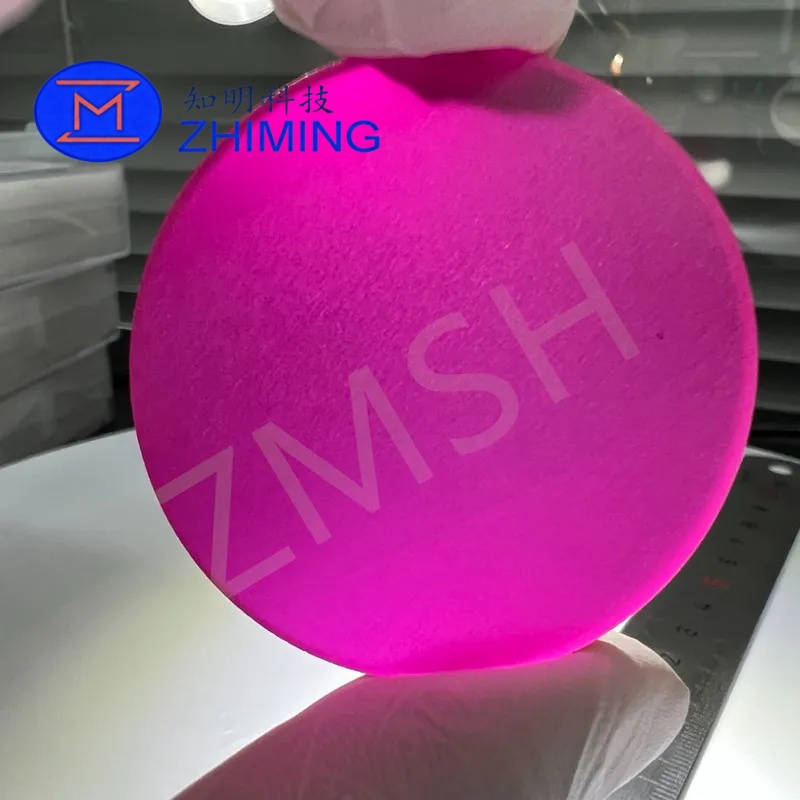
1. High-Power Laser Systems
In industrial cutting, research laboratories, and laser processing equipment, sapphire windows serve as protective optical barriers and laser exit windows. Their optical clarity ensures minimal beam attenuation, while their mechanical and thermal properties allow long-term operation under high-energy exposure.
- Optical Requirements: Transmittance ≥ 85% (400–1100 nm), laser-induced damage threshold ≥ 5 J/cm².
- Typical Thickness & Size: 2–5 mm thick, commonly 8-inch diameter for industrial systems.
- Advantages:
- High Hardness: Mohs hardness of 9 ensures excellent scratch resistance even under high-power laser irradiation.
- Termal Kararlılık: Can withstand temperatures exceeding 1500°C for short periods and maintain dimensional stability under continuous laser exposure.
- Low Thermal Expansion: Reduces stress on mounts, preventing warping or cracking under repeated thermal cycling.
Case Example: An 8-inch sapphire window in a 500 W continuous-wave laser system maintained ≥ 88% transmittance after 1,000 operational hours, demonstrating remarkable durability. Finite element analysis of thermal stress showed maximum stress below 40 MPa, well below sapphire’s fracture threshold (~400 MPa).
2. Infrared (IR) Spectroscopy Instruments
Sapphire windows are used as protective windows or sample compartment seals in IR spectroscopy, offering broad optical transparency and chemical stability. Their performance is critical for accurate measurements and system longevity.
- Optical Requirements: Transmittance ≥ 80% in 2–5 μm infrared range.
- Thickness & Dimensions: Typically 2–4 mm; custom shapes are often required for specialized sample chambers.
- Advantages:
- Chemical Resistance: Can withstand acids, alkalis, and organic solvents without degradation.
- Mechanical Strength: Supports vacuum or pressurized compartments without cracking.
- Surface Uniformity: Minimizes scattering and optical aberrations, preserving spectral accuracy.
Case Example: A sapphire window in a Fourier-transform IR spectrometer was subjected to 500 chemical cleaning cycles. Transmittance reduction was less than 1%, confirming its chemical durability. Additionally, stress tests in vacuum environments up to 0.01 Pa confirmed negligible deformation, highlighting reliability in precision instrumentation.
3. High-Resolution Optical Microscopes
Sapphire windows are increasingly used in high-resolution microscopy to protect detectors, laser excitation paths, and sensitive sample enclosures. Their optical uniformity ensures accurate imaging, and their mechanical robustness prolongs instrument lifespan.
- Optical Requirements: Visible light transmittance ≥ 90%, minimal birefringence, high surface flatness (≤ λ/10).
- Thickness & Size: 0.5–2 mm for small mounts; research-grade systems may use 12-inch wafers for specialized optical assemblies.
- Advantages:
- Scratch and Abrasion Resistance: Protects critical optics from sample contact or environmental contaminants.
- Optical Clarity: High uniformity ensures precise imaging and measurement, essential for applications such as confocal and multiphoton microscopy.
- Thermal and Mechanical Stability: Essential for high-intensity illumination and prolonged experimental sessions.
Case Example: In a confocal microscope experiment, sapphire protective windows endured continuous 12-hour laser exposure daily for three months without observable degradation in imaging resolution. Surface roughness remained below 1 nm RMS, ensuring consistent optical performance.
Summary and Future Trends
Across high-power lasers, IR spectroscopy instruments, and high-resolution optical microscopes, sapphire windows demonstrate unmatched durability, optical clarity, and chemical resistance. Their ability to maintain performance under extreme mechanical, thermal, and chemical stress makes them indispensable in modern optical instrumentation.
Key technical metrics:
- Transmittance: 85–90% (visible), 80% (IR 2–5 μm)
- Laser damage threshold: ≥ 5 J/cm²
- Thickness range: 0.5–5 mm
- Maximum diameter: 12 inches for research-grade wafers
Emerging Trends:
- Large-Diameter Windows: Scaling from 8-inch to 12-inch and beyond to meet advanced optical system requirements.
- Anti-Reflection and Functional Coatings: Optimized for UV, visible, and IR ranges to reduce reflection loss.
- Thin-Film Sapphire Windows: Reducing thickness to 0.5 mm while maintaining high mechanical strength for compact instruments.
Sapphire windows remain a cornerstone of high-performance optical instrumentation, supporting both industrial and scientific advancements through reliable, long-lasting, and precise optical solutions.